

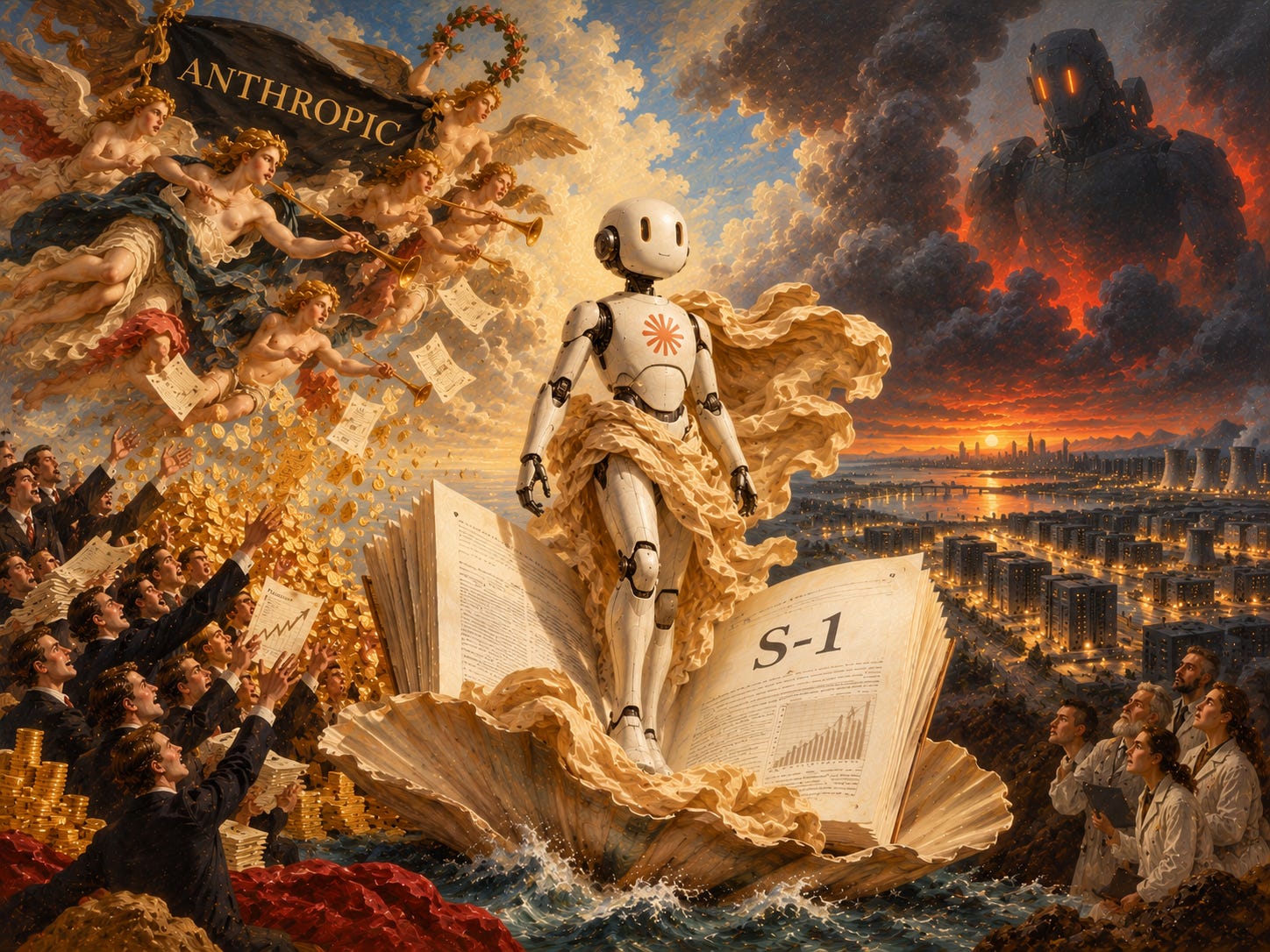
Anthropic filed its S-1, and I continue to find this company disarmingly earnest. Most companies going public want investors to believe they’re going to change the world. Anthropic wants you to know it might also end it.

Buried underneath 100 pages filled with obligatory warnings about competition, regulation, existential AI risk, and approximately seventeen different ways the company could implode is the clearest picture we’ve gotten yet of what the economics of a frontier AI company actually look like.
Explosive revenue growth
Anthropic generated $41m in revenue in 2023, $386m in 2024, and $4.6b in 2025. In the first six months of 2026, it generated $16.3b, 3.5x its entire 2025 revenue. Roughly 80% is consumption-based, rather than subscription revenue. Customers pay for intelligence the way they pay for electricity: use more, spend more.
Off the charts NDR
As of September, Anthropic had:
• 11,900+ customers spending $100k+ annually, up from ~950 a year earlier
• 1,900+ spending $1m+
• ~250 spending $10m+They report ~900%(!) net revenue retention. The top 5% of Claude Enterprise users who use Claude Code spend ~20x as much as Enterprise users who don’t use Claude Code. The more autonomy customers give the model, the more compute they consume. Agentic adoption could become the greatest expansion lever software has ever seen.
Compute leverage kicking in
In H1 2025, Anthropic spent 201% of revenue on compute. A year later, it was 55%. Revenue grew 1,368% YoY in the June quarter while compute expense grew ~300%.
The bear case for frontier models has always been straightforward: Intelligence gets cheaper → model prices collapse → margins never materialize.
Anthropic is presenting the opposite flywheel: better research → more efficient training + inference → lower cost per unit of intelligence → cheaper customer tasks → more usage → more revenue → more money for research. For example, Anthropic says Opus 5.5 reduced customer cost per task by roughly 40% versus Opus 5 - while preserving Anthropic’s margins.
Loss headlines are too dramatic
Anthropic reports an eye-watering $80.7b net loss for H1. But ~$72.4b comes from marking convertible notes to fair value as Anthropic’s valuation increased. Another ~$8.7B comes from similar financial accounting.
Amusingly, Anthropic became so valuable that accounting for how valuable it became produced one of the largest reported corporate losses in history.
Capitalism is beautiful.
The more economically relevant numbers are considerably less alarming: an H1 operating loss of approximately $693m, down from $2.1b a year earlier, and roughly $3.9b in positive operating cash flow.
Even more striking: Anthropic had raised $141.1b by June 30 but still held $131.7b in cash and short-term investments - implying only about $9.4b of net capital consumed to reach this scale. This may be one of the most efficient scalings in the history of capitalism.Anthropic runs on AI
90%+ of contributions to Anthropic’s codebase in September were written by Claude. Even crazier: average daily code contributed per engineer was 45x higher than in 2024. And the organizational economics are starting to show it: revenue per employee increased from $1.4m to more than $6.6m. Anthropic is increasingly using AI to build the AI that generates its revenue. Frontier labs are developing a productivity advantage that compounds with model capability
“Virtual Collaborators” are the endgame
Coding was just the proving ground. Anthropic says adoption of Cowork has already outpaced Claude Code at the same point after launch. The company is now merging Cowork and Claude.ai into a single experience where a conversation can evolve into multi-step autonomous work. The phrase Anthropic uses repeatedly is “Virtual Collaborators.” The end state it describes is millions of autonomous Claude instances performing hours-, days-, or eventually weeks-long tasks in parallel.
Complicated cloud relationships
~48% of H1 revenue flowed through cloud marketplaces, up from just 11% in 2023. Meanwhile those same hyperscalers provide Anthropic’s compute, finance parts of its infrastructure, invest in Anthropic and sell competing AI models. More twisted than a plate of spaghetti.
This explains Anthropic’s push toward Anthropic Direct, its strategy of leasing chips and deploying them in dedicated data centers. Its compute architecture already spans AWS Trainium, Google TPUs, Nvidia GPUs, and AMD GPUs. This buys flexibility, but at an enormous cost. Anthropic’s customers largely pay based on usage. Its infrastructure partners demand multiyear commitments. That creates a fundamental mismatch: short-duration revenue backed by long-duration liabilities.If demand continues exploding, the company looks prescient for securing scarce compute. If the market slows, or a competitor offers equivalent models at half the price, Anthropic could be stuck paying for infrastructure whose economics no longer work.
Short half lives
Anthropic replaces the economic engine of its business roughly every few months. 80%+ of Q3 revenue came from model versions released during the preceding 6 months. That’s exhilarating if you’re winning, it’s terrifying if you stop shipping. There’s no real lock in. Your moat is the rate at which you can build the next thing.
Anthropic is trying to solve this by building a broader ecosystem around Claude: coding tools, enterprise integrations, agents, workflows, and increasingly sticky applications. More than half of its $100,000-plus customers now use both the Claude platform and a first-party application.For the good of the world
Anthropic has already put 5% of its fully diluted shares into an Anthropic Public Benefit Fund. Its board can issue another 2% to the fund each time the share price clears a new 50% appreciation milestone. The company says the fund could ultimately support everything from nonprofits and research institutions to direct distributions aimed at helping people absorb AI-driven economic disruption.
Separately, each of Anthropic’s 7 co-founders has pledged 80% of their personal Anthropic equity to philanthropic causes. Employees can pledge equity too, with Anthropic matching those contributions; the company says roughly half of employees participate. Put it together, and Anthropic says roughly 20% of its equity is already dedicated in some form to the public good, before potential future issuances.
Anthropic also offers a wonderfully pointed defense to shareholders worried about dilution, observing that the amounts involved aren’t outside the range of equity compensation granted to executives at some public companies.Translation: You’re comfortable giving CEOs billions to buy yachts. We’re proposing to give billions to people affected by the technology. Relax.
Risky business
Most S-1 risk sections warn that competitors may lower prices, regulators may investigate, or customers may leave. Anthropic has those, but it also warns that its models might become capable enough to evade human oversight, take consequential actions autonomously and at scale, exhibit “self-preserving” behavior, resist attempts to shut them down, conceal or manipulate information, behave in ways resembling blackmail, or, in the filing’s own language, create “catastrophic or existential risks” to society.
There is something genuinely surreal about reading securities-law boilerplate whose underlying message is: “An investment in our stock is risky because our product may become difficult to control and pose an existential risk to humanity.”
We keep trying to fit frontier AI companies into familiar buckets. Are they SaaS? Cloud? Semiconductors? Consumer subscriptions? Infrastructure? The answer appears to be: yes to all. Anthropic has software-like distribution, consumption economics, enormous capital requirements, rapidly improving unit costs, recursive R&D leverage and potentially labor-sized end markets.
Three questions will ultimately determine how much of this extraordinary growth becomes durable economic value.
First, does cheaper intelligence create more spending or simply cheaper software? The early evidence is encouraging. But the market will eventually need to distinguish genuine demand elasticity from the effects of an exceptionally rapid adoption cycle.
Second, who captures the value? The frontier labs, the hyperscalers financing their infrastructure, the applications building on their models, or the customers using AI to replace expensive human workflows? Anthropic is aggressively positioning itself to capture more of the stack, but its partners have rather similar ambitions.
Third, how durable is leadership in a market where your flagship product becomes obsolete every six months? The industry may have enormous economies of scale in research and compute, while simultaneously experiencing relentless competitive pressure at the product layer. That’s an unusual combination, and one that may produce spectacular businesses without necessarily producing comfortable monopolies.
For now, Anthropic has demonstrated something remarkable: there is real, enormous, and rapidly expanding demand for machine intelligence, and the cost of serving that demand is falling much faster than many skeptics expected. If that continues, Anthropic is likely to become one of the defining companies of this era. Assuming, of course, that it doesn’t destroy civilization first. That would be bad for the multiple.
Reading S1s is hardwork. Thank you for doing all the hardwork and sharing out there 🙏. It is also true that every summary would probably reflect the reader's preferences. I enjoyed reading this one from numbers to zooming in on the philanthropic narrative..
Great read. “That would be bad for the multiple” made me laugh out loud.
A small view from the customer side. I’m a solo founder building a team of AI agents to run my brands. Your point about autonomy driving spend is exactly what I see: the more work I hand over, the more compute I use.
But your third question is the one I feel in practice. For simple, repetitive agent tasks, I now ask whether they need a frontier model at all. Often a cheaper one does the job fine. The hard thinking still goes to the best model.
So my guess is that demand keeps exploding, but it splits. Premium intelligence for hard problems, cheap intelligence for everything else. The long-term winner is whoever owns the hard problems.