
Beat, Build, Bleed
The market wants AI leadership from hyperscalers, just without the infrastructure bill.

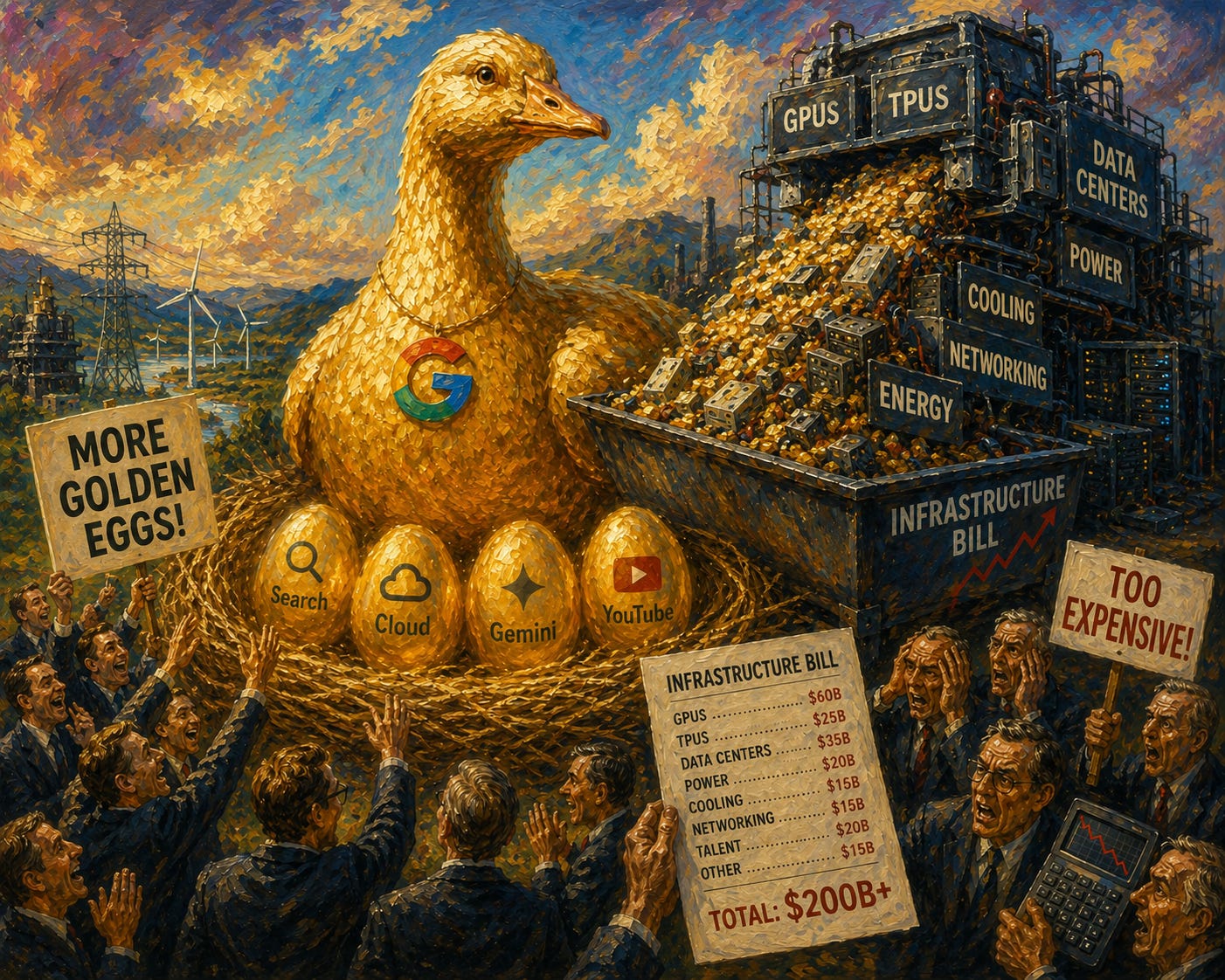
It is becoming possible to forecast Big Tech earnings with unerring accuracy.
This is now the standard AI earnings algorithm: Report enormous growth. Beat expectations. Disclose that demand exceeds available capacity. Raise capital expenditure to build more capacity. Watch the stock fall.
The market’s position is slightly difficult to reconcile. Artificial intelligence is apparently a transformative general-purpose technology. Inference will apparently become one of the largest and fastest-growing computing workloads in history. The hyperscalers are apparently supply-constrained because customer demand is overwhelming.
Should those hyperscalers invest to meet that demand, preserve their strategic relevance and own the infrastructure on which machine intelligence will run?
Absolutely not. That sounds expensive.
The market is simultaneously terrified that the hyperscalers will underinvest and offended whenever they do not.
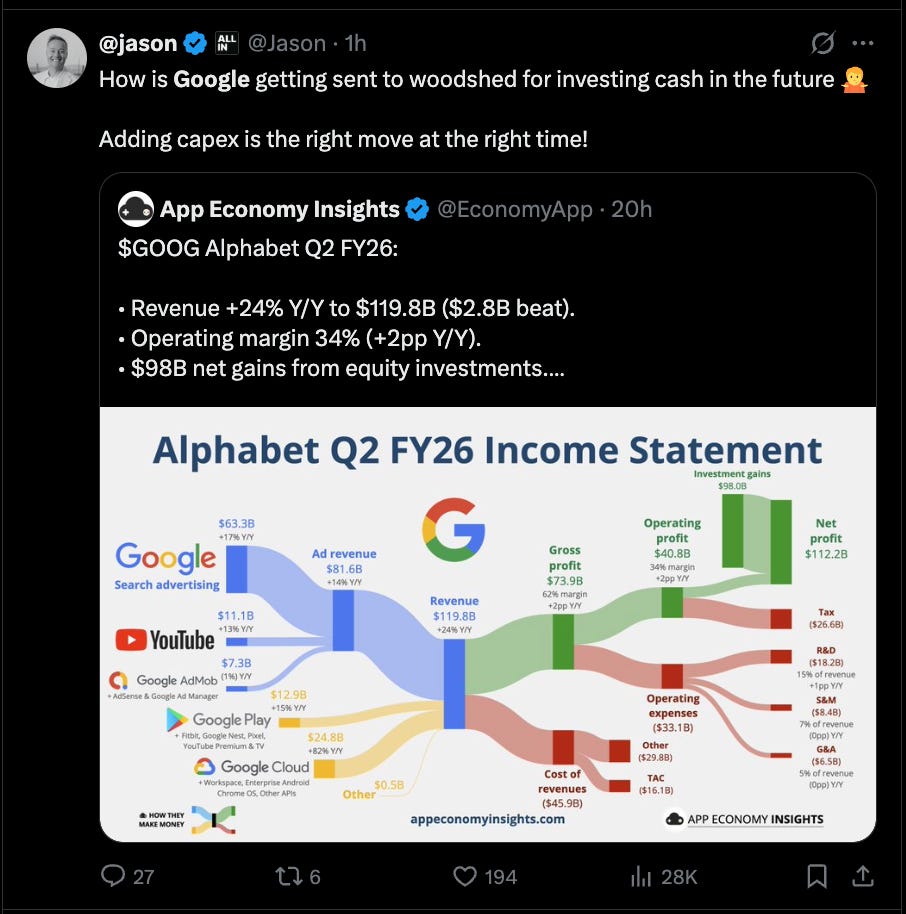
Alphabet reported results yesterday. Revenue rose 24%. Search accelerated. Cloud grew 82%. Cloud margins expanded dramatically. Backlog reached $514 billion.
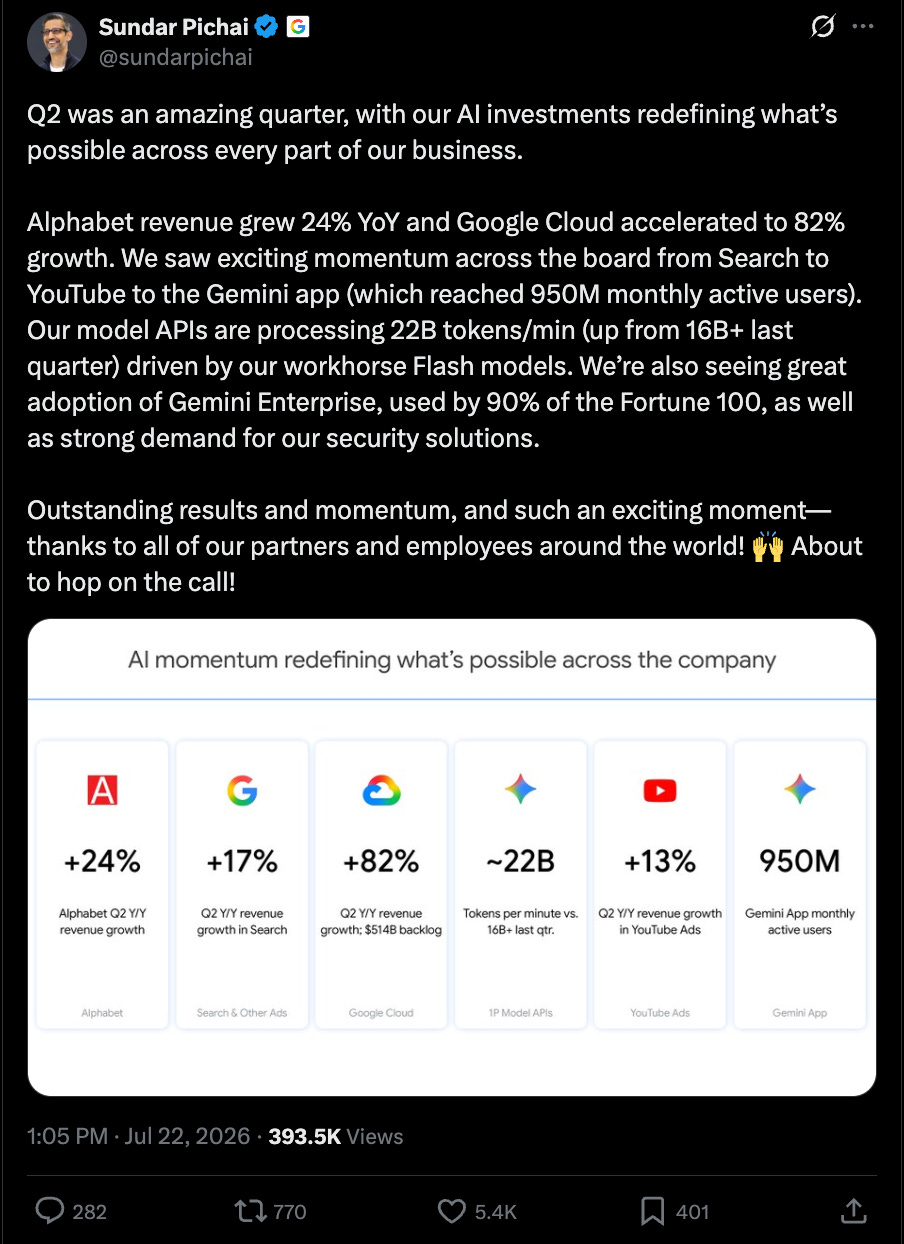
Alphabet raised capex guidance, and investors promptly removed roughly 6% from the stock in trading today.
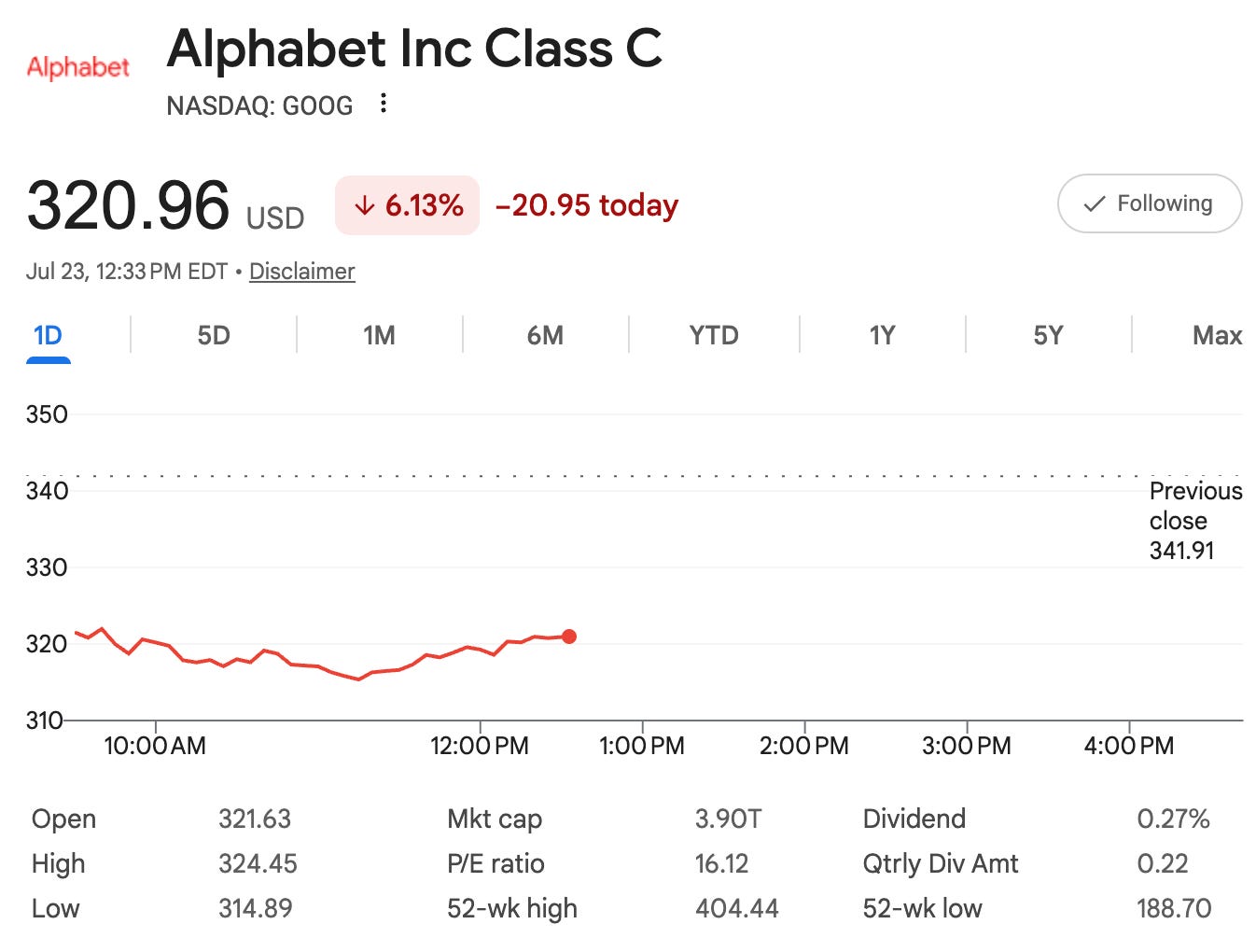
Rather than psychoanalyzing the tape, let’s get into the substance of Google’s quarter.
1. Search appears to have passed the AI cannibalization test
The great Google bear case was always straightforward. Conversational AI would replace lists of links with direct answers. Direct answers would produce fewer commercial clicks. Fewer commercial clicks would weaken the advertising auction. Meanwhile, every AI response would cost considerably more to serve than ten blue links. In other words: worse monetization, higher costs, and a shrinking moat.
So far, the opposite appears to be happening:
Users submit longer, more detailed queries.
Gemini gives Google more information about commercial intent.
More queries that were previously difficult to monetize can now support relevant ads.
That improves the product and the auction at the same time.
Advertisers using AI Max or Performance Max reportedly generate about 15% more conversions or value at similar returns. Meanwhile, Google continues to reduce the cost of AI Mode responses even as it adds more sophisticated capabilities.
AI may in fact expand Search’s addressable market. Google can answer questions that were previously too complex, ambiguous, or multi-step for traditional search, then monetize the resulting intent more precisely.
The early evidence is difficult to square with the cannibalization thesis. Not only is core search accelerating growth (+17% to $63B), but AI Mode (1B+ MAUs now) and AI Overviews are increasing total query volume.
2. Cloud is becoming Alphabet’s second economic center
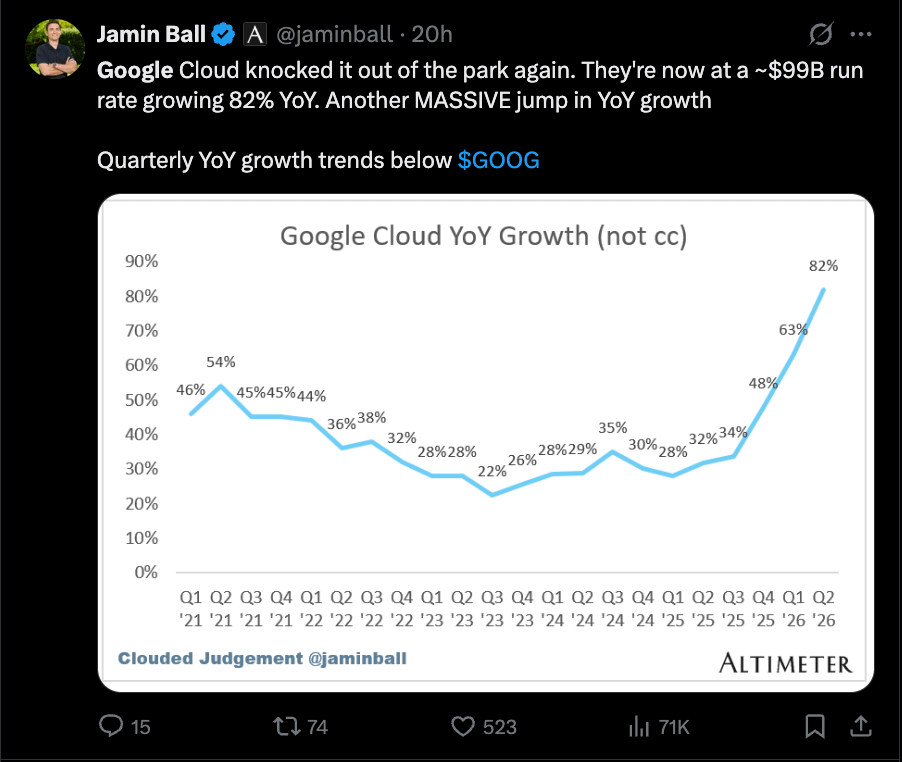
Google Cloud produced ~$25B of revenue, +82%, at a 35.6% operating margins. Operating income grew 3x to ~$9B. Backlog increased by more than $50B in a single quarter to $514B. Not only is growth accelerating but margin is also expanding.
Nearly 90% of the Fortune 100 reportedly use Gemini Enterprise. Roughly 90% use Google Cloud security products. New-customer acquisition velocity has more than doubled, while existing customers are exceeding their contractual commitments by more than 50%.
GCP is the commercial distribution layer for the entire Google AI stack: TPUs, GPUs, Gemini, agents, data, cybersecurity and developer tools. That full-stack structure gives Google several ways to capture value from the same workload. It can sell infrastructure, charge for model tokens, provide the data layer, secure the application, distribute agents, and potentially sell the hardware system itself. Few companies can capture value at that many layers.
3. TPUs are becoming a commercial platform
Google delivered its first TPU systems into customer data centers during the quarter, although most revenue from existing agreements will not be recognized until 2027.
This is a meaningful strategic expansion. Historically, TPUs were an internal weapon: a way for Google to train and serve models more efficiently than competitors reliant on third-party silicon. Now Google is beginning to commercialize that advantage directly. The TPU strategy now has 3 layers:
Internal frontier development: Google prioritizes TPUs for Gemini training and AGI research.
Hosted Cloud infrastructure: Customers consume TPU capacity through Google Cloud.
Customer-owned systems: Alphabet sells TPU systems for deployment in customer or third-party data centers.
That creates a useful hedge against nearly every plausible AI market structure.
Should model APIs become commoditized, Google can still monetize the underlying compute. Should cloud customers prefer multiple models, Google can sell them the infrastructure and orchestration layer. Should NVIDIA remain supply-constrained or expensive, Google has an alternative architecture it controls.
4. Google is sacrificing near-term margin to avoid long-term customer loss
Alphabet plans to rely on more third-party infrastructure while its own capacity comes online. That will pressure Cloud margins in the near term.
The decision is economically rational. Google may accept poor economics for six months to secure a highly profitable multiyear customer.
Enterprise infrastructure is unusually sticky because temporary decisions have a habit of becoming permanent architecture. Once a company builds its data pipelines, agents, security systems and applications on a cloud platform, moving is expensive, risky and politically painful.
If Google refuses a large customer today because capacity is tight, that customer may move to Azure or AWS and stay there for a decade.
So Google is renting expensive infrastructure to prevent a temporary supply shortage from becoming a permanent customer loss.
5. AI is beginning to offset the cost of AI
The call contained several underappreciated examples of internal AI adoption:
A Chrome team expects to compress a two-year refactoring project into three months.
83% of the sales organization uses Gemini-assisted tools weekly.
Customized AI-generated sales narratives are associated with win-rate improvements of up to 20%.
Agentic support systems autonomously handle 75% of advertising support queries.
AI tools have expanded Alphabet’s ability to reach hundreds of thousands of additional SMB customers.
These examples suggest AI could partially offset the expense of AI. Alphabet is spending more on infra and talent, but it may also increase engineering throughput, sales productivity and support capacity without equivalent headcount growth.
The ultimate margin impact will depend on whether these productivity gains scale faster than depreciation and infrastructure expenses.
The great capex debate
Alphabet raised 2026 capex guidance from $180-$190B to $195-$205B. It expects capex to increase significantly again in 2027.
Q2 capex was $45B, exceeding quarterly operating cash flow and producing negative free cash flow of ~$6B.
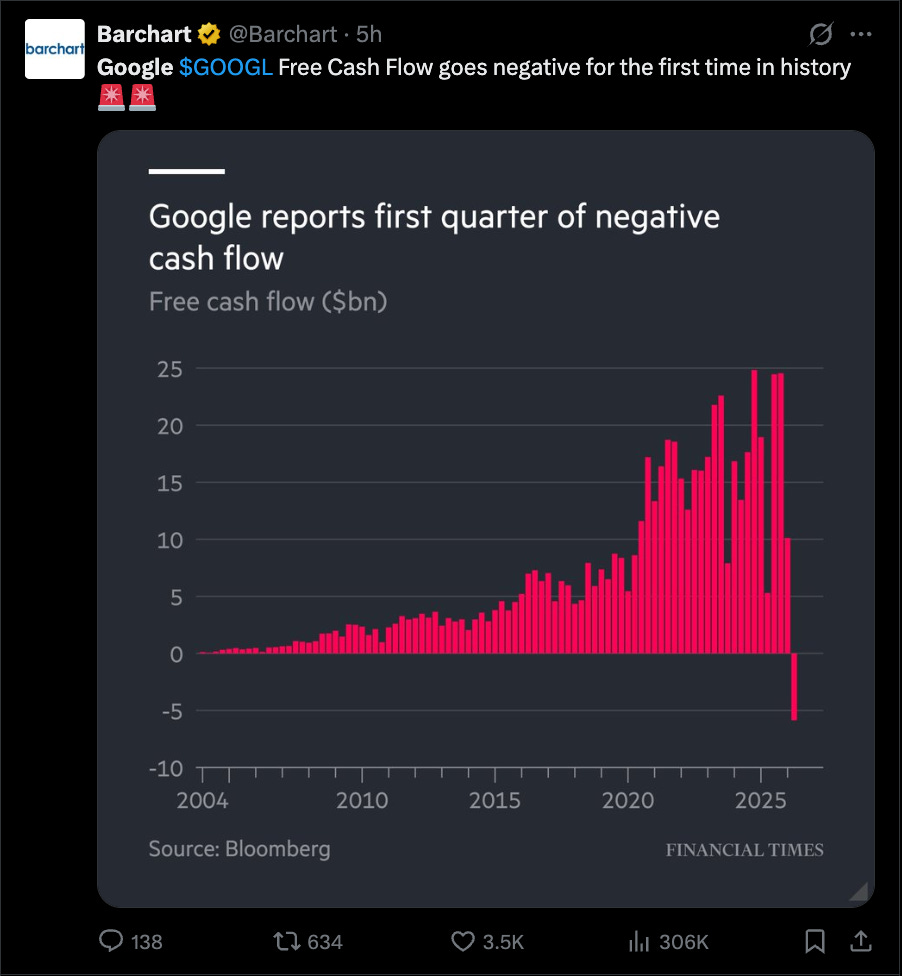
This is the most important shift in Alphabet’s financial model. The company is increasingly resembling a hybrid of:
a high-margin digital advertising platform,
an enterprise software company,
a hyperscale utility,
a semiconductor systems vendor,
and an AI research laboratory.
Each business reinforces the others. Together, they are vastly more capital-intensive than the Google of the previous decade.
Alphabet is entering a delayed-payoff cycle: spending today on infrastructure that will support revenue streams maturing over several years.
Management’s argument is that demand is already visible. Cloud backlog is enormous, capacity is constrained, customers are signing multiyear agreements, and existing users are consuming beyond their commitments. This is not speculative overbuilding. Google is not erecting empty data centers and praying that AI shows up. The customers are already waiting outside.
The investor concern is that infrastructure demand can be genuine while returns still deteriorate. Hardware can become obsolete quickly. Token prices can collapse. Energy costs can rise. Competitors can subsidize pricing. Large customers can demand concessions. Capacity that is scarce today can become abundant tomorrow.
The crucial question is therefore not whether Alphabet can fill today’s capacity. It is whether the economic life of the infrastructure will be long enough, and pricing durable enough, to generate attractive returns after depreciation.
Bottom line
This was an excellent quarter.
Search is stronger than expected. Cloud is becoming a second profit engine. Gemini adoption is scaling across consumers and enterprises. TPUs are becoming a commercial platform. AI is improving internal productivity. Alphabet’s full-stack position gives it multiple ways to win.
The concern is equally clear. Alphabet is committing to one of the largest capital programs in corporate history before the long-term economics of AI infrastructure are fully known.
But there is an odd symmetry to the market’s complaint. Investors spent two years worrying that Google was moving too slowly and would lose the AI transition. Now Google is spending aggressively enough to remain central to that transition, and investors are worried that it is moving too quickly.
Apparently the correct amount of AI investment is always slightly less than whatever the hyperscalers just announced.