
Beijing’s Robot Olympics: From Pratfalls to Protocols
What a weekend of tumbles taught us about benchmarks, autonomy, and adoption

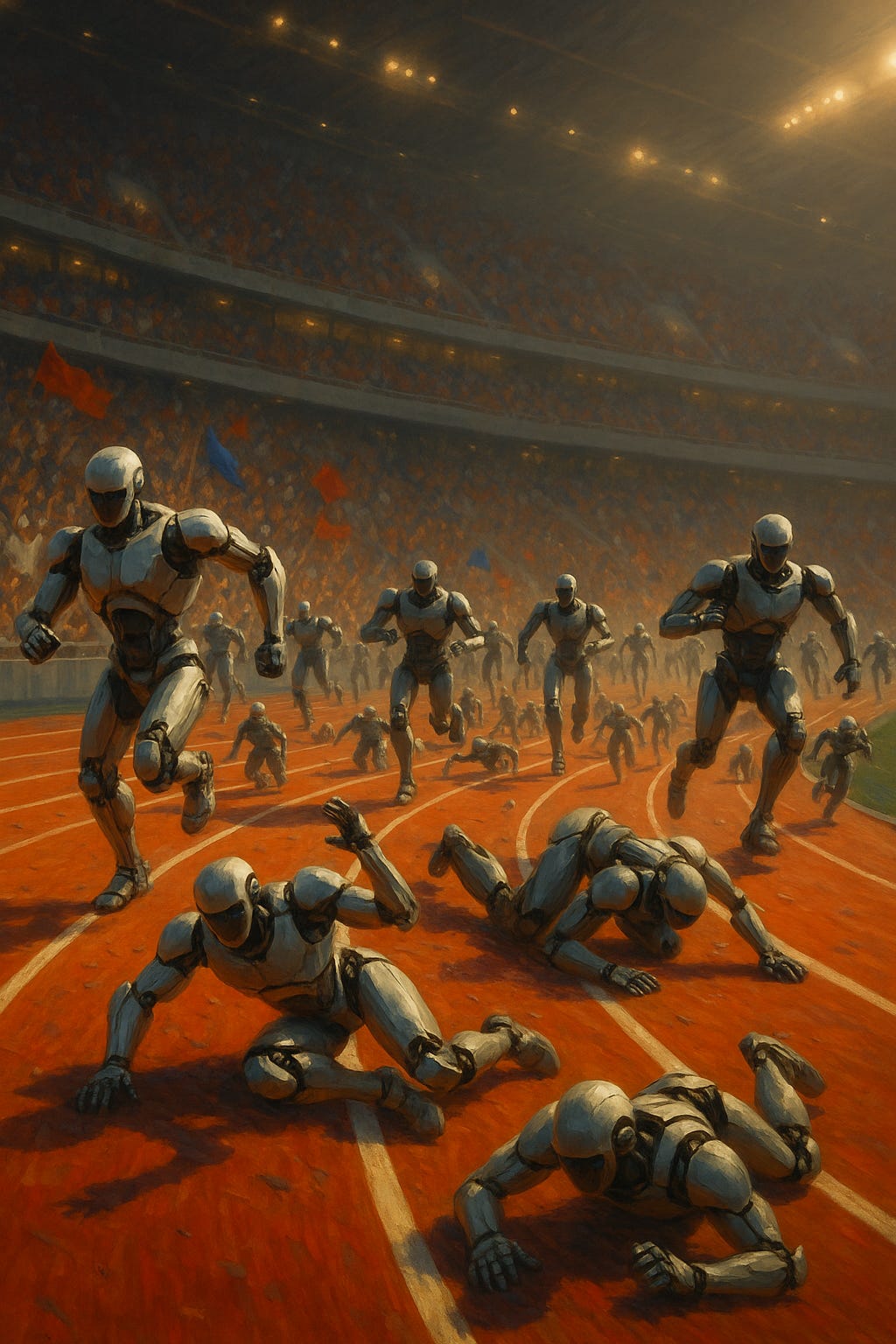
China just held a sports meet for robots. Yes, really. The inaugural World Humanoid Robot Games took over Beijing’s National Speed Skating Oval - the same “Ice Ribbon” from the 2022 Winter Olympics - and spent three days proving that gravity is still the heaviest hitter in athletics.
More than 500 humanoids from 280 teams across 16 countries sprinted, passed, boxed, played ping-pong, danced hip-hop, attempted martial arts, and tackled factory-style chores like materials handling, medicine sorting, and cleaning. A ticketed crowd filled a 12,000-seat arena (180–580 yuan a pop) to watch machines discover, repeatedly, how slippery a polished floor can be.
Why this is a big deal
While this reads like a tech fair stunt, it is policy theater with an R&D purpose. Beijing framed the games as part of a national push into embodied AI and humanoids - sectors it sees as leverage against demographic headwinds and a route to higher-productivity industry.
China’s population has fallen three years in a row and is rapidly aging - meaning fewer workers supporting more retirees. They need output-per-worker to rise fast, which is exactly what industrial and service robots do.
This push isn’t hand-wavy, either. Robotics sits in national plans: the 14th Five-Year “Robotics Industry Development Plan” (2021–2025) and a 2023 MIIT blueprint for humanoid robots have explicit 2025/2027 targets (innovation system by 2025; scale and key breakthroughs by 2027). This isn’t vibes, there are dated deliverables.
China is already the world’s largest robot market by far - installing ~51% of new industrial robots in 2023 0 with an operational stock around 1.7 - 1.8 million units. That base gives domestic suppliers scale, cost advantages, and learning curves Western rivals must overcome.
The state of the tech - hype vs. reality
Two things were true on the track:
A lot of robots fell down. Often. Sometimes with exquisite comic timing.
The baseline is clearly up: smoother gaits, faster stand-ups, better ball control, and fewer panic flails than even a year ago.
Still, a noteworthy caveat: much of the field remains tele-operated or semi-autonomous, with full, on-the-fly autonomy still rare in crowded, dynamic settings like soccer.
Many robots still struggled to stand, balance, and finish tasks - so the tech gap is real. But in China, policy, procurement, and pageantry are aligned to erase that gap faster than a normal startup market would.
Here are my takeaways beyond the viral pratfalls:
(1) It’s not a “tech show” - it’s a procurement funnel. The Games sit alongside Beijing’s World Robot Conference and even a new “robot mall,” forming an annual cadence that showcases winners, writes specs, and then channels public purchasing to them. Reuters has already documented heavy use of government tenders and a planned ¥1T (~$137B) fund; that makes competitions a top-of-funnel for state buyers, not just PR. Assume Chinese robotics will graduate from medals to municipal and SOE contracts quickly even if the tech still looks shaky because the buyer (the state) is aligned with the organizer.
(2) Social license by design. China is normalizing robots via mass events: a 12,000-seat venue, ticketed audiences, and prime-time spectacles around WRC and other festivals.Watching a robot eat floor and then recover is disarming. Humor and visible failure actually reduce fear and build acceptance. Laughter turns into permission.When a similar machine appears in a hospital or train station later, it’s not an intruder; it’s the klutz from the highlight reel. That’s how you de-weird new tech.
(3) China is using Games to define the benchmarks (and eventually, the standards). The events are built around repeatable tasks (medicine sorting, cleaning, materials handling), which convert nicely into public test protocols. China is already standing up a national standard system for humanoids and legged robots; competitions are a fast way to legitimize those benchmarks and seed them into procurement. If Chinese test protocols become the de facto measure in Asia or Belt & Road markets, U.S. vendors may end up “failing” tests that weren’t written for them.
(4) The near-term winners aren’t just bipeds - they’re whoever ships useful autonomy under constraints. Many bipeds still fall, yet a wheeled system won the room-cleaning task and several teams relied on semi-autonomy or teleop—evidence that utility beats body plan in the next 12–24 months. The winning strategy is to not over-index your roadmap on bipedal form factors; invest in perception-planning stacks and end-effectors that port across wheels and legs.
(5) Component supply-chain is the quiet moat. Unitree’s H1 is listed around $90k and leverages domestically produced actuators, drivetrains, and sensors - a cost structure few Western startups can match today. As China already accounts for >50% of global industrial robot installations, scale effects in motors, reducers, and controllers will compound. Expect price pressure on Western humanoids long before feature parity. U.S. strategy should prioritize differentiated software, reliability, integration services, and safety certifications - places where BOM scale is less decisive.
Bottom line: Beijing’s “robot Olympics” mixed slapstick with serious signal. Yes, the pratfalls went viral but beneath them was a coordinated effort to turn embodied AI into an industrial growth engine. If the games keep iterating - and autonomy catches up - their medal table could become a surprisingly useful proxy for who’ll win the humanoid deployment race.