
Compute Meta-Morphosis
Meta selling compute is less an AI cloud strategy than a utilization strategy for a company whose infrastructure has outrun its products.


For the past two years, every large AI company has delivered roughly the same investor pitch: We need to spend an extraordinary amount of money on compute today because intelligence tomorrow will justify it.
It was a remarkably convenient proposition. Ignore this year's cash flow. Ignore next year's margins. Somewhere beyond the horizon sits AGI, and whoever owns the most GPUs when it arrives wins.
Meta embraced that logic as aggressively as almost anyone. It bought NVIDIA GPUs by the warehouse, signed nuclear and renewable power agreements, redesigned datacenters around AI workloads, and built what is rapidly becoming one of the largest compute fleets on Earth. This year's AI infrastructure budget alone is expected to approach $145 billion.
Now comes the awkward question. What exactly do you do with all of it?
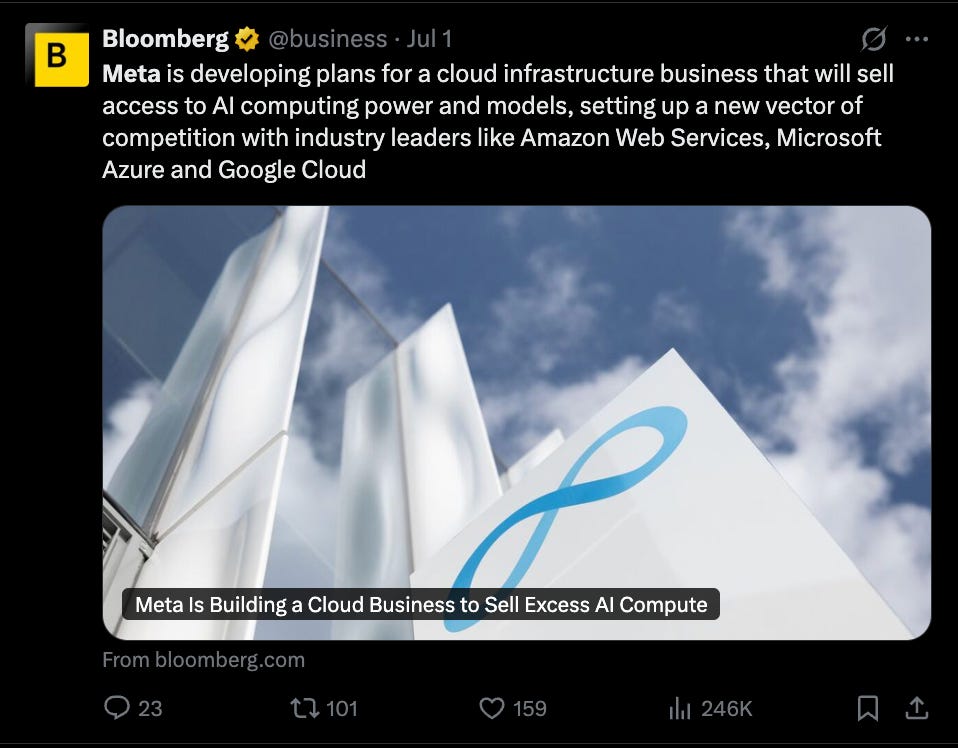
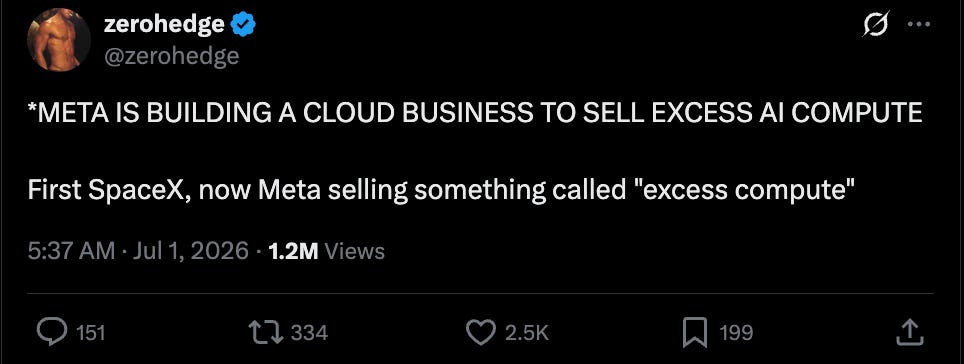
According to Bloomberg, Meta is exploring a cloud business, internally known as "Meta Compute," that would rent excess GPU capacity and hosted models to external customers. On the surface, it's an obvious way to generate revenue from an enormous capital investment.
The market seemed to read something more ominous into it. Meta rallied, while CoreWeave, Nebius and much of the semiconductor complex sold off. The implicit conclusion was that if Meta has GPUs sitting idle, perhaps the entire AI industry has overbuilt. Maybe we have reached the point where everyone built clusters for demand that never materialized. Maybe the great GPU shortage has finally become the great GPU glut.
I’m skeptical. That theory is hard to square with the rest of the market. Demand for frontier compute remains ferocious. Just look at xAI’s infrastructure deals: Anthropic reportedly paying $1.25 billion per month, Google around $920 million, and Reflection AI about $150 million monthly. Those are astonishing numbers. They imply that companies with successful AI products are willing to pay almost any price for immediately available compute.
Demand for compute hasn’t weakened. Demand has concentrated.
That's an important distinction because it shifts the question from "Who owns the most GPUs?" to "Who has built products capable of keeping them busy?"
There is a very large difference between an industry with too much compute and a company with more compute than its own products can currently absorb.
Meta has extraordinary infrastructure, world-class researchers, and distribution that every company in Silicon Valley envies. What it doesn't yet have is an AI product with the gravitational pull to match the scale of its infrastructure investment. Meta AI is embedded everywhere, yet it has not become the place people instinctively go when they need AI. Lately, the Meta AI narrative has been less about product velocity and more about morale issues, prediction market chatter, talent drama, and now, selling compute.
Meta has largely solved the supply side of the equation before demonstrating comparable demand. That makes selling compute look less like a grand strategic pivot and more like rational asset management.
Every capital-intensive business eventually learns the same lesson. Airlines optimize seat occupancy. Hotels optimize room occupancy. Cloud providers optimize server utilization. AI labs will need to manage GPU utilization with the same religion.
A GPU hour is perishable. If it sits idle today, you can’t put it back on the shelf and sell it tomorrow. Once you’ve spent tens of billions building the cluster, the economics overwhelmingly favor utilization over exclusivity.
If your own products don't need every GPU this quarter, someone else's almost certainly will. xAI's infrastructure deals illustrate the point. The company can lease capacity while external demand is stronger than internal demand, then reclaim it later if Grok's inference footprint grows. The cluster doesn't change. Only the customer does.
For the last two years, compute has been treated almost mythologically: a strategic asset to be accumulated, a moat measured in H100s, a balance sheet shrine to the coming intelligence explosion.
Now the question is becoming more prosaic, and more important: what return does that asset generate?
Selling compute gives investors a cleaner answer than “eventually our AI assistant will monetize.” Compute has customers today. That may be less glamorous than AGI, but it is much easier to underwrite.
Whether Meta ultimately launches a full-fledged cloud business remains to be seen. The company has not formally announced the product, pricing, or launch timeline.
But the conceptual shift matters. The AI race is no longer just about building the biggest cluster. It’s about making sure the cluster behaves like a productive asset instead of an expensive science project.
This is the sharpest framing I've read on the whole episode, moving it from "who owns the most GPUs?" to "whose products can keep them busy?" is the right question, and "demand hasn't weakened, it's concentrated" is the line the glut crowd keeps missing.
Let me add one piece of evidence that reinforces your anti-glut case, from the supply side rather than the demand side: three days before this news, the FT reported Google had to cap Meta's Gemini access because Meta's demand outran what Google could supply. So it isn't only that xAI's counterparties are paying up, even a hyperscaler couldn't feed Meta. That's the opposite of idle capacity.
Where I'd gently push is on "infrastructure has outrun its products." I think that's fair for consumer Meta AI....it hasn't become the reflex people reach for. But it undersells the product already absorbing the fleet: the ads and recommendation engine, which took revenue up ~33% last quarter and is a bottomless pit for compute. So I read the resale less as a confession that Meta over-supplied its own demand, and more as a high-margin release valve on the excess above an internal engine that's already earning its keep.
And on why utilization matters as much as you say...Wells Fargo models reselling 1 GW at ~$20B revenue and an 85% margin, because the infra is already sunk. That's ~$5.69 of EPS accretion on a single GW of a projected 13.2 GW footprint. Perishable asset, near-pure-profit when you fill it...your airline/hotel lens is the right one.
Really enjoyed this. Went deep on the same news today and landed in a similar place, if a bit more constructive on Meta.