
Meta: Compute Without a Compass
A trillion-dollar compute bet in search of a unifying strategy

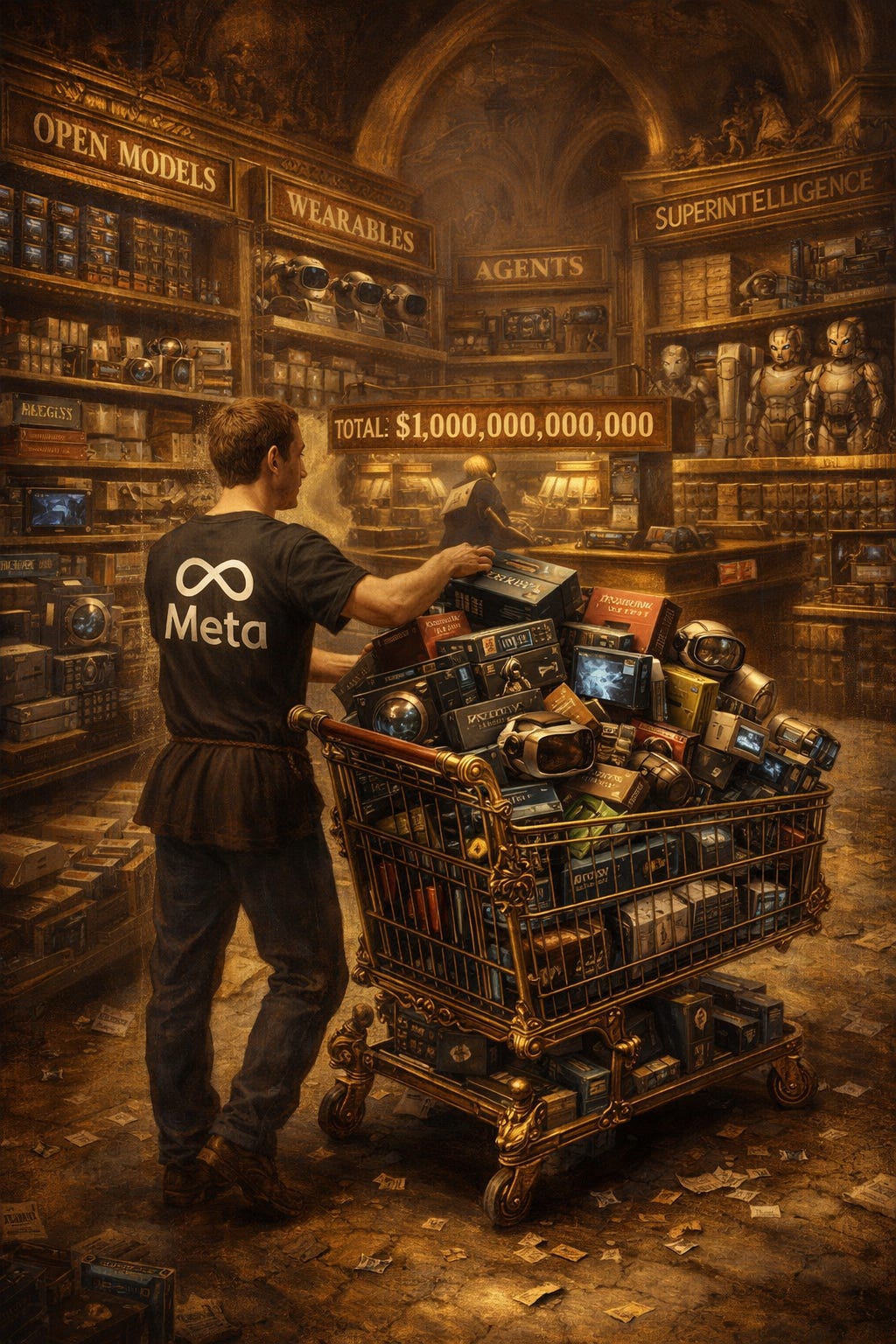
Meta’s AI strategy feels less like a strategy and more like a shopping spree.
They’re consistently first to write the check and last to explain the plan. The last real articulation of intent was Zuckerberg’s “personal superintelligence” note from June 2025 - roughly ten AI years ago. Even that read less like a roadmap and more like a disclaimer, positioning Meta as “distinct from others in the industry who believe superintelligence should be directed centrally towards automating all valuable work.” Defining what you’re not can be useful but it is not, by itself, a strategy.
The most obvious feature of Meta’s AI push is the scale of the spending. The company signed an infrastructure deal with Nebius that could reach $27 billion over five years. This is a very large amount of money to spend on compute for a company that is not, in fact, in the business of selling compute to other people. Amazon, Microsoft, and Google can justify giant infrastructure budgets by saying, “Some of this is for us, and some of it is because the rest of the world would also like to rent our servers.” Meta’s pitch is more like, “All of this is for us.” But then you run into the basic follow-up question, which is: for what?
This is where Meta gets slippery. Every major AI player has a legible narrative:
OpenAI: win the consumer, expand to enterprise, build agents
Anthropic: sell trust, safety, and enterprise-grade intelligence
Google: fuse frontier models with unmatched distribution
Microsoft: tax the enterprise via distribution and Copilot
To be fair, maybe compute is the strategy. Meta may be betting that compute becomes the critical chokepoint in AI - and that owning it at scale buys them time to figure everything else out. But time is not the same as direction. And what Meta has shown so far looks less like a singular thesis and more like a rotating set of narratives:
Open ecosystem champion (Llama)
Ubiquitous consumer assistant
Frontier superintelligence lab
Infrastructure-scale model builder
All of these individually make sense. But together they look less like a strategy and more like a portfolio of bets.
The open-weight story, once Meta’s sharpest edge, has dulled. Llama initially gave Meta a solid position in the market: if OpenAI and Anthropic were building expensive API kingdoms, Meta would flood the zone with open weights and become the Switzerland of the model layer. That was legible.
But over time, the strategy blurred. Behemoth was delayed after questions about whether it was good enough to justify release. Avocado, Meta’s newer model, has also reportedly been delayed after underperforming internal expectations, and Reuters says leaders even discussed licensing Google’s Gemini temporarily.
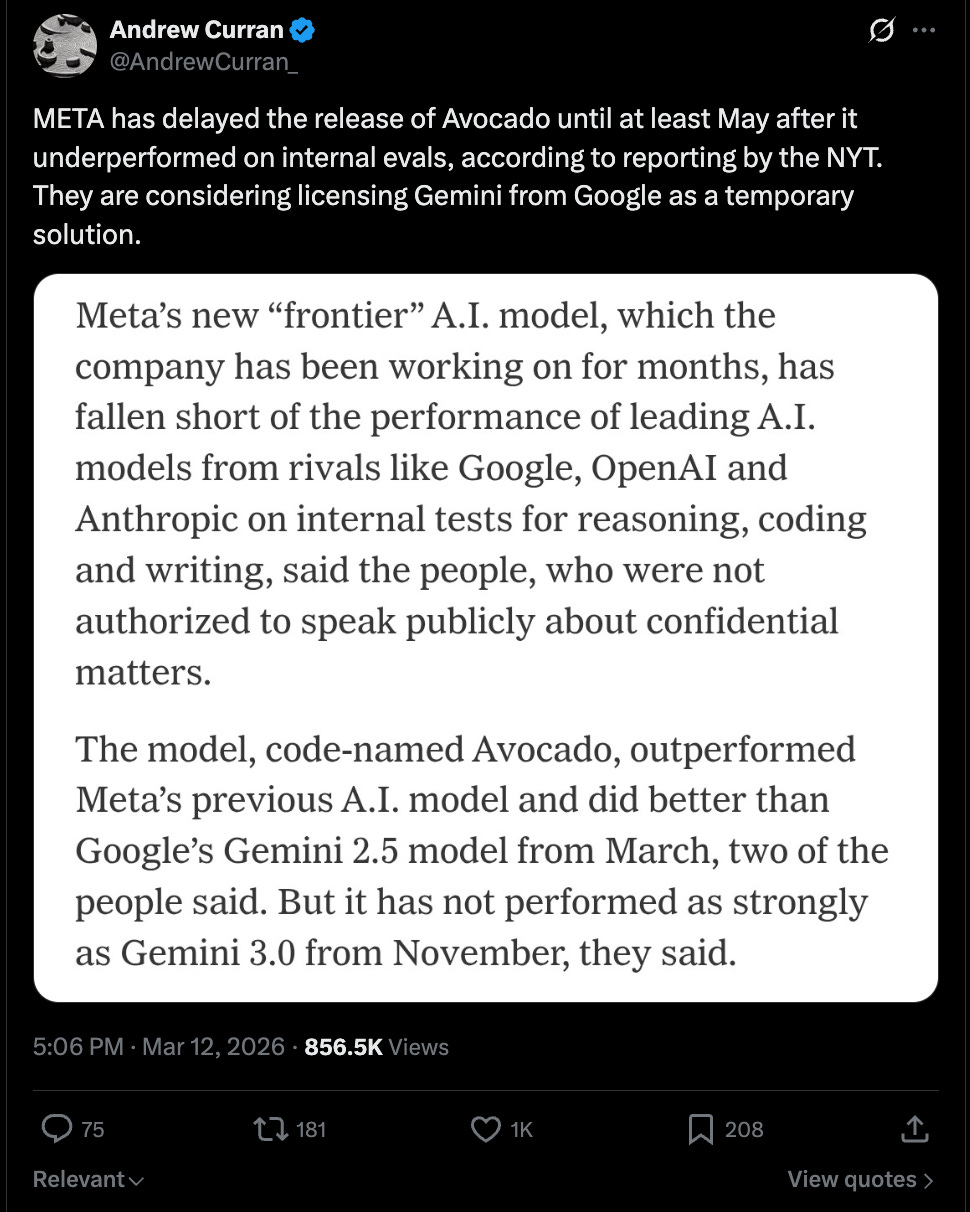
That is not what market leadership looks like. That is what happens when the company that popularized open-weight swagger starts peeking over the neighbor’s fence.
Then there is the org chart, always a wonderful place to look when a company insists everything is going according to plan. Meta took a 49% stake in Scale AI for $14.3 billion to bring Alexandr Wang into its orbit and help lead its superintelligence effort. It later reorganized the AI division again, split Superintelligence Labs into multiple groups, and cut around 600 roles across FAIR, product AI, and infrastructure while shielding the new TBD Lab. More recently, Reuters reported even larger layoffs are under discussion. More recently, reports of ~20% layoffs have surfaced - cost-cutting reframed as strategy.

When a company keeps redrawing the map, it usually means the destination is still being debated internally.
The acquisition trail adds to the sense that Meta is collecting pieces faster than it is integrating them.
Manus, the China-linked AI startup it agreed to buy, gives it agentic technology and geopolitical headaches in one package.
Moltbook, the AI-agent social network built around OpenClaw, gives it a foothold in the strange new world of bots talking to bots on purpose.
These are not random deals. But together they still read more like option value accumulation than a tightly sequenced master plan.
To be fair, there is one area where Meta does have a real AI strategy already working in production: advertising. Reuters reported in 2025 that Meta aimed to fully automate ad creation and targeting with AI by the end of 2026. Meta has also said AI is improving creative generation, campaign setup, and performance across its ad stack. This is the most credible monetization story in the company’s AI portfolio because it sits directly on top of Meta’s actual cash machine. If you want the steelman case for Meta, it is not “they will win the chatbot race.” It is “they will turn AI into the biggest margin-expanding ad optimization engine on earth.”
And there is a second plausible lane: wearables. The Meta AI app and the Ray-Ban smart glasses give the company at least a shot at owning consumer AI distribution outside the phone screen. EssilorLuxottica said Meta AI glasses were driving booming demand in late 2025. If there is a world where AI becomes ambient rather than app-centric, Meta has a reason to believe it can matter there.
But even the bull case proves the core critique. Ads and wearables are real businesses. Open-weight models are a developer posture. Superintelligence is a research ambition. Agent social networks are a speculative side quest. These are different games with different time horizons, different moats, and different definitions of winning. Meta is playing all of them at once.
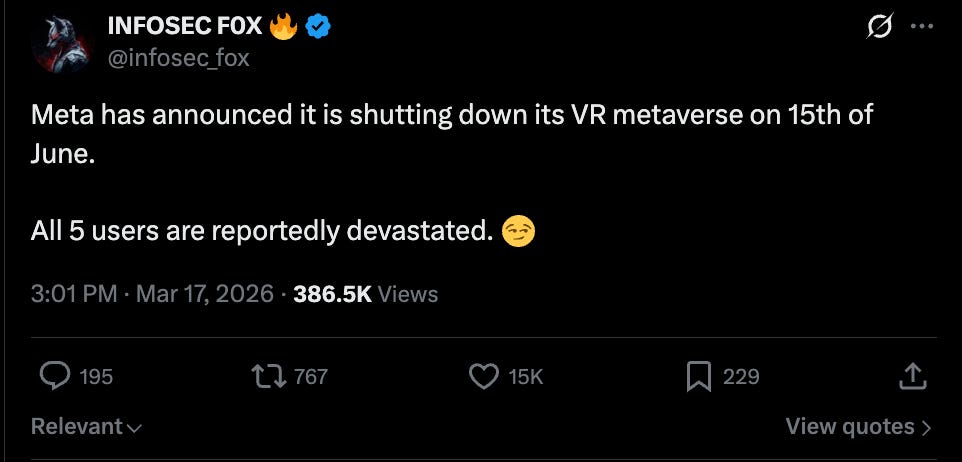
Meta has always been more comfortable than its peers with brute-forcing optionality at enormous scale. Sometimes this works because Zuckerberg is unusually willing to spend through uncertainty until something clicks. Sometimes it produces the metaverse
Right now Meta has compute, capital, and distribution. It has one of the world’s best ad machines and a founder who does not scare easily. What it still lacks, from the outside anyway, is strategic legibility.
Meta does not look, from the outside, like a company executing a clear AI strategy. It looks like a company buying enough pieces of the AI future to ensure that, if one of the strategies works, it will be able to claim that was the plan all along.