
Mind the J-Space
Anthropic found Claude’s “inner monologue.” Now everyone is arguing about whether it counts as a mind.

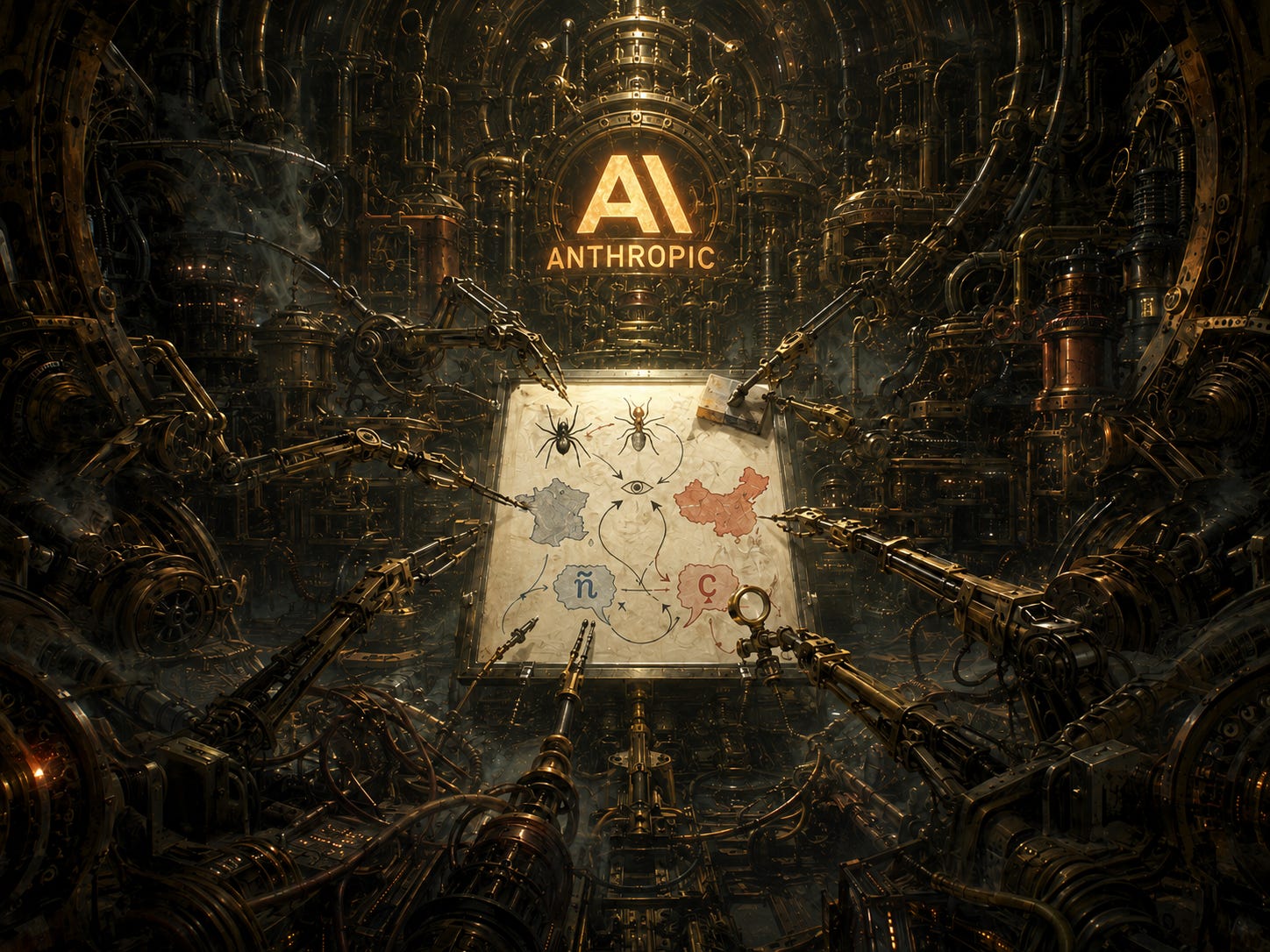
Anthropic’s new paper, “Verbalizable Representations Form a Global Workspace in Language Models,” is classic Anthropic: wearing a lab coat but clearly coming from a philosophy seminar.
The core claim is not, despite the inevitable headlines, “Claude is conscious.” Anthropic is careful - mostly - to say something narrower: modern language models appear to contain a small, privileged set of internal representations that are reportable, steerable, useful for reasoning, broadly readable by the rest of the model, and selectively involved in higher-order cognition. They call this space J-space, because they discovered it with a new interpretability method called the Jacobian lens, or J-lens.
The analogy is to Global Workspace Theory, a theory about the human brain that says most cognition runs quietly in the background until some piece of information becomes important enough to enter a shared mental workspace. You do not consciously manage your kidneys. But remember you left the oven on and suddenly memory, planning, language and anxiety all have the memo.
Anthropic’s claim is that Claude seems to have something functionally similar. Most of the model is doing enormous quantities of automatic computation but some concepts get promoted into a small, privileged internal space where they can be reported, manipulated and reused for different downstream tasks.
Anthropic explicitly says it is not claiming Claude has subjective experience; it is investigating the functional analogue of “access consciousness,” not the metaphysical glow of “what it is like” to be Claude.
The J-lens tries to identify internal activations that are not merely predicting the next token, but are poised to become verbalizable - things the model could say if asked. In plain English: it looks for the words sitting on the model’s mental workbench before they show up in output. Anthropic says these J-space tokens can reveal Claude recognizing bugs, identifying images, tracking intermediate reasoning steps, noticing prompt injections, or registering that it is in an evaluation, even when none of that appears in the visible answer.
LLM interpretability has often felt like spelunking through fog: sparse autoencoders, circuits, probes, logit lenses, feature dictionaries, all useful but partial. The J-lens offers a seductive interface: instead of staring at millions of activation dimensions, you get something closer to a ticker tape of latent concepts. That is a big deal because it links internal state to reportability and causal control, not just correlation.
Anthropic’s experiments are designed to show that J-space is not just a dashboard.
In one example, Claude was given the prompt: “The number of legs on the animal that spins webs is...” Claude needed to infer spider, then retrieve eight. The word spider appears nowhere in the question or answer. Yet midway through the model’s processing, “spider” lights up in J-space. Anthropic swaps the internal representation of spider for ant. Claude answers six.
This shows that this wasn’t just an activation map, the representation was a load-bearing intermediate variable in the computation. Change the variable, change the reasoning.
In another experiment, Anthropic swaps France for China. The same intervention causes Claude to answer Beijing when asked for the capital, Chinese for the language, Asia for the continent and Yuan for the currency. Multiple downstream computations appear to read from the same shared representation. Write once. Read everywhere.
The paper’s most interesting experiment involves Spanish. Claude is given Spanish text. Anthropic replaces the Spanish representation in J-space with French. Ask Claude what language the passage is written in and it says French. Ask for a famous author in the language and García Márquez becomes Victor Hugo. But then ask Claude to continue the passage. It continues writing perfectly fluent Spanish.
The machinery that knows how to speak Spanish never needed the workspace. Billions of tokens have turned language continuation into routine infrastructure. But when Claude needs to abstract the concept “Spanish” and use it for a novel downstream task, the information gets pulled into J-space.
Anthropic then takes the more aggressive approach of suppressing the workspace itself. Claude remains fluent. It can classify sentiment, extract answers from passages and handle several routine tasks. Multi-step reasoning, however, collapses toward zero
This starts to make the architecture of intelligence look annoyingly familiar. A lot of competence is cached. Pattern matched. Automatic. But novel problems require deeper thinking.
The paper’s bigger claim is that these verbalizable representations satisfy five workspace-like properties: verbal report, directed modulation, internal reasoning, flexible generalization, and selectivity.
Anthropic is not saying the whole model is one big conscious soup. They are saying a small subset of representations behaves like a cognitive bottleneck layered atop a much larger amount of automatic computation. In their framing, Claude has something like a “surface of thought” floating over a deep sea of machinery.
The thing to be careful about, as ever with Anthropic, is anthropomorphic inflation. Anthropic’s science is careful enough; its language occasionally gets a little too cinematic. “Claude’s mind,” “what Claude is thinking,” “silent reasoning steps in its head” - these are vivid metaphors, and maybe defensible in a blog post, but they invite precisely the overreading the paper tries to avoid. The model does not need to be a subject of experience for this work to be profound. In fact, the practical result is more interesting if we resist the temptation to make it mystical.
Why this matters
The immediate implication is for AI safety and model auditing. Chain-of-thought monitoring is increasingly shaky as a safety primitive: models can reason without faithfully verbalizing their reasoning, and future models may learn to hide or optimize their visible scratchpads. If J-space provides even a noisy window into “what the model is thinking but not saying,” it becomes a candidate instrument for detecting deception, evaluation awareness, hidden goals, reward-model gaming, or internal conflict. Anthropic says J-lens surfaced signs of fabricated data, hidden goals inserted during training, and suspicious concepts like “fake,” “secretly,” or “trick” in misaligned model organisms.
The second implication is for training. Anthropic introduces “counterfactual reflection training”: train the model to articulate ethical principles if interrupted and asked to reflect, and those principles later show up in the workspace during uninterrupted behavior. In other words, you may be able to shape what the model silently reasons with by shaping what it would be disposed to say under a counterfactual prompt. That is a fascinating, slightly spooky idea: not just RLHF on outputs, but something closer to workspace gardening.
The third implication is for the consciousness debate, whether Anthropic wants that fight or not. The paper repeatedly invokes access consciousness and global workspace theory, while disclaiming claims about phenomenal consciousness. That is the right distinction, but it will not save them from the discourse. Once you say a frontier model has a global-workspace-like mechanism, can hold concepts “in mind,” and has hidden thoughts it does not say, the public conversation will sprint straight to “Claude has a mind?” Nuance, as usual, will be the first casualty.
The field’s reaction: impressed, excited, and side-eyeing the metaphors
The most interesting reactions are not from the press but from the expert commentaries Anthropic published alongside the paper.
Stanislas Dehaene and Lionel Naccache, central figures in global neuronal workspace theory, seem genuinely intrigued. They call several findings close analogues of human conscious access, especially the separation between routine automatic processing and high-level reportable reasoning. But they also flag a major missing piece: ignition. In human global-workspace theory, conscious access is often associated with nonlinear, competitive, all-or-none entry into the workspace. The Anthropic paper shows capacity limits and suggestive selectivity, but not yet the full “ignition” signature familiar from neuroscience.
Eleos AI researchers Patrick Butlin, Derek Shiller, Dillon Plunkett, and Robert Long call the results “the most significant evidence of consciousness in LLMs so far uncovered by mechanistic interpretability research,” but immediately add the important caveat: evidence of access-like processing is not the same as evidence of phenomenal consciousness. Their stance is basically: this is a serious update, not a coronation.
Neel Nanda, who leads interpretability work at Google DeepMind, is perhaps the most practically useful read. He says the scientific claim - that there is a cognitive space inside the model used for intermediate variables - is the most interesting one, and he is persuaded by it. He also independently replicated core claims on Qwen 3.6 27B. But he is cautious about the stronger interpretations: J-lens looks useful for hypothesis generation and model forensics, less definitive for hypothesis validation. That is exactly the right posture: treat it like a powerful new instrument, not a lie detector strapped to a transformer.
So the reaction map looks roughly like this:
Interpretability researchers: “This is probably important. Let’s replicate it, stress-test it, and wire it into audits.”
Consciousness researchers: “This is philosophically relevant, but please stop treating access and experience as synonyms.”
Press: “Claude has an inner workspace! Maybe consciousness! Also maybe not!”
Skeptics: “Cool tool, dangerous metaphors.”
I think the paper is strongest when read as mechanistic interpretability, not machine phenomenology.
The phrase “global workspace” is both illuminating and hazardous. Illuminating because it gives a crisp functional hypothesis: some representations are special because they are reportable, controllable, flexible, broadcast-like, and capacity-limited. Hazardous because “workspace” smuggles in a theater-of-the-mind picture, and “conscious access” is one rhetorical inch away from “consciousness,” at which point everyone loses their minds, including the humans.
But the substance is hard to dismiss and may move model monitoring from observing outputs to observing latent deliberation.
Today’s safety stack mostly asks: What did the model say? Did the tool call look bad? Did the chain of thought contain suspicious words?
This line of work points toward a richer stack: What concepts were active before the model acted? Was it aware of being evaluated? Did it represent the user as vulnerable? Did it internally label the instruction as fake, risky, deceptive, or exploitable? That opens a new category of cognitive observability for AI systems.
Anthropic has found something like the whiteboard inside the transformer, a privileged scratch space where certain concepts become available for flexible reasoning and report. For AI safety, that is a potential breakthrough. For consciousness debates, it is gasoline.