
Model Mania
The frontier still matters. But the race to good enough may decide the market.


It has been a manic 48 hours in AI: We got a frighteningly economical Grok, a frontier-grade image model from ByteDance, a new voice architecture from OpenAI, Meta shoulder-checking its way back into the agentic model race, and the GPT-5.6 family finally rolling out.
Not one clean “GPT moment,” but something more important: the model market is fragmenting into a knife fight over price-performance, latency, modality, and workflow fit.
The leaderboard era is not over. But the “good enough, much cheaper, right where the user works” era is very much here.
1. OpenAI drops GPT-5.6 Sol and Sol Ultra
Sol, Terra, and Luna are finally moving into broader availability today after preview access.

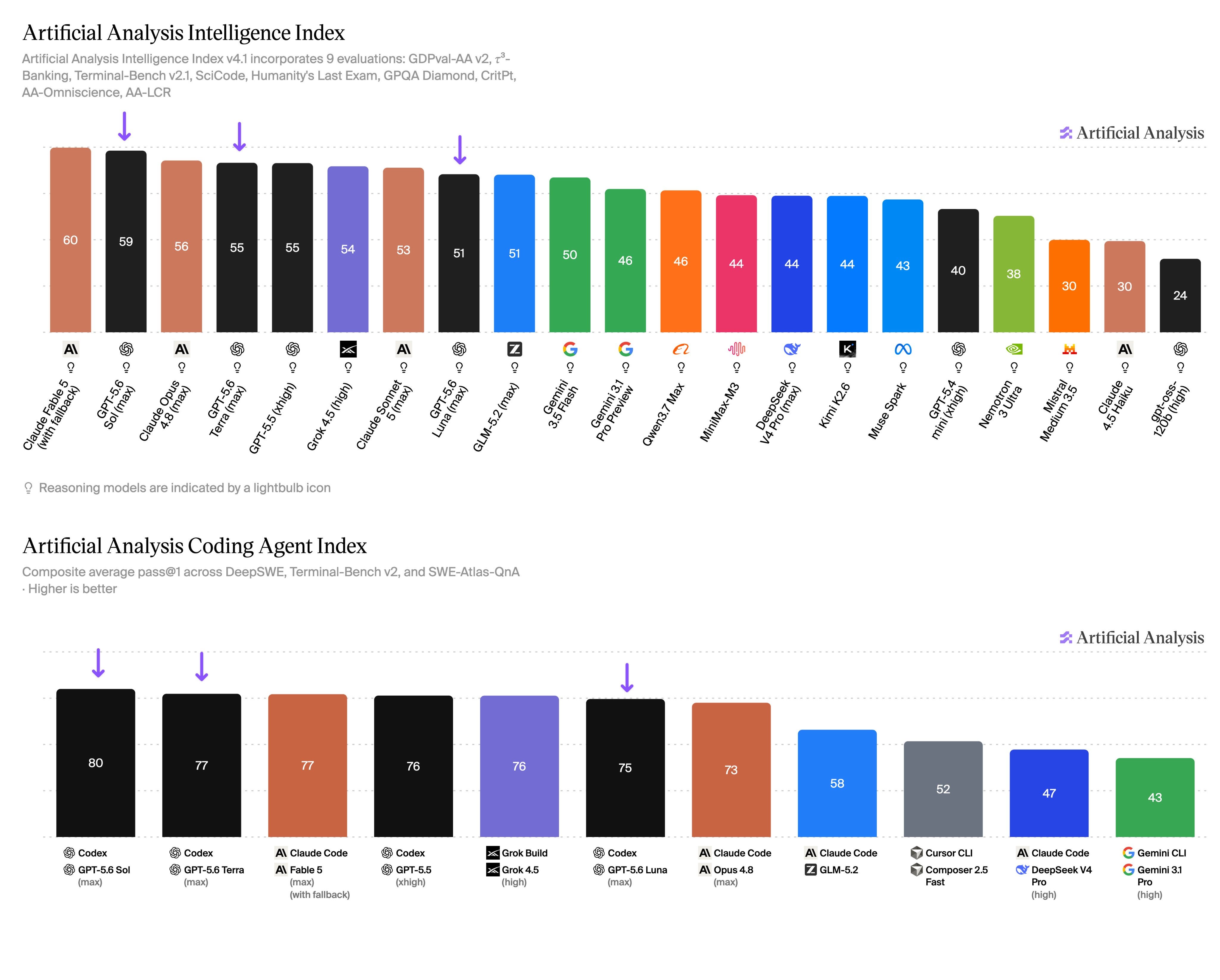
Early coverage suggests Sol is getting positive reviews, especially around coding and agentic workloads. It comes in just behind Claude Fable 5 on the Artificial Analysis Intelligence Index, at roughly one-third the cost, while leading the Artificial Analysis Coding Agent Index in OpenAI’s Codex harness.
The model brings stronger agentic performance, improved tool use, better coding, multimodal reasoning, computer use, a 1M-token context window, and parallel sub-agent execution.
2. Grok 4.5 enters through the Cursor / SpaceXAI side door
Grok 4.5 may be the most strategically annoying launch of the week for the frontier labs.
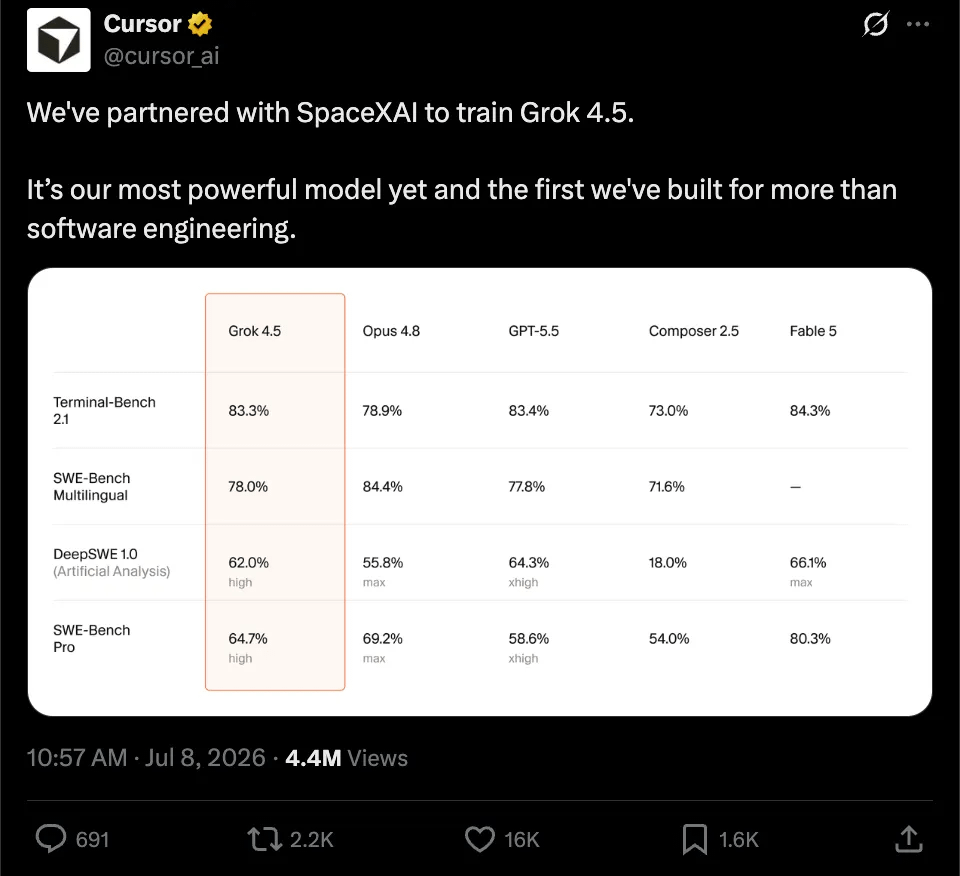
It is a coding and agentic-work model built after SpaceXAI’s Cursor deal, positioned around speed and cost rather than absolute frontier supremacy. The headline claim: roughly Opus 4.7-ish quality, 80 tokens per second, and pricing at $2 per million input tokens and $6 per million output tokens.
Cursor already owns one of AI’s highest-value workflows. It sits directly between developers and the frontier models currently doing the work. Now, backed by xAI’s compute and model resources, it has an obvious incentive to push more workloads toward cost-competitive models it can control rather than indefinitely piping premium tokens from the incumbent labs.
This is the wedge that should make incumbents sweat. If the interface owns the workflow, and the workflow owns the budget, then the model provider may become the replaceable part.
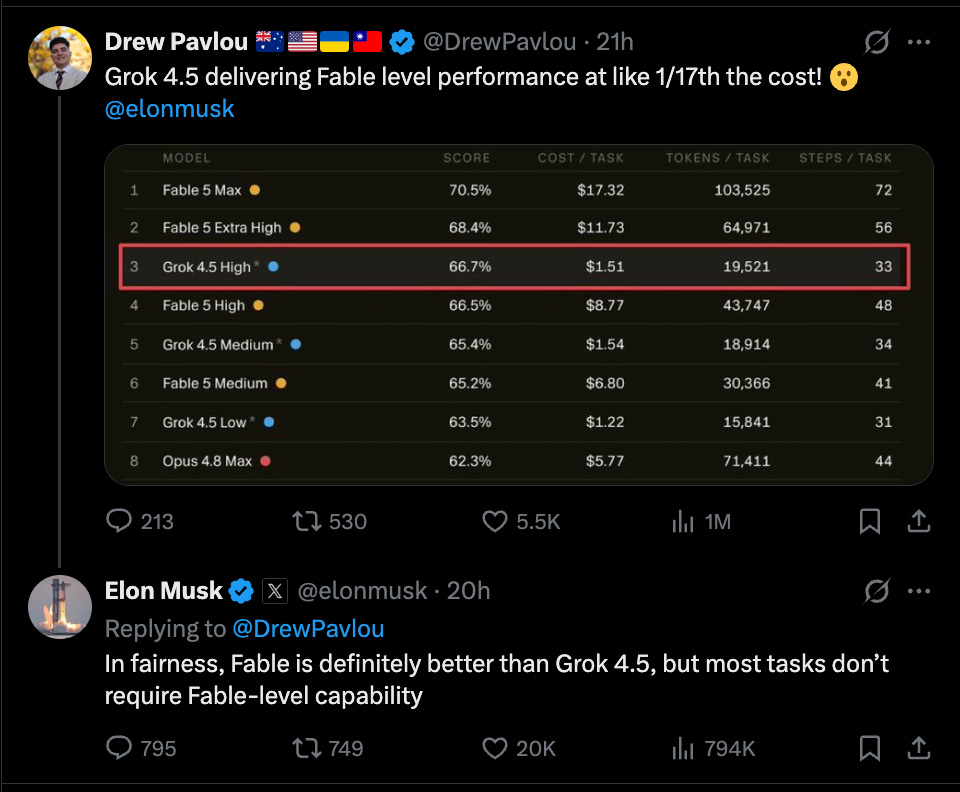
Grok 4.5 is a reminder that “not the smartest” can still be an incredibly dangerous market position when paired with distribution, workflow adjacency, speed, and aggressive pricing. Here’s Musk summing up the point.
3. ByteDance Seedream 5 Pro makes image generation cheaper and more practical

ByteDance’s Seedream 5 Pro is reportedly showing up as a top-tier image model: nearly at the level of GPT Image 2, but at one-quarter the cost, around $0.045 to $0.09 per image.
It is aimed squarely at professional design workflows: dense infographics, precise localized edits, sketch-to-image rendering, multi-image fusion and even separating finished images into editable layers. ByteDance explicitly frames the model around controllability and production work rather than prettier prompt art.
If Seedream is close to GPT Image 2 at dramatically lower cost, and comfortably ahead of Meta’s Muse Image in practical edit/infographic use cases, then the image-model market is about to face the same pressure as text. The frontier is cool, but unit economics are king.
4. GPT-Live makes voice feel less like a walkie-talkie
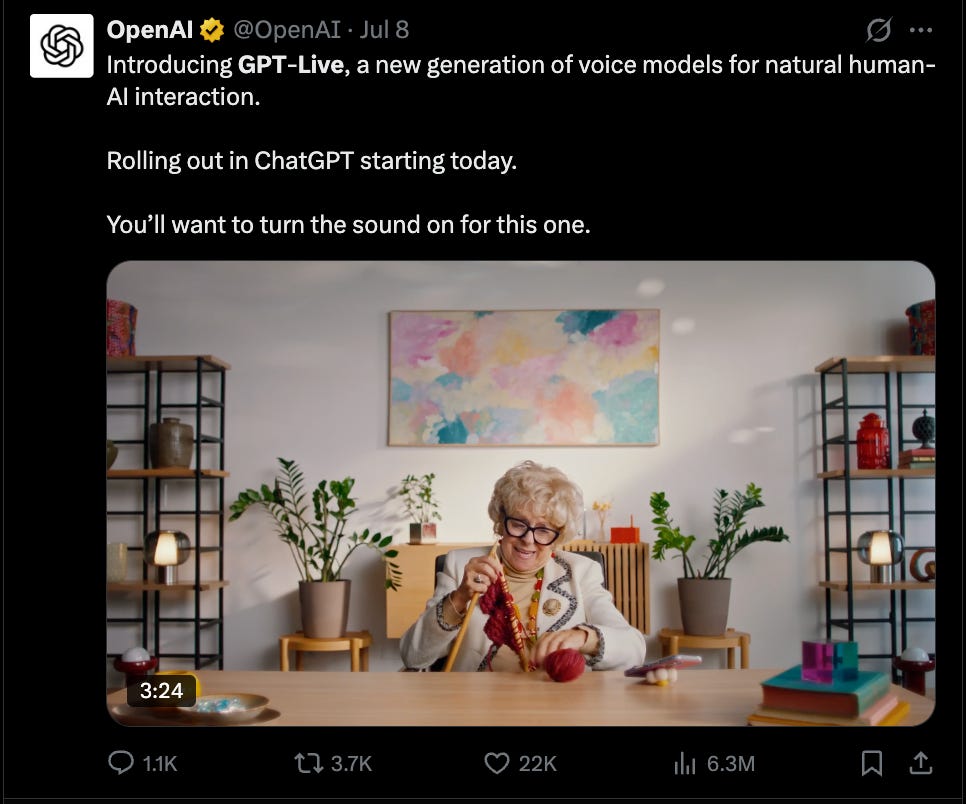
GPT-Live may have the biggest consumer implications of anything launched this week. OpenAI's new voice model is full duplex. It can listen and speak simultaneously, rather than forcing users into awkward turn-taking. It is a major upgrade to ChatGPT voice interactions across mobile and web.
Most voice AI today still feels like talking to a very polite drive-through speaker. You speak. It waits. It thinks. It responds. You interrupt. It panics. Everyone pretends this is natural.
Full duplex changes the interaction model. It lets AI handle interruptions, backchannels, corrections, hesitation, and overlapping speech. That is the difference between a voice assistant and something that starts to feel socially present.
5. Meta Muse Spark 1.1 says: “Remember us?”
Muse Spark 1.1 launched today as a multimodal reasoning model built specifically for agentic work, with major improvements in tool use, computer use, and coding.
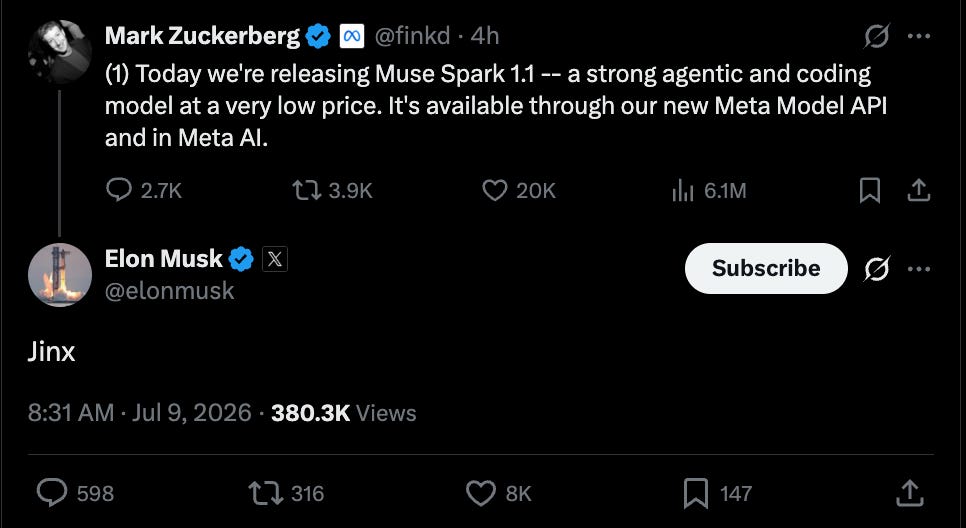
It has a 1 million token context window and can act as a lead agent that gathers context, builds a plan and delegates work across parallel subagents. Meta is also opening its new Model API in public preview and putting Spark 1.1 into Meta AI's Thinking mode.
For years, Meta’s AI strategy was mostly open weights, ecosystem gravity, and research credibility. Muse Spark looks more like a direct commercial swing: a proprietary, API-accessible model aimed at developers and agentic workflows. Turns out distribution remains a useful feature.
The global story this week is not that one lab pulled decisively ahead. It is that the pack compressed.
OpenAI and Anthropic are now fighting on multiple fronts at once. They are navigating unpredictable government scrutiny and supervision. They are still being chased by open-source and open-weight alternatives. And now xAI/SpaceXAI and Meta look meaningfully back in the race, hitting the incumbents exactly where it hurts: cost-competitive performance for most real use cases.
The complaint du jour in AI has been spiraling token cost. Every serious AI team has had some version of the same conversation: “This demo is magical, but what happens when 10,000 employees use it all day?” This week, the ecosystem seemed to answer.
The model maelstrom is not just about intelligence going up. It is about the price of useful intelligence going down.