

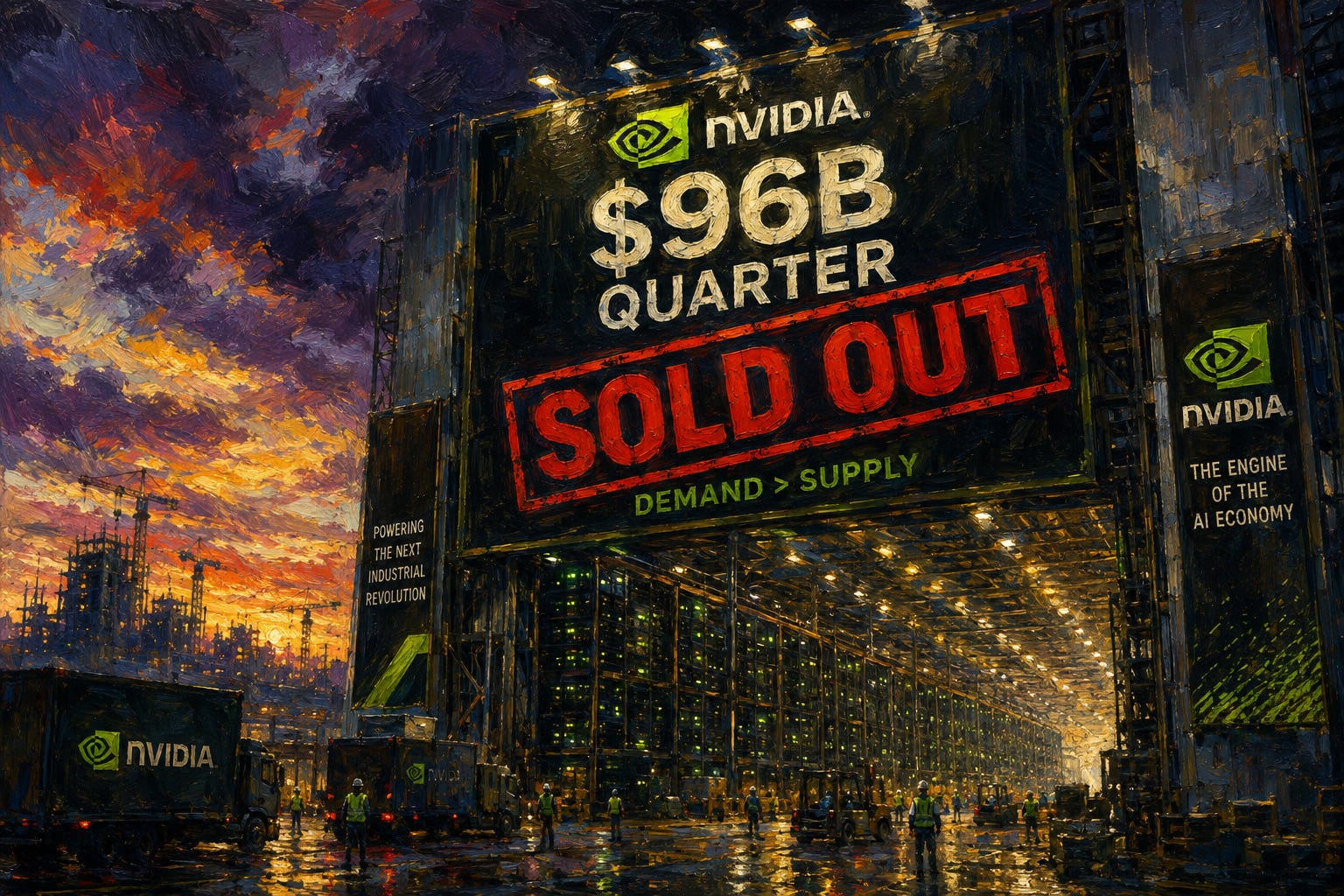
Nvidia has made a habit of blowing past expectations but this quarter was particularly special, as it inched closer to a $100B quarter.
2Q27 revenue hit $96.2B, +106% YoY and +18% QoQ. Data Center reached $89.0B, +117% YoY. Q3 guidance came in at $108B, despite assuming zero China Data Center compute revenue. At some point, “beat and raise” stops being a useful description.
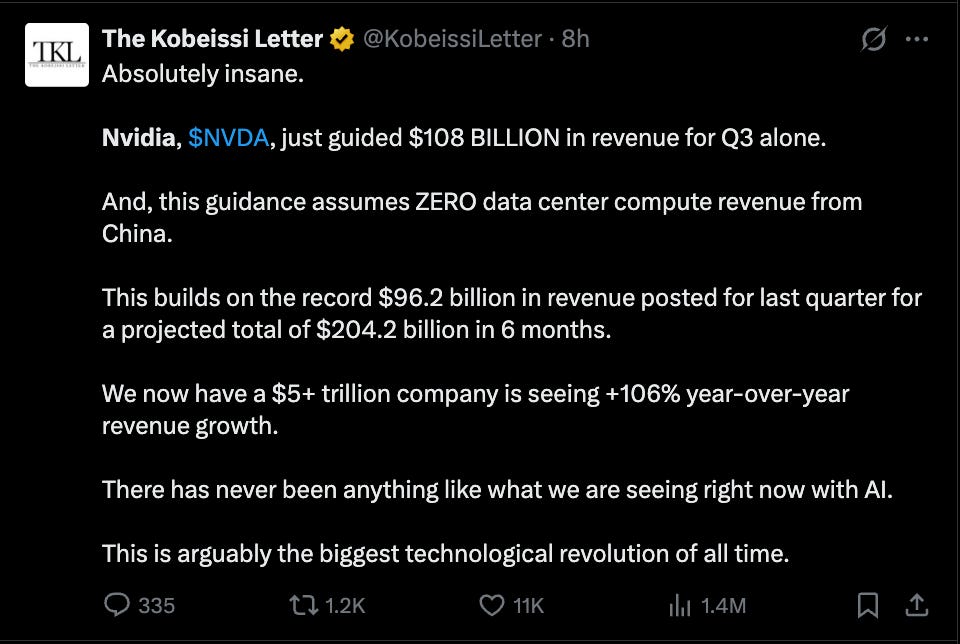

At this point, we’re running out of superlatives. More importantly, we’re running out of conventional frameworks for understanding the business.
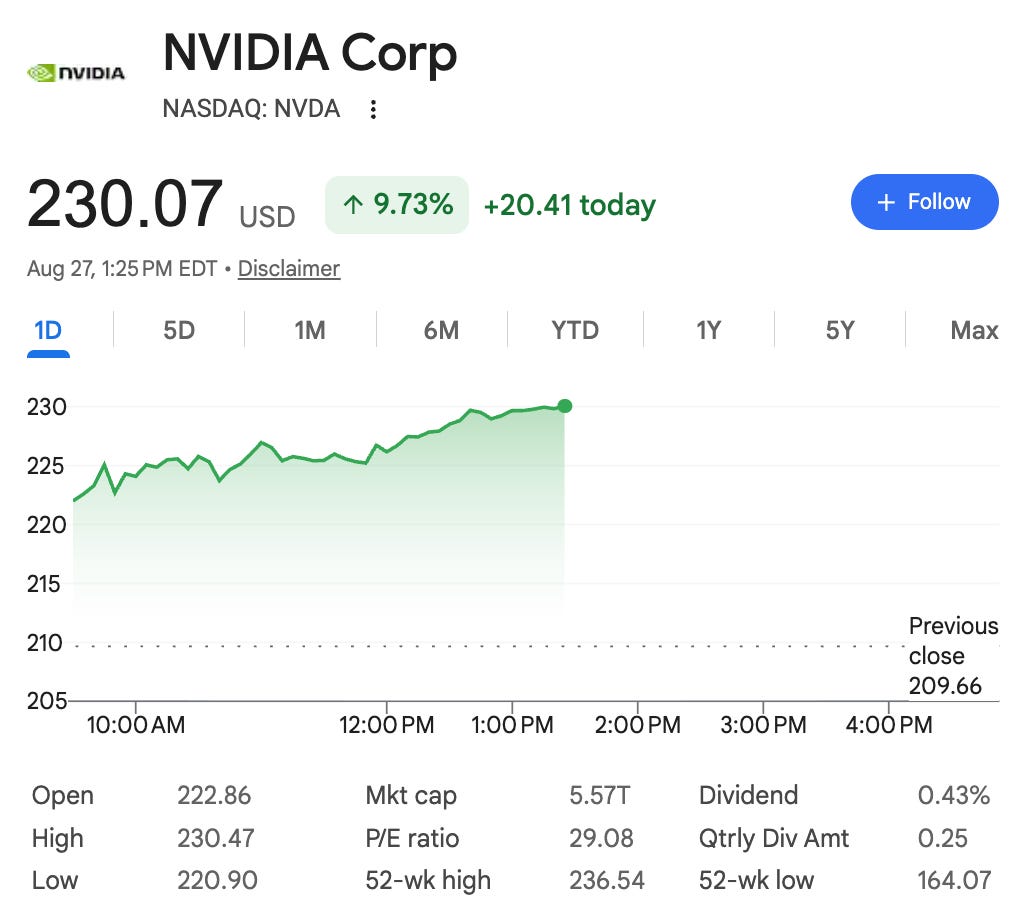
For once, the market seemed to agree. Stock is up 9.73% so far today.
A few things from the earnings that were even wilder than the headline numbers:
1. The AI infra cycle is still supply-constrained.
Nvidia expects FY28 revenue to grow ~70% YoY, versus ~44% embedded in Street expectations - and notes that forecast is still supply constrained.

Customer demand, according to Nvidia, can support growth closer to a doubling next year, but they simply cannot supply it all. That is a remarkable statement for a company already approaching a $400B annualized revenue run-rate.
The bear case for AI infrastructure has been: surely hyperscaler capex eventually runs out of room to accelerate. Nvidia’s answer is effectively: maybe, but first we need to find enough stuff to build it.
The bottlenecks are increasingly mundane things: advanced packaging, HBM, networking, racks, power, cooling and data center capacity.
In a traditional cycle, demand eventually gets saturated and inventory catches up. Here, demand is spilling outward, turning whatever sits one layer downstream into the next bottleneck.
2. Nvidia is monetizing more of the gigawatt
Nvidia is increasing its share of wallet of every AI data center being built. Its revenue opportunity per gigawatt has expanded dramatically with every successive chip generation: $18B with Hopper → $25B with Grace Blackwell → $40B with Vera Rubin.
Nvidia is no longer just monetizing the GPU but it is expanding across the entire stack: GPU + CPU + NVLink + networking + rack-scale systems + software.
Networking had another record quarter, up 18% sequentially. Spectrum-X grew 2.6x YoY. Grace CPU revenue has surpassed $5B on a trailing-12-month basis, and Nvidia expects CPU revenue to more than double next year. This is how great companies defend margins and market share - they move up the stack.
This matters enormously as custom silicon improves. The question of whether another chip can beat Nvidia’s GPU on performance or price is incomplete. Increasingly, a TPU or ASIC has to compete with something much broader: a fungible rack-scale architecture that spans training, post-training and inference, runs across clouds and workloads, and plugs into the CUDA ecosystem. Nvidia’s moat is migrating upward from the chip toward the architecture.
3. Physical constraints are showing up in the margins.
For years Nvidia managed to grow at absurd rates while holding gross margins around 75%. That gets harder from here.
Q2 gross margin was ~75%. Nvidia guided Q3 to ~74%, but more importantly expects margins to bottom around 71–72% in Q4, before settling around 72–73% in FY28. The primary culprit is memory. Management said memory pricing has increased more than expected and could rise further, with Nvidia planning price increases to offset some of the pressure.
But constraints exist across the board. When asked to identify the key bottleneck, Jensen said: “Our entire supply chain is challenged. Everybody is really running flat out.”
This is both the biggest blemish in the quarter and another signal of how extreme AI demand has become: the AI buildout is now consuming enough advanced memory and infrastructure capacity to create bottlenecks across its own supply chain.
4. Agentic AI materially changes compute intensity
Jensen argued that inference demand is structurally changing: an AI agent requires 15–100x the compute of a human-driven interaction because it reasons, plans, calls tools and loops through multiple steps.
His vision of the end state: “In the future, every company will have a whole bunch of agents. We have 40,000 employees, roughly. In the future, we'll have 400,000 agents, 4 million agents.”
Naturally the GPU salesman believes the future contains four million software workers who eat GPUs But the underlying point is important.
If you believe in this trajectory and expect the number of agents to explode and agentic workloads to be 15–100x more compute-intensive then we are just at the very start of this infra supercycle. This transition from training-driven demand to persistent inference-driven demand will be Nvidia’s growth engine for many many years to come.
Jensen distilled the entire AI investment cycle into one line: “Now, compute is revenue.”
If that feedback loop holds - more compute → better models / more inference → more revenue → more compute - then the industry's capex ceiling may be far higher than conventional semiconductor-cycle analysis suggests.
There are still real risks: customer concentration, huge capital requirements, infrastructure financing, custom silicon competition and margin compression.
But the growth tailwind is unlike anything we’ve ever seen. In the face of seemingly infinite demand, Nvidia seems only constrained by the physical world’s ability to keep up. At nearly $100B of quarterly revenue, that is an extraordinary place to be.