
OpenAI Sharpens Its Claw
On iteration asymmetry, runtime architecture, and why the edge now moves faster

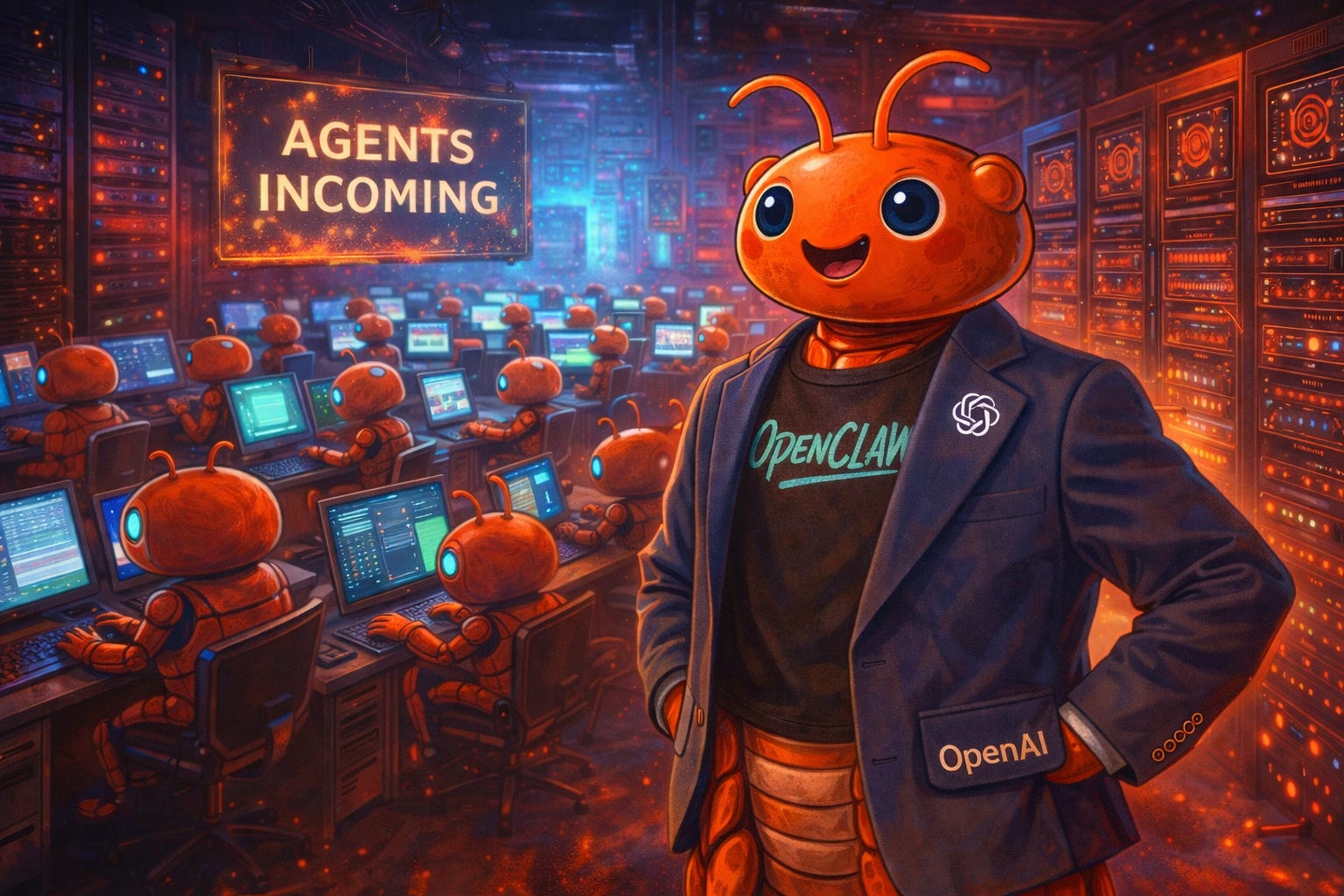
When the OpenClaw GitHub star chart went vertical, it triggered the only KPI that reliably moves Silicon Valley: fear. Fear of being late. Fear of missing talent. Fear of explaining to a board why someone else owns the next platform primitive.
Every AI CEO in the Valley reached for their checkbook. As the user graph steepened, so did the dollar values on offer. Meta and OpenAI made it to the final stretch. Yesterday, OpenAI won - a timely boost for a company that had ceded some narrative momentum to Anthropic in recent weeks.
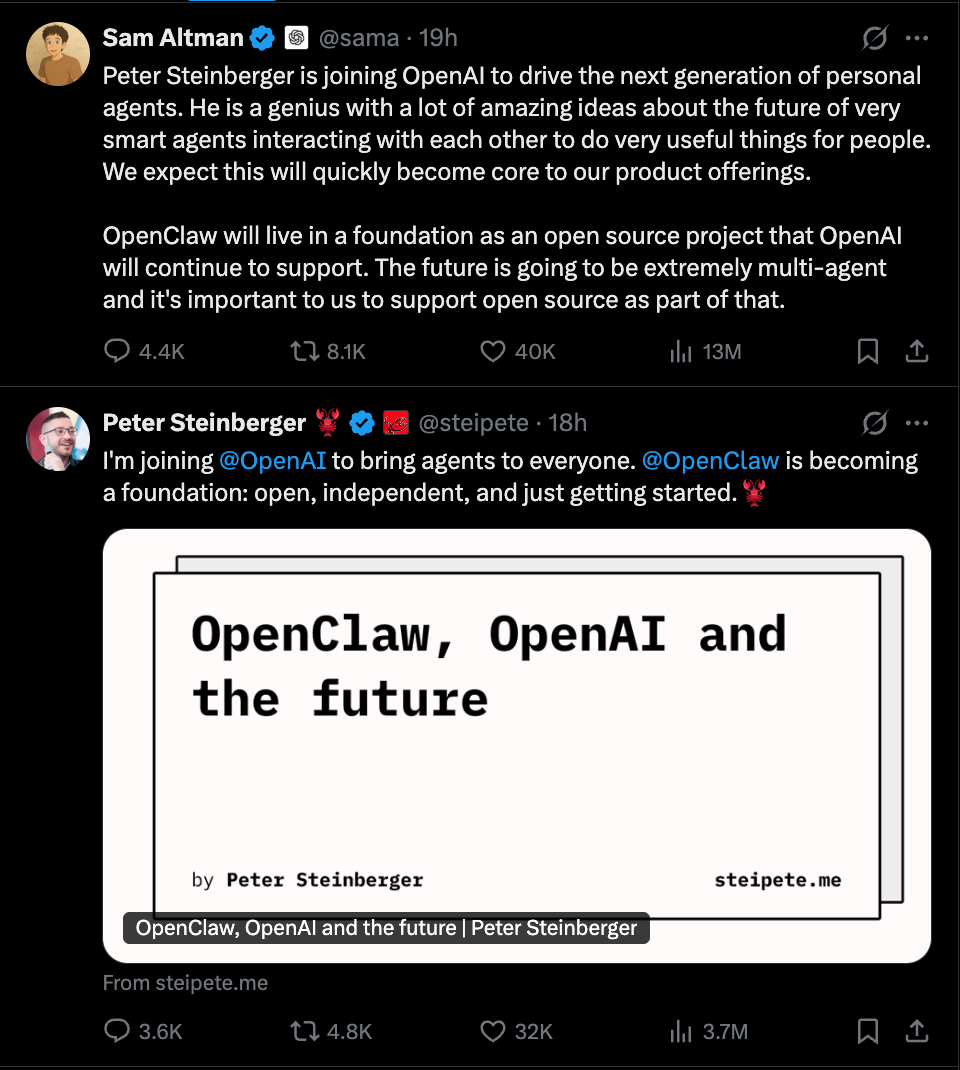
Peter Steinberger - who sold his previous company PSPDFKit for $100M+ - said the most important thing to him was that OpenClaw remain open. In a twist of narrative irony, Meta - the long-time open-source evangelist and erstwhile champion of the people - lost the deal to OpenAI.
This deal is a clean illustration of how dramatically the economics of innovation have shifted. We talk about collapsing barriers to creation as theory. OpenClaw is practice. One person, with taste, velocity, and a point of view, can now build something that forces trillion-dollar companies to react. The marginal cost of experimentation has collapsed.
There is also a very important asymmetry here. Steinberger has said that OpenClaw was his forty-fourth experiment. The first forty-three did not work. This is fine. The cost of iteration for an individual builder is low: time, attention, some compute, maybe mild psychic damage. You move on.
Now imagine OpenAI shipping forty-three failed projects in a row. The cost is headlines, credibility, internal morale, external trust, and a lot of very serious emails from people who use words like “optics.” Large platforms are constrained not by talent but by the compounding cost of visible mistakes.
We may end up with a system that looks a lot like outsourced R&D. Individuals run high-variance experiments in public. When one hits hard enough, the incumbents show up with checkbooks and integration plans.
This suggests that the best job interview going forward might just be to build the thing. Put it out there. Let people use it. Proof > Pedigree. If it works, you do not need to convince anyone. Someone larger, slower, and more constrained will eventually come find you.
What I’ve been thinking about more, though, is what OpenClaw actually got right. It wasn’t context window hacking, secret prompt magic, or model fine-tuning breakthroughs. The models were broadly available to everyone. The difference was architectural:
It externalized state. OpenClaw treated long-term memory as a systems problem rather than a prompt problem. Instead of stuffing more and more history into context windows, it externalized state: memory lived outside the model in structured stores, context was reconstructed selectively, behavioral history persisted independently of token limits. That allowed agents to feel continuous without becoming brittle or prohibitively expensive.
It hacked integration friction. OpenClaw made it stupidly easy to bind agents to real-world surfaces - slack, telegram, signal, iMessage etc. Agents started listening. This required solving auth flows, event ingestion, rate limiting, execution safety, webhook orchestration. That’s the boring infrastructure glue that agent frameworks have largely ignored thus far. That’s why the product felt embedded.
It got concurrency right. Many early agent systems are essentially linear loops: plan, act, observe, repeat. OpenClaw structured agents as independent processes that listen to event streams and communicate asynchronously. That’s closer to distributed systems engineering than prompt chaining. The result was responsiveness and multi-agent interaction that felt alive rather than sequential.
It avoided over-orchestration. There’s a temptation to design a full “agent operating system” with heavy planners and hierarchical supervisors. OpenClaw stayed comparatively lightweight. Simpler loops and fewer abstractions made it easier to fork, extend, and experiment. That matters in an ecosystem phase. Growth follows simplicity.
It unlocked visibility. OpenClaw didn’t go viral because it performed well on some esoteric benchmark. It spread because people could see agents participating in real conversations. Screenshots traveled. Videos circulated. The behavior was legible to non-experts. In early platform shifts, demonstrability often matters more than theoretical capability. The most contagious ideas are visible ones.
It hit the “agent timing window”. The industry had largely accepted that frontier LLMs were capable enough to support agentic workflows. At the same time, tooling hadn’t consolidated around a standard. When a category is inevitable but not yet consolidated, the first compelling implementation can gather enormous gravitational pull - even if it’s rough around the edges. OpenClaw landed in that window.
It embodied a philosophical shift. Underneath the code was something deeper: OpenClaw treated AI not as a tool you query, but as an entity that participates. That framing resonates because it matches where cognition models are going - persistent, stateful, contextual, multi-actor systems.
It felt aligned with the future.
The bottleneck in agent systems is no longer model intelligence, it is system design around the model - state management, runtime architecture, integration surfaces, and safety boundaries. OpenClaw’s growth came from solving the system layer well enough that the intelligence could express itself.
Most builders are still fighting the model, OpenClaw focused on the runtime. That’s what they landed right.