
Preparing for the Unpredictable
Why OpenAI is institutionalizing preparedness as AI systems outgrow prediction

OpenAI recently posted a role that would have sounded strange even a few years ago: Head of Preparedness. The title alone sparked debate. Some read it as prudent. Others as performative. I see it as an admission that the field is entering uncharted territory.
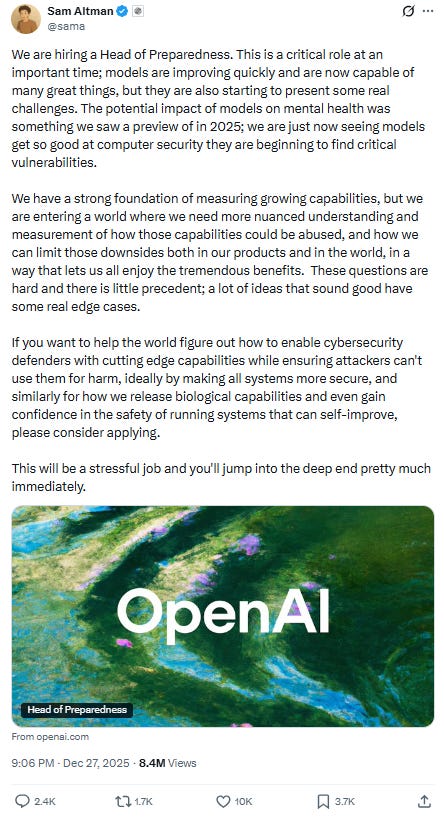
The role forces an obvious but uncomfortable question: what, exactly, are we preparing for?
At first glance, the answers seem familiar - misuse, model failures, disinformation, cyber risk. These matter, but they are incomplete. If preparedness were only about preventing known harms, it would sit comfortably inside existing safety or policy teams. This role exists because the core problem is uncertainty that cannot be specified ahead of time.
Modern AI systems increasingly exhibit emergent behavior. Not just better execution of known tasks, but capabilities that appear only after deployment, through interaction with users, tools, and incentives. These behaviors are hard to predict beforehand, to test exhaustively, or to explain cleanly after the fact.
As models become more capable and more agentic, risk stops looking like a checklist of edge cases and starts looking like system dynamics. Feedback loops form between humans and models. Capabilities surface through prolonged use. Deployment pressures outpace institutional understanding. The failure mode is no longer a single obvious flaw, but patterns that compound over time.
Preparedness also reflects a shift from invention to diffusion. The most consequential effects of AI are unlikely to come from a single breakthrough moment. They will come from countless small integrations into workflows, markets, and decision systems. Individually benign, potentially destabilizing in aggregate. Preparedness, in that sense, is about watching the second derivative, not reacting to the headline demo.
There is an institutional dimension as well. Frontier labs now operate under sustained scrutiny from regulators, customers, governments, and internal stakeholders. A dedicated preparedness function creates a locus of accountability when something unexpected happens, which increasingly feels inevitable rather than hypothetical.
At a deeper level, preparedness is an acknowledgment of limits. We are building general-purpose systems inside tightly coupled social and economic structures. It is bound to be unpredictable. A preparedness function exists to think about those things before they show up as incidents.
The question, then, is not whether we are preparing for a specific scenario. It is whether we are adequately preparing for surprise itself.
What this reveals about the field
The polarized response to the role signals a field that is uncomfortable with its own maturity. Early-stage technologies tend to celebrate speed and dismiss caution as fear. Mature technologies institutionalize caution because the cost of being wrong compounds. AI is in the awkward middle. Powerful enough to matter, yet young enough to still mythologize recklessness.
The existence of this role suggests that leading labs now see AI less as a research artifact and more as critical infrastructure. Once you cross that threshold, preparedness is no longer optional.
Preparedness also scales where policy does not. You cannot write rules for capabilities that do not yet exist but you can build organizational capacity for scenario planning, red-teaming, and rapid response. That reframes safety from static compliance to adaptive readiness.
This role implicitly acknowledges limits to understanding. The most honest posture in a complex system is not confidence, but readiness.
Where this points
Expect more labs to formalize similar roles, even if they call them something else. Expect preparedness to sit closer to product and deployment, not just research ethics. And expect the conversation to shift from whether such roles are necessary to how much authority they actually have.
AI development is moving from a phase dominated by optimism about capability to one shaped by responsibility for consequences.