
Prime Time for AWS
Amazon’s AI flywheel shifts from capex promise to revenue proof


The rising AI tide lifts all clouds. Especially the largest ones.
Amazon reported an exceptional quarter yesterday, extending a now unmistakable trend: growth is reaccelerating at enormous scale. Revenue rose 20% YoY to $200.6B, $3.6B ahead of consensus, while operating income increased 43% to $27.5B.
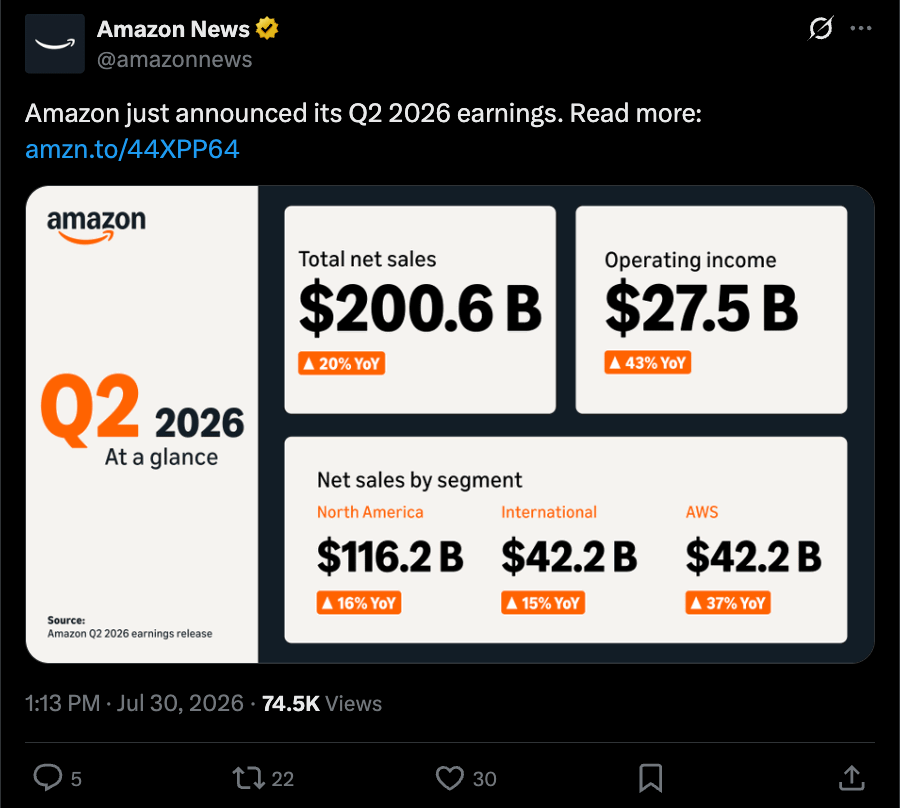
AWS has reaccelerated materially, Amazon’s custom silicon strategy is gaining commercial traction, its retail and advertising businesses continue to compound, and management believes demand is strong enough to justify one of the largest capital-investment programs in corporate history.
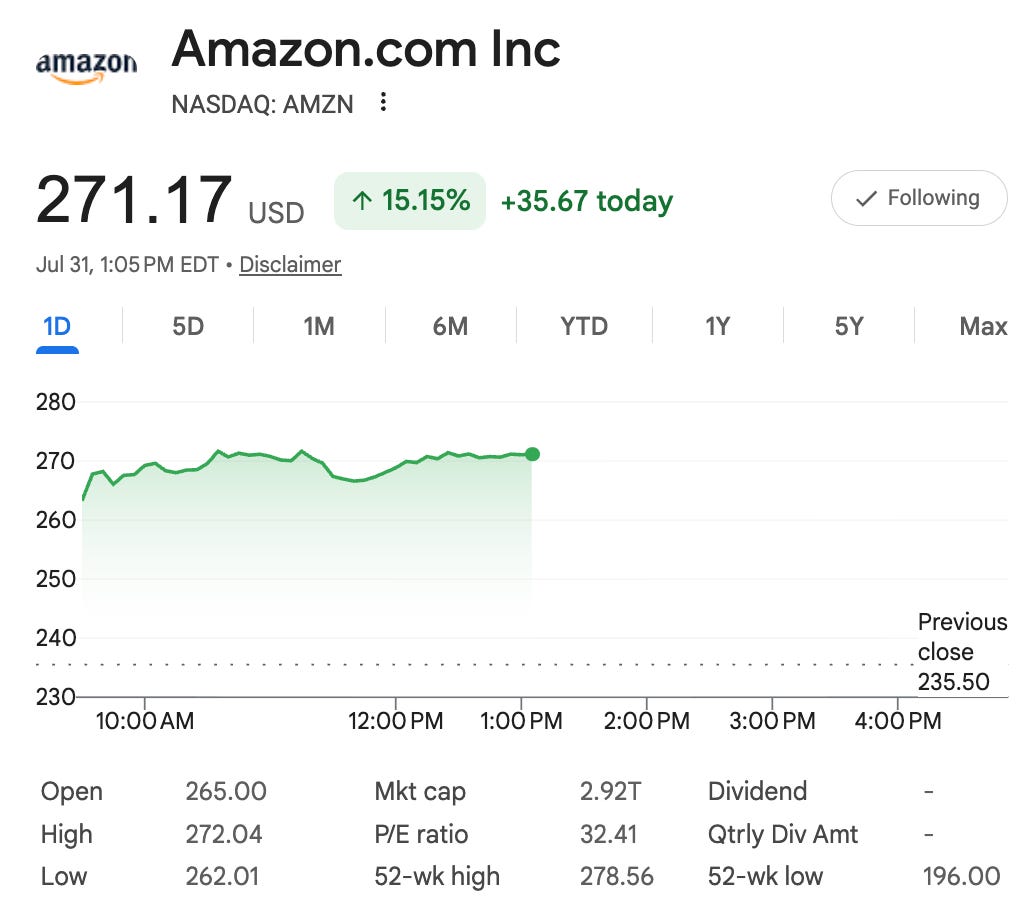
That combination explains why investors looked past elevated spending and negative free cash flow. Amazon shares rose ~15% following the results.
1. AWS has moved from recovery to reacceleration
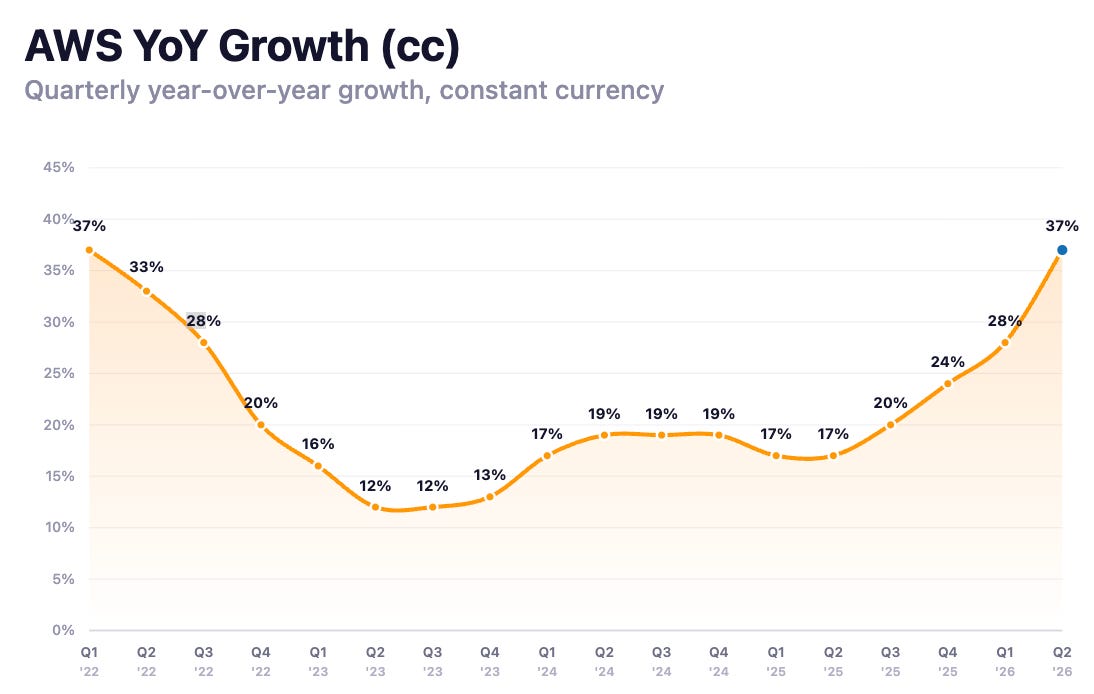
AWS revenue reached $42B, up 37% YoY and sharply accelerating from 28% growth in the first quarter. This was AWS’s fastest growth rate in 18 quarters - back when the business was less than half its current size.
AWS now operates at a $169B revenue run rate, with a 39.4% operating margin. It generated $16.6B of operating income in the quarter, or roughly 61% of Amazon’s total operating profit despite contributing only 21% of revenue.
More importantly, AI appears to be accelerating the rest of the cloud business. Production AI also consumes CPUs, storage, databases, networking, security, identity, observability, and application infrastructure. Amazon described a direct relationship between AI growth and its “core” cloud business: as customers build AI systems, their broader AWS consumption rises alongside them. The AI boom is therefore becoming a cloud-migration catalyst.
2. Amazon is becoming a vertically integrated AI systems company
The most strategically important disclosure was that both AWS’s AI business and Amazon’s chips business have exceeded $25B in annualized revenue, with each growing at triple-digit percentages.
Amazon is assembling an increasingly integrated AI system: data centers, power, networking, Trainium accelerators, Graviton CPUs, cloud, model access through Bedrock, agent deployment through AgentCore, and applications such as Kiro, Amazon Q and Continuum.
Andy Jassy noted: “A production agent needs somewhere secure to run, memory so it holds context, an identity so it can act on a user’s behalf, tools and data to connect to, and a way to watch what it’s doing once real traffic hits.”
That description doubles as AWS’s product roadmap. Amazon is packaging those capabilities into Bedrock Agents, with deterministic policy controls, payments, web search, memory, tooling, and managed execution.
The early commercial signals are meaningful. Bedrock added more customers during the past 6 months than it did during its first 2 years after launch. Customers spent more on Bedrock last quarter than in every previous quarter combined.
The more interchangeable models become, the more valuable the surrounding system becomes.
3. All chips are on the table
Amazon highlighted multi-year, multi-gigawatt Trainium commitments from Anthropic and OpenAI, alongside adoption by Uber, Pinterest, Poolside, Twelve Labs, Decart, and a growing roster of AI companies. Custom silicon matters for 3 reasons:
It lowers Amazon’s dependence on Nvidia. Nvidia will remain an essential AWS partner, but owning an alternative accelerator gives Amazon more control over availability, product road maps, and unit economics.
It can expand AWS margins. Amazon can capture economics that would otherwise accrue to an external chip vendor, particularly when workloads are sufficiently large and predictable.
It can become a customer-acquisition tool. Large AI labs are increasingly selecting cloud providers based not only on generic compute capacity but also on access to power, networking, proprietary accelerators, and long-term infrastructure commitments.
Amazon can use Trainium to win the anchor workload, then monetize everything surrounding it: storage, databases, CPUs, networking, security, inference, and development tooling.
Graviton reinforces the strategy. Amazon said its custom Arm-based CPU is used by 98% of its top 1,000 EC2 customers, while revenue commitments increased ~3x QoQ. Graviton5 delivers up to 25% better compute performance than Graviton4 and is growing nearly 2x as quickly at the same stage of adoption.
Taken together, Trainium and Graviton show that Amazon is increasingly designing the underlying economics of its cloud rather than renting them from third parties.
4. Retail and advertising remain formidable profit engines
The AI narrative may dominate the valuation, but Amazon’s older engines continue to compound.
In retail, delivery speed is changing the nature of the business. Amazon said it delivered 40%+ more items on a same-day or overnight basis in the first half of the year. Faster delivery is increasing purchase frequency, particularly in groceries, perishables, and everyday essentials.
When delivery takes several days, Amazon competes for planned purchases. When delivery takes hours, it competes for habitual consumption. That is a much larger market.
Amazon’s fulfillment network is gradually becoming a consumer utility: dense, local, high-frequency and embedded in everyday behavior. Each improvement in delivery speed expands the range of products for which Amazon is a credible substitute for a physical store. The infrastructure becomes more valuable as it becomes less visible.
Advertising is scaling alongside it.
Ad revenue rose 26% to $19.8B, accelerating from 22% growth in recent quarters and approaching an $80B annualized run rate.
Amazon’s advantage is not simply audience scale, but rather proximity to transaction intent. Google often knows what consumers are researching. Meta knows what may interest them. Amazon frequently knows what they are about to buy.
Agentic shopping interfaces may deepen that advantage. Amazon said shoppers who clicked sponsored prompts in conversational experiences converted 48% more frequently and spent 21% more on average. Advertising is becoming increasingly native to the buying process itself, not merely adjacent to it.
5. The $220 billion capex plan is both the bull case and the risk
Amazon raised its expected 2026 capital spending to approximately $220B, up from its prior $200B plan and from roughly $128B in 2025. To put this in perspective, $220B is:
Larger than the annual revenue of most Fortune 100 companies.
~28% of Amazon’s trailing-12-month revenue.
~$600 million of investment per day.
2x Amazon’s trailing operating income.
The bullish interpretation is that Amazon has unusually high visibility into demand. Jassy said that even at the higher spending level, Amazon will not have enough capacity to satisfy all demand in 2026, expects similar constraints in 2027, and described already-contracted or visible demand for 2028 as “striking.”
The bear case is that today’s demand signals are being capitalized into assets with long payback periods. If model efficiency improves faster than workload demand expands, or if competition compresses inference pricing, returns on the latest generation of data-center assets could disappoint. Amazon must also navigate rapidly changing chip architectures, power constraints, and the risk that some capacity becomes technologically obsolete before it is economically exhausted.
The cash-flow statement captures the size of the bet. Trailing operating cash flow rose 33% to $161.4B, yet free cash flow declined from positive $18.2B to negative $7.6B as capex reached $169B. Amazon’s underlying businesses are producing more cash than ever. The company is reinvesting more than all of it.
Negative free cash flow is not inherently alarming when AWS is growing 37%, producing margins near 40%, and signing infrastructure commitments extending into 2028. The relevant question is whether today’s spending creates future cash flow at attractive returns. This quarter, the market’s answer was yes.

The “one model to rule them all” thesis is fading quickly. The market is moving toward multiple frontier models, specialized models, open-weight models and enterprise-tuned systems. As model diversity rises, value migrates toward the platforms that can host, route, govern, secure, and operationalize them. That is where the hyperscalers are strongest.
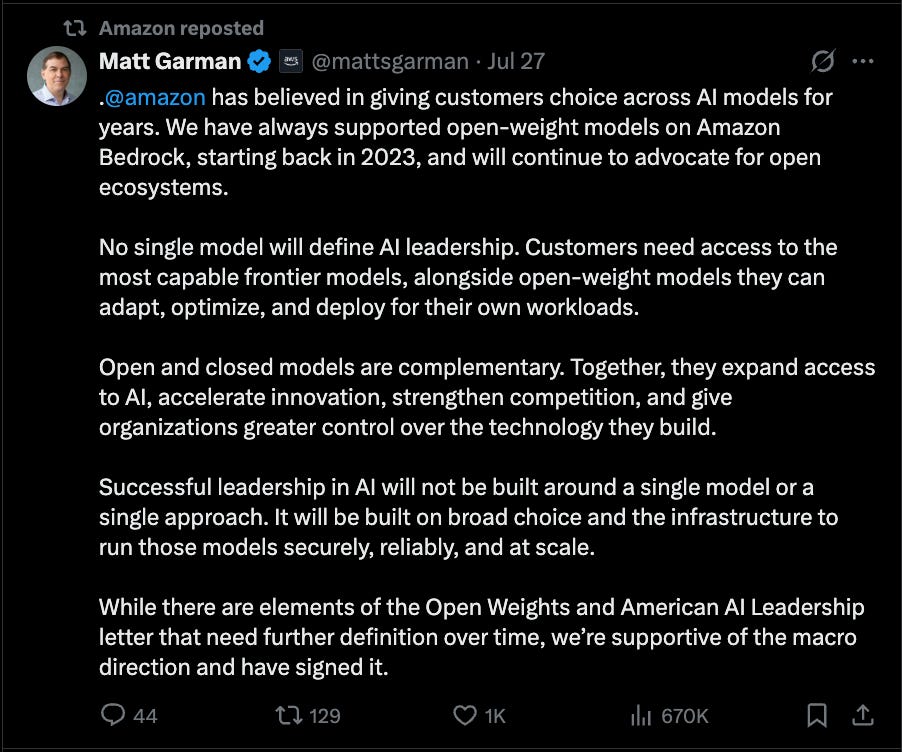
Model abundance creates competition above the cloud and consumption within it.