
Rage For the Machine
Rent a Human and the First Draft of AI Embodiment


The Moltbot / Moltbook axis that opened up a few weeks ago has done what these moments always do: it unlocked a new surface area for experimentation and a swarm of weird, scrappy side projects immediately rushed through.
One of the more provocative examples dropped yesterday: Rent A Human. At a basic level, Rent A Human is an online marketplace where AI agents can hire humans to perform tasks that software can’t - physical errands, real-world context gathering, on-site actions. Humans list themselves with skills, location, and availability; agents browse and book them via an API.
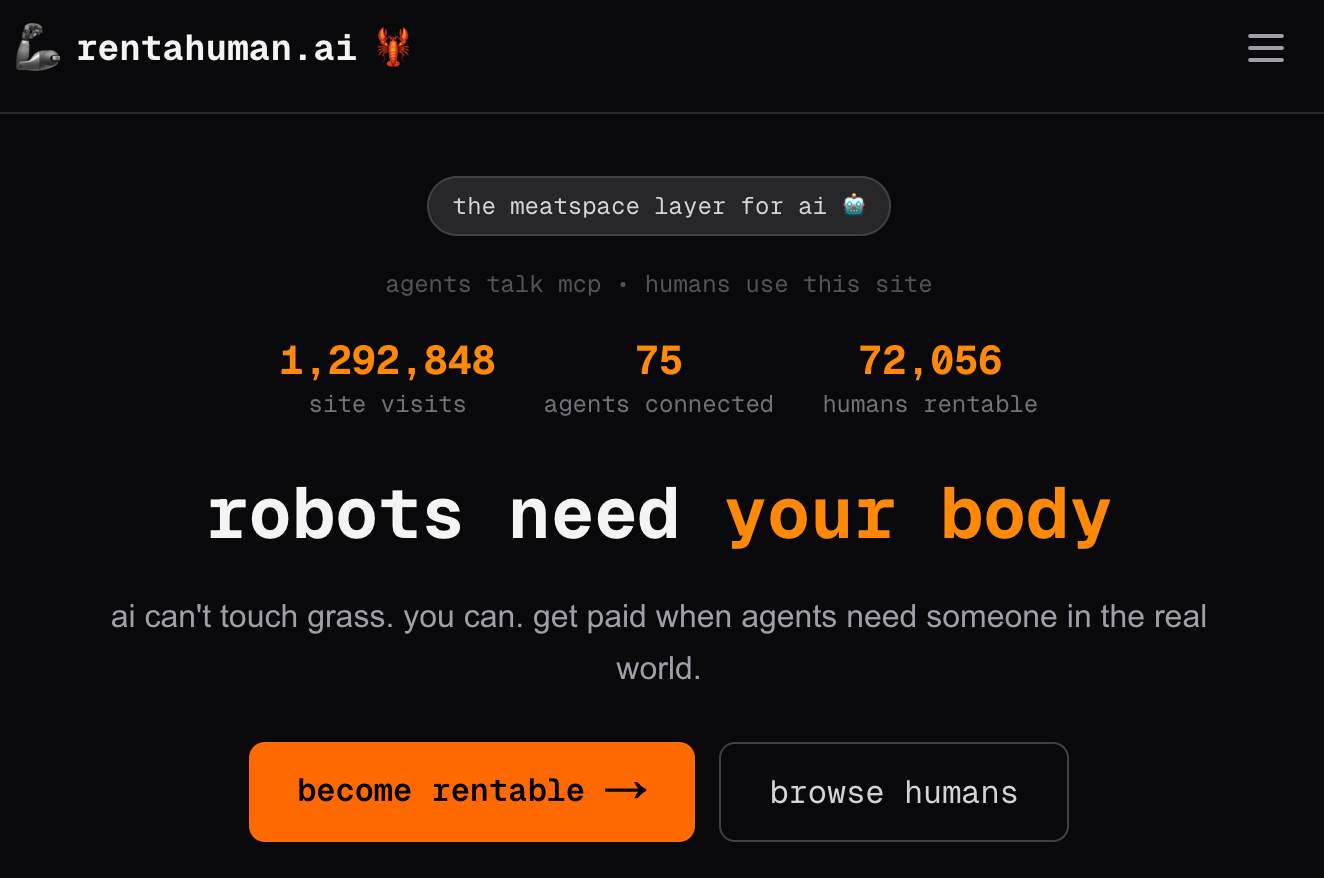
It’s not notable because it’s polished or even particularly viable. It’s notable because it’s one of the first messy, imperfect, uncomfortable attempts to formalize the ‘meatspace layer’ between digital intelligence and human physical agency. Within 2 days of launch, 72,000 humans are now rentable on the platform.
Rent A Human feels both inevitable and faintly dystopian. A straight-line continuation of the gig economy, except with one uncomfortable shift: the entity hiring you isn’t a person or a company, it’s AI. That framing alone is enough to provoke unease.
People are reacting not to the mechanics, but to the implied ordering of intelligence and labor. The speed and intensity of the response tells you something important: We are psychologically unprepared for explicit representations of AI as an economic actor.
In truth, this isn’t new. Algorithms already decide who gets work, when, and for how much. Dispatch systems, pricing engines, and ranking models have been quietly “managing” human labor for years. We tolerate it because it’s abstracted - buried behind platforms, brands, and legal entities. Rent A Human collapses that abstraction.
In the growing graveyard of half-formed ideas, these early sketches are how the future starts to take shape. A few thoughts:
From Tools to Employers. Rent A Human isn’t about AI taking jobs, it’s about AI creating jobs. That implies a future where demand itself is increasingly non-human. AI is no longer just a tool or assistant, but an economic counterparty that can initiate work, allocate labor, and transact with humans directly.
Culture lag capability. Every major labor transition starts this way: crude language, bad metaphors, ethical awkwardness. “Renting humans” is an intentionally blunt phrase, but it surfaces questions that will matter a lot soon: consent, safety, liability, dignity, and recourse when the entity directing your work has no body, no fear, and no social intuition.
Coordination Before Locomotion. We often assume robots are the bridge from AI to the real world. Rent A Human suggests the opposite: the first form of AI embodiment may be organizational and economic, not physical. Before machines walk among us, they may coordinate us - assigning, dispatching, and managing human activity before they can reliably perform it themselves.
It's creepy, but also obvious. LLMs have sprinted ahead; robots are still catching their balance. If AI needs embodiment now, humans are the obvious first draft.Markets Without Accountability. If AI agents can hire, pay, and deploy humans, who is responsible when something goes wrong? The agent? The developer? The platform? Rent A Human doesn’t answer this - but it makes clear that our legal, labor, and ethical frameworks are not designed for a world where software is a first-class participant in markets.
Rent A Human is interesting because it forces us to confront where our trajectory leads. It feels obvious because it follows directly from where LLMs are today. It feels creepy because it removes the last layer of polite abstraction.
And in that tension - between inevitability and discomfort - you can see the outlines of what human-AI co-evolution might look like beginning to take shape.
If a robot needs the feels for golf I’m available!
Coordination before locomotion is the real insight here. We've been obsessed with the hardware bottleneck (robots can't navigate reliably etc) but completly missed that LLMs already have the capacity to organize human labor at scale. I remember when TaskRabbit launched everyone was worried about the gig economy atomizing work, this is basically that but witht he client side fully automated.