
Satya’s Convenient Truth
The platform argument hiding inside Microsoft’s AI manifesto

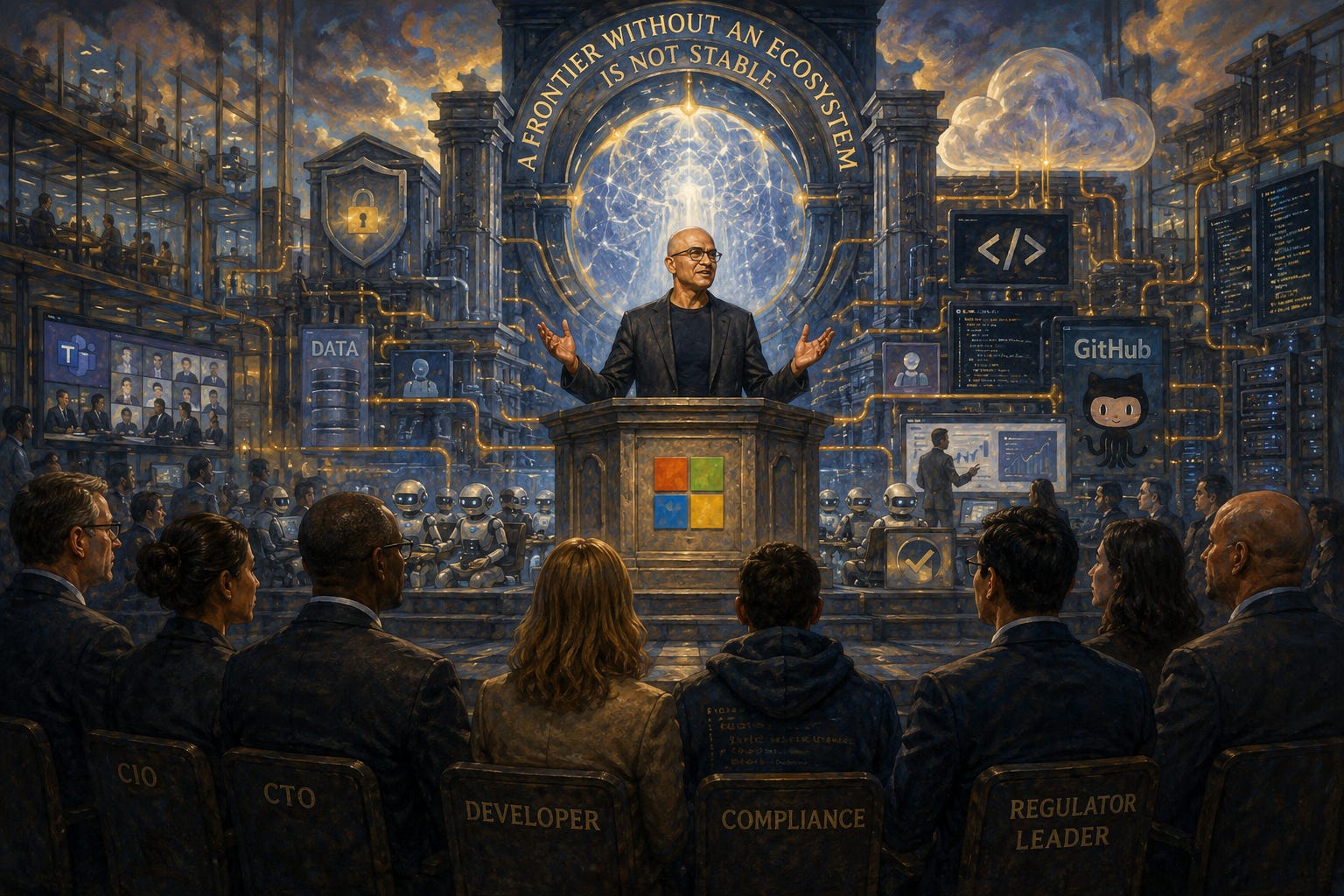
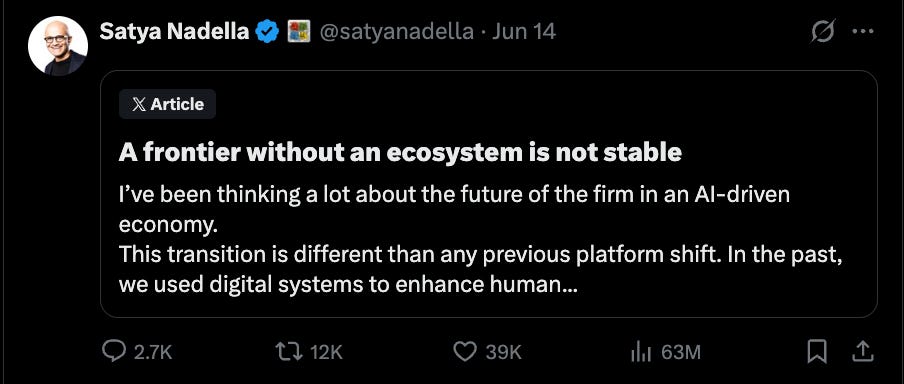
Satya Nadella published an AI manifesto this weekend, arguing that “a frontier without an ecosystem is not stable.”
This is, among other things, an excellent sentence for the CEO of Microsoft to say. Microsoft is the ecosystem business. It owns the place where employees work, developers build, data sits, permissions live, and, increasingly, the place where the agents are supposed to go do agent things under supervision.
Of course Microsoft believes in ecosystems. Microsoft has been an “ecosystem” since before most AI founders were born.
The interesting part is that Satya is probably right.
For the last two years, AI strategy has had a very frontier-maximalist flavor. Who has the best model? Who has the most GPUs? Who has the highest benchmark score? Who gets access to the model that everyone else is not allowed to use yet? This is a fun way to run a research lab but a stressful way to run a company. If you are an enterprise CIO, your AI strategy cannot be: “We hope the smartest lab continues to like us, price us reasonably, pass its safety evals, avoid regulatory trouble, and not revoke access to the model we built our workflow around.” That is a hostage situation.
Satya gives enterprises a more pleasant story to tell themselves: You are not powerless. You have the data, workflows, permissions, identity layer, compliance requirements, business logic, distribution, and institutional scar tissue that turns a clever demo into something a bank, hospital, retailer, or insurer can actually run.
The frontier model may be smarter than your company, but it does not know your company. That gap is where the money is.
This is also where Microsoft’s argument becomes very Microsoft. The value, in this telling, migrates from the model to the harness around the model: agents, memory, permissions, enterprise data, evaluation, observability, governance, workflow integration - things Microsoft already sells, bundles, secures, bills, and calls a platform.
The strategic elegance of the argument is that Microsoft does not have to say frontier models are commoditizing. That would be rude, especially given its OpenAI relationship. It simply says frontier models are unstable without ecosystems, which is a much nicer way of saying: the engine matters, sure, but you need to build the car around it to actually go places.
This is especially timely because the pure frontier bet is beginning to look expensive, brittle, and mildly insane. Costs are spiraling. Pricing is a moving target. And if Fable 5 can be effectively yanked out of customers’ hands overnight, the lesson is not just “be careful which model you pick” but that dependency on any one of them is an architectural risk.
The enterprise response cannot be to bet the farm on one model. It has to be to build the farm. The model must become one replaceable component in a broader operating system. Still important. Still expensive. Still magical on a good day. But no longer the whole religion.
There is also a political argument hiding inside the platform argument.
A world dominated by a few frontier labs may be technically impressive, but it lacks permission. No enterprise wants to explain to its board that its core workflows depend on a model it does not control, trained by a company it cannot audit, governed by policies it did not negotiate, and potentially changed or restricted overnight. No government wants the economy’s cognitive infrastructure concentrated in a handful of private labs. No regulator wants to bless a future where intelligence is both essential and externally administered.
That is the deeper meaning of Satya’s warning that there is no societal permission for an AI future that hollows out entire industries. Such a world would be economically concentrated, politically fragile, operationally brittle, and socially hard to legitimate.
An ecosystem softens that threat. It spreads power around. It creates stakeholders. It lets enterprises participate in the future rather than be colonized by it. It gives regulators more seams to grab. It gives customers more exit options. And, conveniently, it gives Microsoft the role it has always wanted: the control plane through which the frontier enters the real economy.
So the line is both reassurance and strategy.
To enterprises: do not panic, your context is power.
To frontier labs: intelligence without distribution is a science project.
To regulators: ecosystems are easier to trust than empires.
And to Microsoft shareholders: the platform era is not over.
She lands on "the model becomes one replaceable component." The question is whether replaceable cuts both ways. If any enterprise can swap one frontier model for another, the enterprise has leverage and Microsoft's harness is the valuable layer. But if any platform can plug in any model, the harness is replaceable too, and the leverage flips back to whoever has the best model at any given moment.
So the whole argument comes down to a sequencing bet. Microsoft is betting the model commoditises first. The frontier labs are betting the platform does. The essay reads as though the model layer is already losing, and maybe it is, but the harness layer has no moat either if the APIs stay interchangeable. Whoever's layer commoditises second holds the margin. Neither side knows which one that is yet, and that uncertainty is the actual game being played underneath the manifesto.