
Tag, You're It
How Claude Tag turns AI from single-player productivity tool into multiplayer labor layer

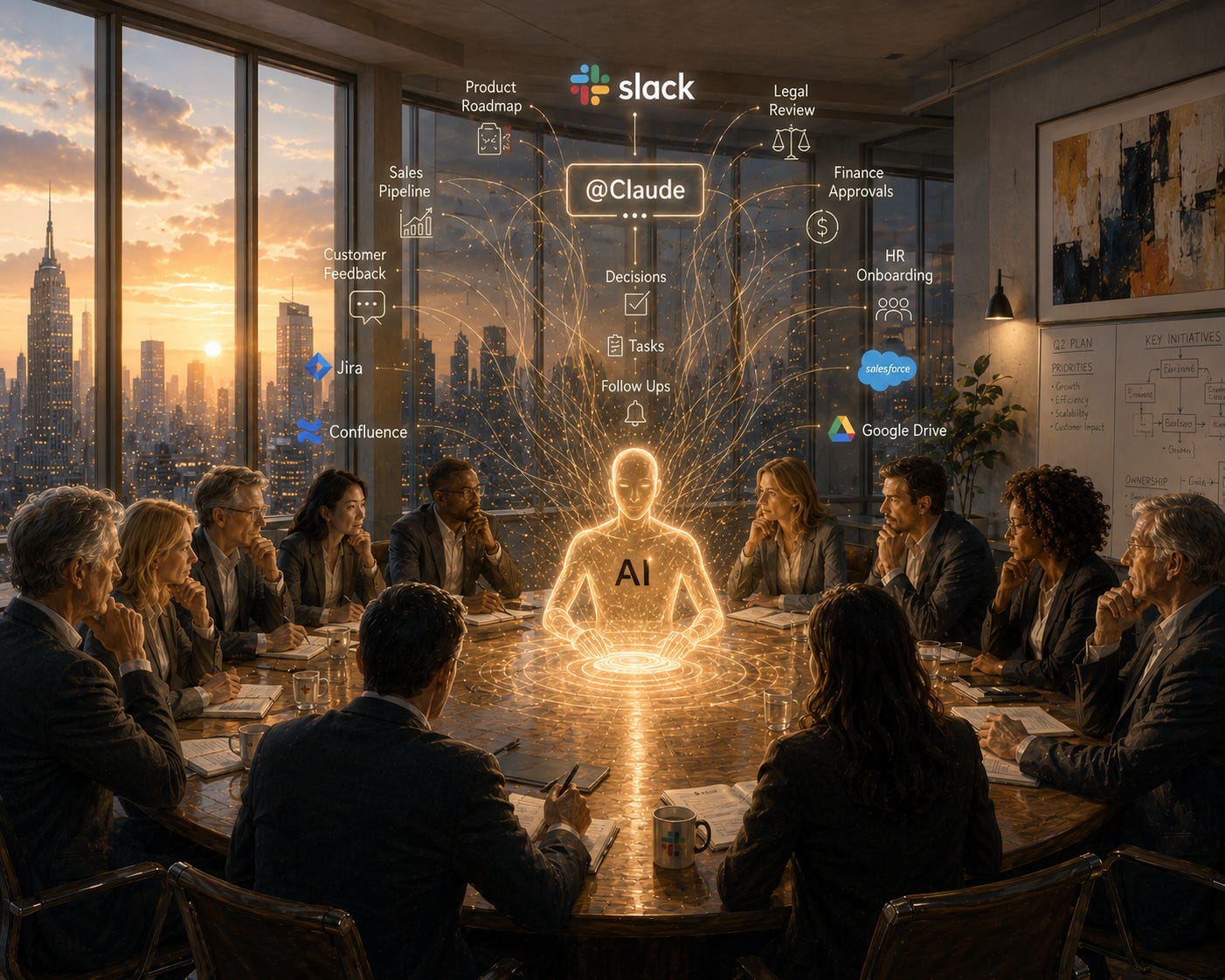
Yesterday, Anthropic pulled Claude into Slack, turning it from a destination into a participant. Claude Tag sits where multiplayer work happens, can be tagged like a colleague, retains relevant channel context, connects to approved tools and data sources, and can plan work for later completion.
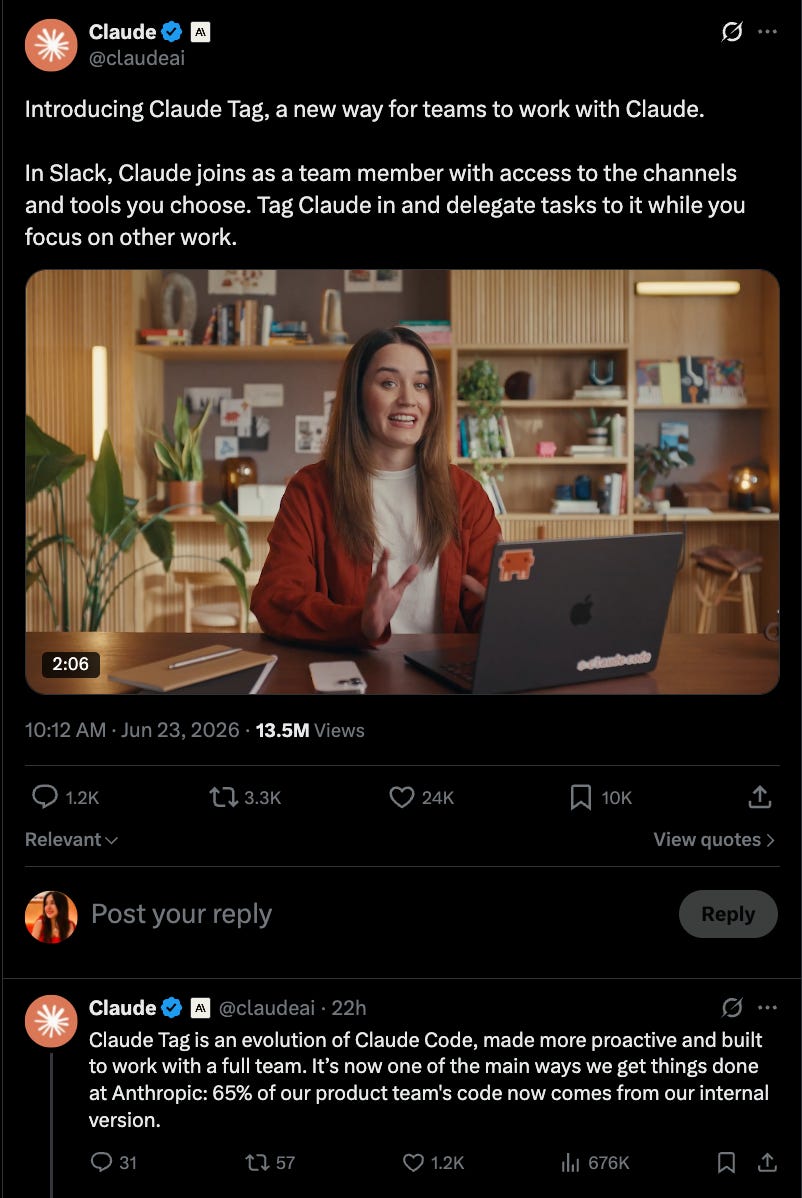
Andrej Karpathy called this the “third major redesign of LLM UI/UX”: from websites you visited, to apps you downloaded, to a “self-contained, persistent, asynchronous entity with org-wide tools and context, working alongside teams of humans”. The direction is clear: software is becoming labor.
Some thoughts:
Where matters more than what.
Slack already contains the messy, high-value substrate of work: decisions, exceptions, status updates, handoffs, and the implicit knowledge that rarely makes it into a system of record. Tag makes that stream usable as persistent working context. The model’s intelligence matters, but the more consequential asset is its position inside the flow of coordination.A channel-native agent can learn how a team actually operates over time: who owns what, which decisions were made but never documented, what “urgent” means in this org, which exceptions matter, and where the bodies are buried. That makes Claude not just a tool for retrieving knowledge, but a living index of institutional memory. That is much harder to rip out.
Familiar, but different.
Agents in Slack are not new. Plenty of startups let teams trigger agentic workflows from a channel. OpenAI has Slack integrations for Q&A, drafting, summaries, and retrieval. Some adventurous companies have even dropped OpenClaw-style agents into Slack and hoped for the best.
The difference is the bundle. Claude Tag combines channel membership, persistent shared context, explicit delegation through @claude and asynchronous task completion across connected tools.
The distinction will come down to depth of integration and span of control. Retrieval bots answer questions. Workflow bots trigger predefined automations. A channel-native agent can accept input from multiple people, iterate in public, work on its own timeline, use approved tools, and report back to the group. Closer to teammate than clever bot.
The unit of AI adoption shifts from user to channel.
Most copilots are private productivity tools. They help one person draft faster, summarize faster, code faster. Useful, but often trapped at the level of individual efficiency.
A channel-native agent can improve the shared process: summarize a debate, retrieve prior decisions, turn a request into a task plan, chase an owner, or surface a blocker to everyone who needs to see it. That is a more credible path to measurable enterprise ROI because it targets coordination overhead, not just drafting speed.
This points toward an AI employee budget.
The last two years were sold as “every knowledge worker gets a copilot.” Claude Tag points to a different procurement question: which recurring workflows can this agent own, and what systems is it allowed to touch?That moves pricing away from flat per-seat chatbot licenses and toward outcomes, throughput, managed workflows, or agent capacity. In other words, the buyer is funding a new kind of labor layer.
That is powerful. It is also a cost-control nightmare. A shared agent can be invoked by many people, work asynchronously, touch multiple systems, and generate cost while no one is actively “using” it. We are already seeing this movie in coding tools: usage-based pricing looks elegant until the meter starts running like a taxi in Manhattan traffic. Yes, enterprises can set token budgets but allocation and tracking for a shared agent will be trickier, especially once it is embedded into real workflows.Early productization of ambient agency.
The “@Claude” invocation makes delegation visible, preserves a shared audit trail, and gives colleagues a chance to correct the agent in public. It keeps the human organization in the loop while the machine organization learns where it is useful. The likely trajectory is from explicit invocation to proactive monitoring and eventually scoped autonomy.New Failure Modes.
A persistent agent inside workplace communication can misread a thread, expose context to the wrong audience, or turn informal conversation into operational action. Control will be key.
A lot of workflow software was built to help humans navigate complexity: find the right record, update the right field, route the request, trigger the approval, chase the owner. If an agent can navigate that complexity on their behalf, the interface layer gets compressed.
The user does not need to know which system to open, which field to update, or which workflow to trigger. They describe the desired outcome in the place where the work is already being discussed. The agent becomes the connective tissue.
The market will converge on this shape quickly. The more consequential competition will be over who owns the work graph: the collaboration suite, the system-of-record vendor, the enterprise search layer, or the frontier model provider.
Wow! That’s a big news. Slack and Salesforce tried to push CRM processes and workflows into Slack for the last four years.
This one is a game changer and what a smart move to re-enforce Anthropic’s presence in Enterprise and MM.
If I were still at Salesforce, I’d advocate to build plug&play “CRM skills” that Claude tags can execute (assuming it’s extensible).
Then Slack becomes the OS for Salesforce customers and possibly non Salespeople customers (figure out your pricing Salesforce to win that one).
Knock knock, Microsoft Teams, anyone there?