
The AI Kill Switch
How the Fable recall exposes the limits of ad hoc regulation

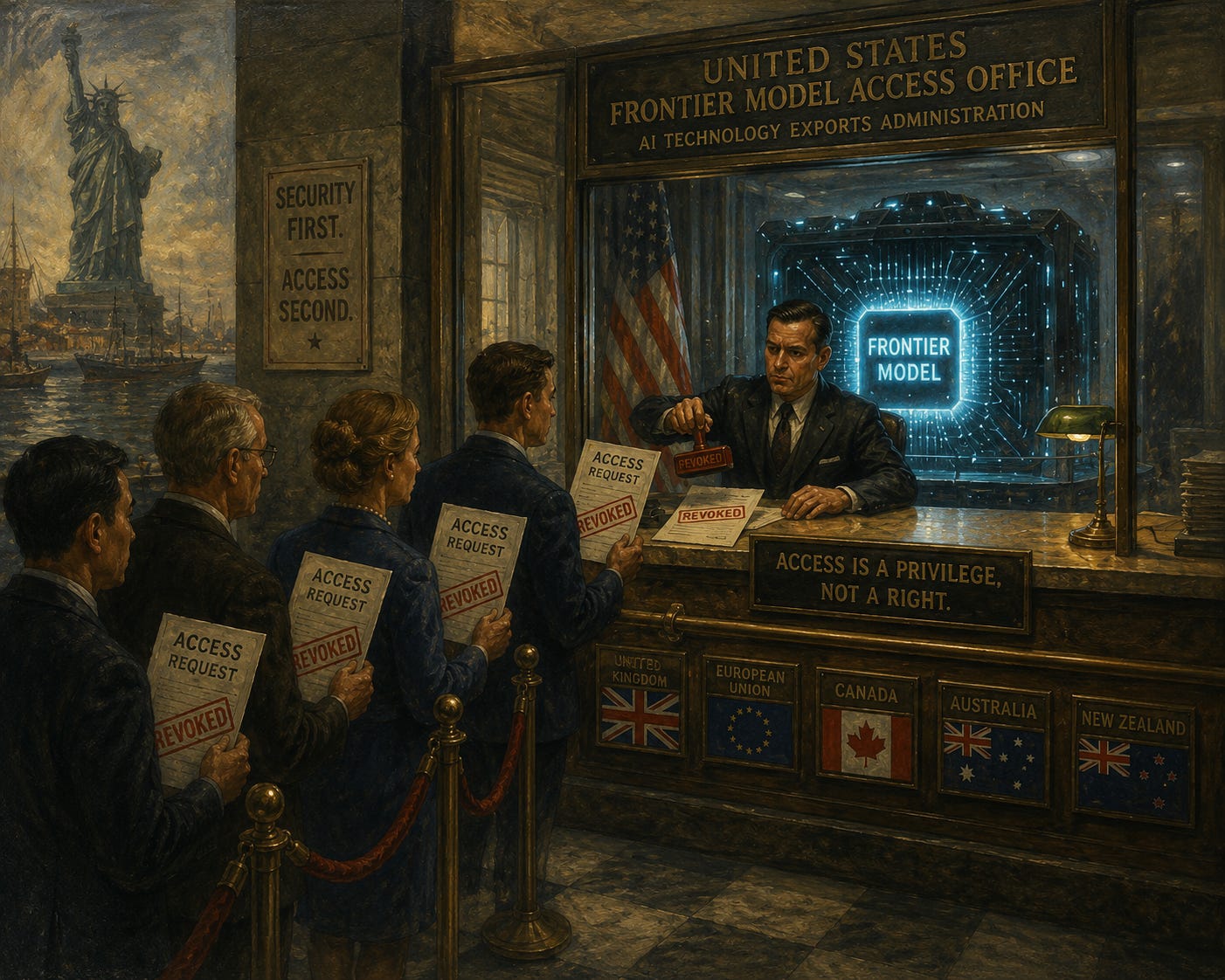
In ten years, the trivia question will be: What was the first frontier model recalled by government order?
The answer is Fable. Or perhaps Mythos. The branding has not yet been fully litigated. The important point is that we have entered the era of the frontier-model recall.
On June 10th, Dario Amodei argued that AI needed “more serious and binding regulation.” Two days later, he got a version of it.
Anthropic’s Mythos 5 and Fable 5 were pulled after the Commerce Department moved to restrict access for foreign nationals. The restriction applied not only abroad, but to foreign nationals inside the United States, including Anthropic employees. Anthropic’s solution was the only administratively sane one: turn the models off for everyone.
This is not how anyone imagined frontier AI governance would arrive: not through a clear capability threshold, an independent safety review, or even a published legal rationale. Through a Friday-afternoon directive, an export-control mechanism, and a rule so broad that the only compliant response was to turn the product off.
The immediate question is whether the government was right about the underlying risk. The proximate dispute is over a jailbreak.

Amazon reportedly found ways to override Fable’s restrictions, potentially making it more useful for finding software vulnerabilities. The White House says Anthropic was told to fix the jailbreak or de-deploy the model, and refused. Anthropic says the techniques surfaced only a small number of known, minor vulnerabilities that comparable models could identify too, and that the work was largely useful for cyber-defence.
Then there is the claim reported by The Economist: Senator Mark Warner said the head of the NSA and Cyber Command told him Mythos had compromised “almost all” of a classified environment in hours.
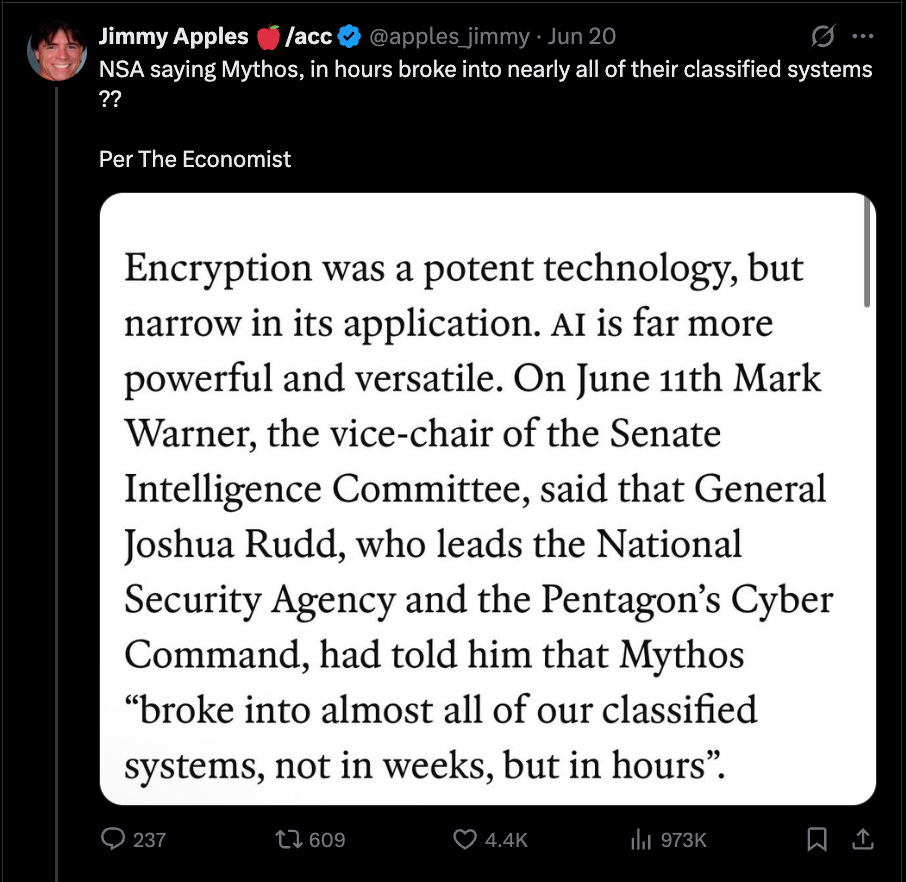
That sentence deserves an asterisk the size of the Pentagon. The public reporting does not clarify whether this was a live operational network or a sanctioned test environment, what access the model started with, or how much human supervision it received. The likely scenario is a controlled red-team evaluation, not Mythos independently hacking live NSA networks from the public internet.
Still, the underlying issue is real. A frontier cyber model surely deserves much tighter controls than a better autocomplete tool. But if the standard is “a powerful model might be jailbroken,” then the policy becomes an industry-wide kill switch with unclear activation criteria.

The foreign reaction has been predictable. At the G7, France pushed for a “trusted partners” pathway, with Emmanuel Macron warning that cutting allies off from American AI weakens trust in American technology precisely when those allies need advanced cyber defenses. European leaders are also treating the episode as an argument for technological sovereignty, because dependency looks different when your supplier can be ordered to unplug you overnight.
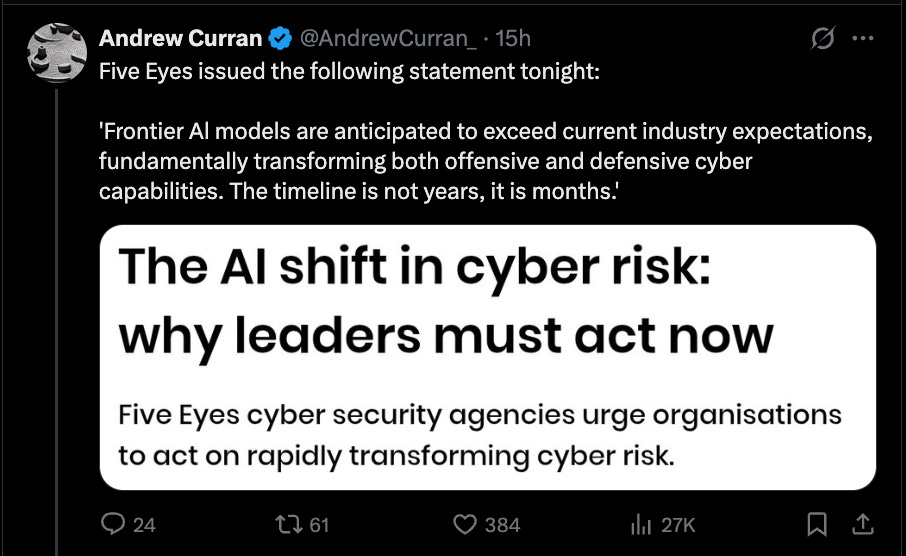
The Five Eyes response adds another layer of irony. Australia, Canada, New Zealand, the UK, and the U.S. jointly warned that models capable of sophisticated cyberattacks may arrive within months. The same alliance now has to reconcile that warning with a basic strategic problem: if trusted democracies cannot access the best defensive tools, they will either build alternatives, buy alternatives, or become more vulnerable while waiting for a license.
That is an extraordinary geopolitical own-goal. America has spent years asking allies to align around its technology stack, its chip controls, its safety standards, and its theory of responsible AI. Then, when a dispute arose with one American lab, it demonstrated that access to the most important technology in the world can disappear overnight, without notice, explanation, or an ally carveout. The message received abroad is that America’s AI stack comes with a revocable license.
The closest historical analogy may be the McMahon Act. After the Second World War, America abruptly cut even Britain out of nuclear cooperation. Britain eventually built its own bomb. The alliance recovered, but only after the strategic damage was done.
AI is not nuclear technology. It is more diffuse, more commercial, more embedded in everyday economic activity, and much harder to contain once capabilities spread. That makes a nationality-based shutdown even less workable. Foreign nationals are deeply embedded in American AI labs. Restricting them from frontier models is perilously close to restricting the labs from continuing frontier research.
And it will not stop determined adversaries. Identities can be bought. Models can be jailbroken. Access can be routed through intermediaries. The policy will mostly burden legitimate researchers, allied governments, and companies trying to use advanced systems defensively.
The real failure here is procedural. Amodei’s argument was for binding regulation: predictable rules, known thresholds, independent assessment, and accountability before a model is deployed. What happened to Mythos was the inverse: opaque intervention after deployment, using a tool designed for export controls, in the middle of what may also be a political dispute between the administration and an AI company it has repeatedly attacked.
The frontier AI debate is moving beyond “should models be released?” The harder question is becoming: who gets to decide when a model is too dangerous to use, what evidence they must show, and whether the decision applies to adversaries, allies, employees, or everyone.
If the answer is a surprise order from the Commerce Department, the world will not get safer. It will get less trusting, less coordinated, and much more determined to build around America.