


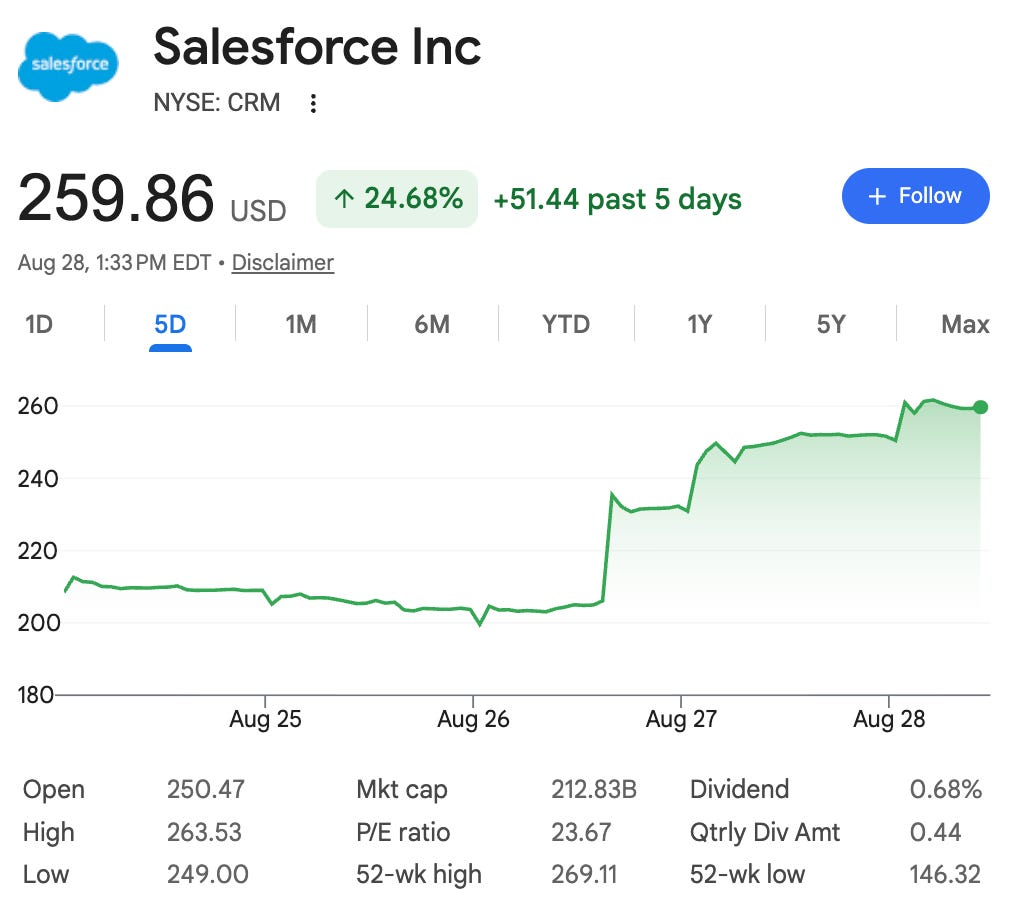
SaaS is back - and how. After spending most of the year in the market’s doghouse - remember the SaaSpocalypse? - software has suddenly found religion again. ServiceNow is up ~12% over the last five days. Salesforce is up ~25%. SaaS multiples broadly have bounced well off the lows they hit just three months ago.
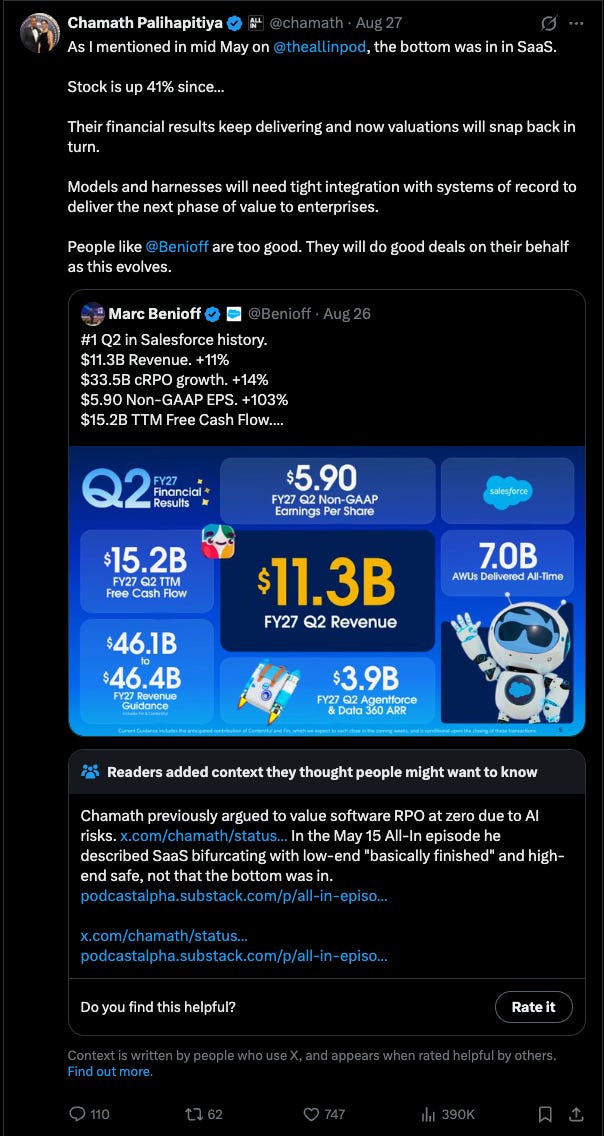
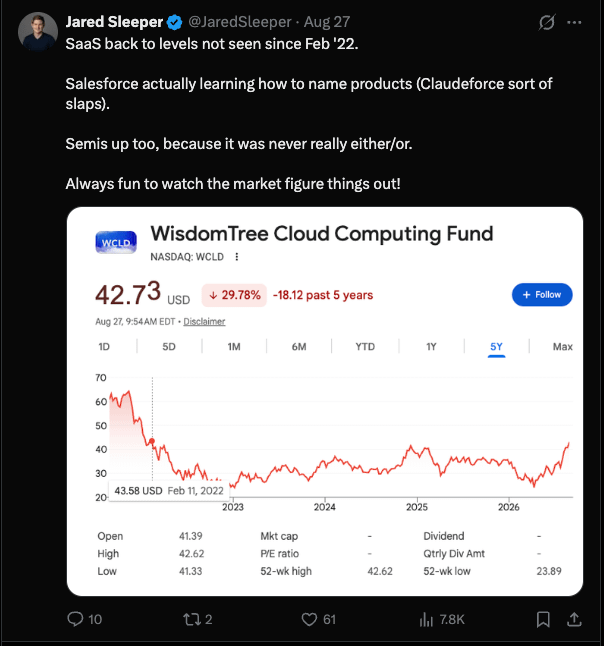
One catalyst for this week’s resurrection was a strategically fascinating move from Salesforce: it put Salesforce inside Claude. The announcement is the logical extension of Salesforce’s headless strategy, which it unveiled earlier this year. The basic idea is simple, but fairly radical: Salesforce is unbundling its system of record from its user interface. Or, in Marc Benioff’s more memorable formulation: “The UI is the AI.”

Salesforce in Claude, named Claudeforce, launches with 37 pre-built sales skills spanning pipeline reviews, meeting prep, account analysis and deal health. Claude can reason across live Salesforce data, Slack and other connected context, then actually do things - update opportunities, create campaigns, execute workflows - while Salesforce continues to enforce the permissions, business logic and governance underneath.
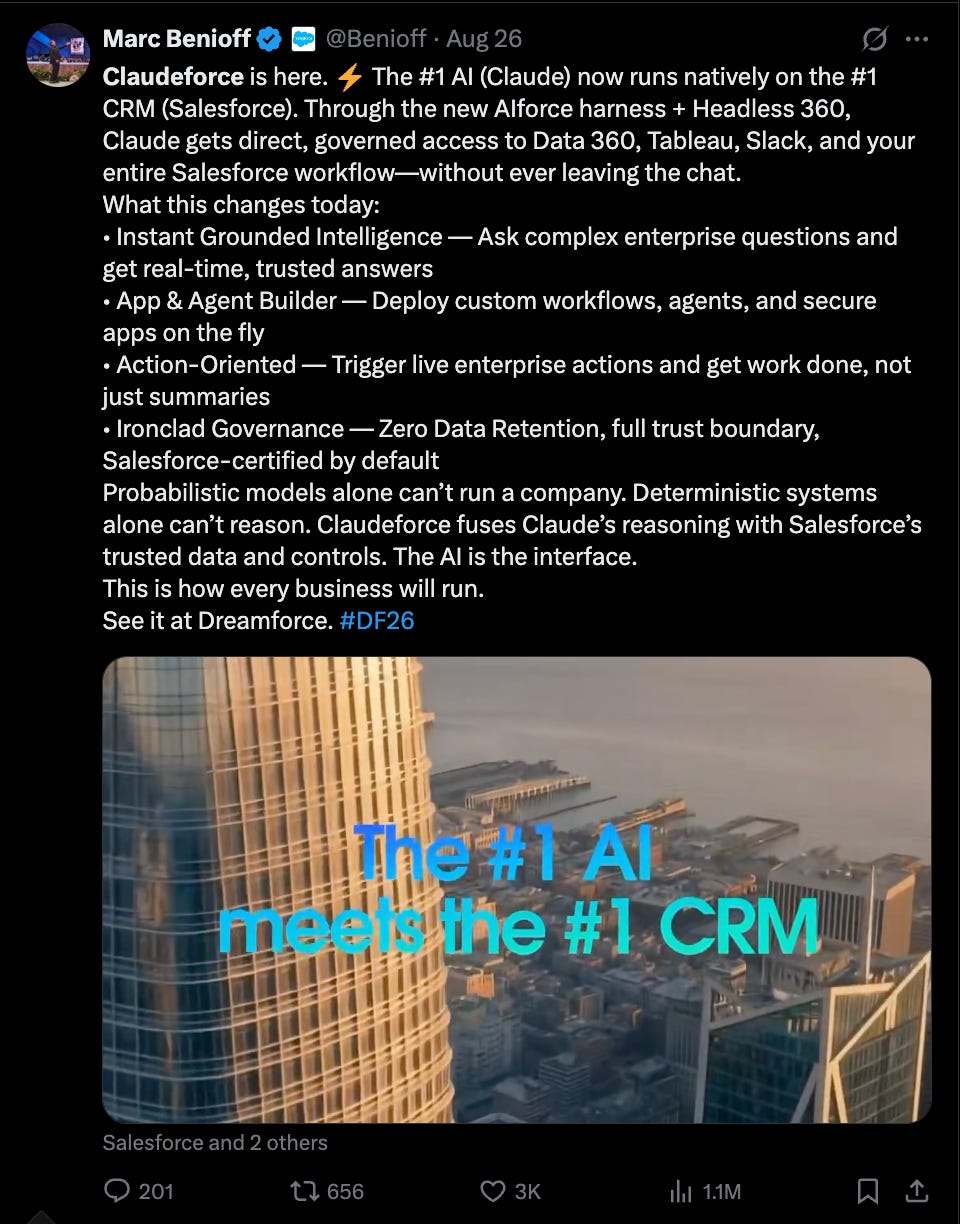
The plumbing underneath is Salesforce’s new Headless 360 / AIforce architecture: Salesforce exposes its data, metadata, workflows and actions to agents through MCP, APIs and other programmatic interfaces.
Salesforce is trying to turn MCP into its next API moment. The original Salesforce platform became powerful because third-party applications could build on Salesforce through APIs. Headless 360 is an attempt to replay that trick for agents: make every Salesforce object, workflow and action discoverable through MCP, while retaining Salesforce governance underneath. Salesforce explicitly compares Headless 360 to the web API it pioneered 27 years ago.
So far, Salesforce’s business model looked like:
Own the data → own the application → own the UI → sell the seat.
It is now moving towards:
Own the data + semantics + permissions + actions → let somebody else own the UI → monetize the work.
That is a very different company. And Wall Street, at least this week, liked this idea. Salesforce shares rose 22.6% Thursday, their best day in six years.
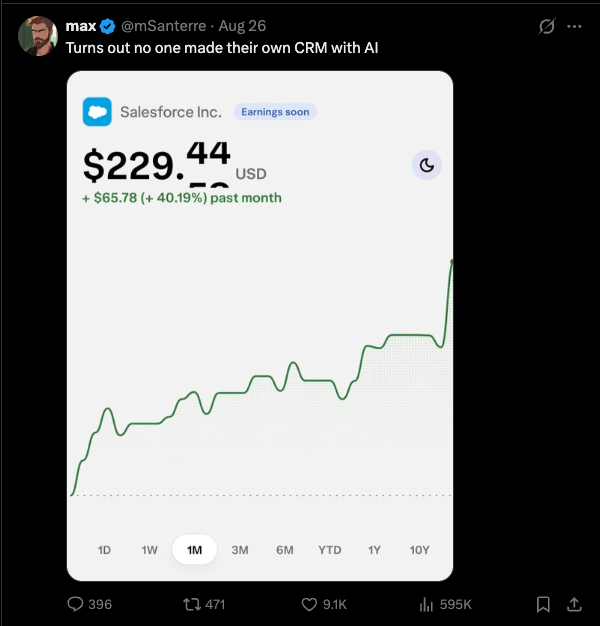
To be clear, Claudeforce did not single-handedly produce that move. Salesforce also delivered a strong quarter: cRPO grew 14%, net-new annual order value growth was the strongest in four years, Agentforce + Data 360 ARR approached $3.9B, Agentforce ARR exceeded $1.5B, and management raised FY27 revenue guidance.
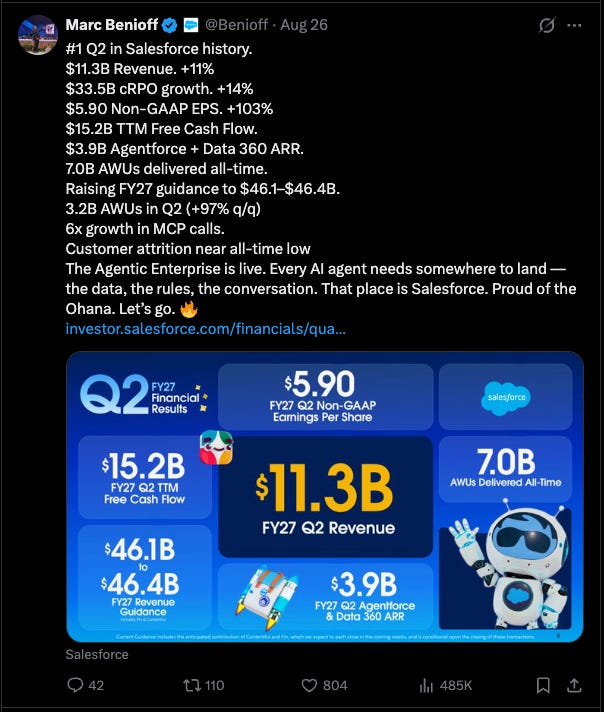
There was also some accounting confetti: Salesforce’s Anthropic investment produced roughly $2.7B of unrealized gains, contributing $2.53 of its $5.90 in adjusted EPS. But the magnitude of the rally felt bigger than an earnings beat. It looked like a narrative repricing.
Some thoughts:
1. The SaaS UI is becoming expendable, the system of record isn’t
The quick version of the “SaaSpocalypse” thesis is: agents can operate software, therefore agents will replace software. But AI that can reason is not the same thing as an enterprise system that knows:
who Acme Corp is,
what it bought,
who is allowed to change its contract,
how your company defines pipeline,
which discount requires VP approval,
and what actually happens when someone clicks “Close Won.”
Salesforce supplies institutional state + semantics + authorization + execution. In an agentic world, that may be an even more important moat than the UI. AI may commoditize the windshield while making the engine more valuable.
2. Salesforce is also giving Anthropic an enormous promotion
There is a fascinating power struggle hiding inside this partnership.
Salesforce wants to become the enterprise harness underneath every model. Claude to be the interface above every enterprise application. Those positions are complementary today. They may be competitive tomorrow.
If the employee starts every morning in Claude - not Salesforce, Workday, ServiceNow, Snowflake, Jira or ten browser tabs - Claude becomes the new aggregation layer for enterprise demand, an extremely valuable piece of real estate. Salesforce is betting that losing the interface is acceptable if it retains the authoritative data model and transaction layer underneath it.
Anthropic wants to own the employee. Salesforce wants to own the enterprise. Claudeforce is the handshake between them - and potentially the future battleground.
3. “Headless SaaS” could actually increase switching costs
At first glance, removing the UI sounds like commoditization. But imagine hundreds or thousands of internal agents continuously discovering and invoking Salesforce capabilities, with Salesforce objects, metadata and business rules embedded throughout machine-generated workflows.
Today, Salesforce switching costs come from customizations, integrations, reporting dependencies, and the sheer emotional toll of retraining 20,000 employees. Tomorrow, switching costs could come from unwinding millions of machine-to-machine dependencies on Salesforce semantics.
Those dependencies are less visible and potentially much harder to unwind. The irony: humans accessing Salesforce through Claude could make Salesforce more deeply embedded while making it less visible.
4. We may be recreating the browser/application relationship
An interesting historical analogy is the web browser. Browsers became the universal interface through which websites were consumed. Claude could become the enterprise equivalent: Salesforce, Workday and ServiceNow still exist, but Claude renders the relevant information and invokes their functionality on demand.
If that happens, the question becomes: who has the Google position and who has the HTTP-server position? Salesforce may remain economically enormous while Anthropic owns discovery, intent and user attention. That is exactly why today's partnership contains tomorrow's platform conflict.
5. Generative UI turns applications into latent capabilities
Salesforce describes Claude generating tailored dashboards based on the individual seller's accounts, pipeline and live enterprise context. That's more radical than conversational UI. Historically, Salesforce product managers decided which screens existed and engineers built them. Now the application can effectively be compiled at query time.
That means SaaS may move from “software vendor designs workflows for personas” toward “model synthesizes interfaces for moments.” If so, much of today's application-development labor - design systems, dashboards, navigation trees, reporting interfaces - gets compressed.
6. Agents could finally fix CRM's original sin.
CRM has always had one structural flaw: the database is only as good as humans’ willingness to update it. And salespeople, quite reasonably, prefer selling to maintaining a beautifully normalized database for their VP of Sales.
Agents change that. They can observe meetings, email, Slack and documents and continuously reconcile that activity back into Salesforce. That creates a fascinating flywheel: better agents → more complete CRM → better context → better agents. AI may therefore improve the underlying Salesforce dataset precisely because users spend less time manually using Salesforce.
We spent the first era of SaaS putting every business process behind a graphical interface. We may spend the next era taking the interfaces back off as applications become headless infrastructure for intelligence.
The irony of Claudeforce is that Salesforce may preserve its relevance by making Salesforce itself increasingly invisible.
The control plane, sized by the filings: Q2 revenue $11.3B, up 11% Y/Y, with Agentforce Apps at $7.2B - 63% of revenue. Net income $3.5B includes the quarter's gains on strategic investments. From the 10-Q.
I'm a big fan of your newsletter. Thank you for sending this one over. As an investor in Anthropic, SFDC benefits from the boost in its investments and the buzz around Claude. However, EPS without the Anthropic bump was in line with expectations. I wonder if this SFDC love will continue. Maybe it will.