
The Empire Strikes Stack
Build 2026 showed Microsoft’s real ambition: turn every layer of enterprise AI, from devices to data to agents, into a Microsoft-shaped market.

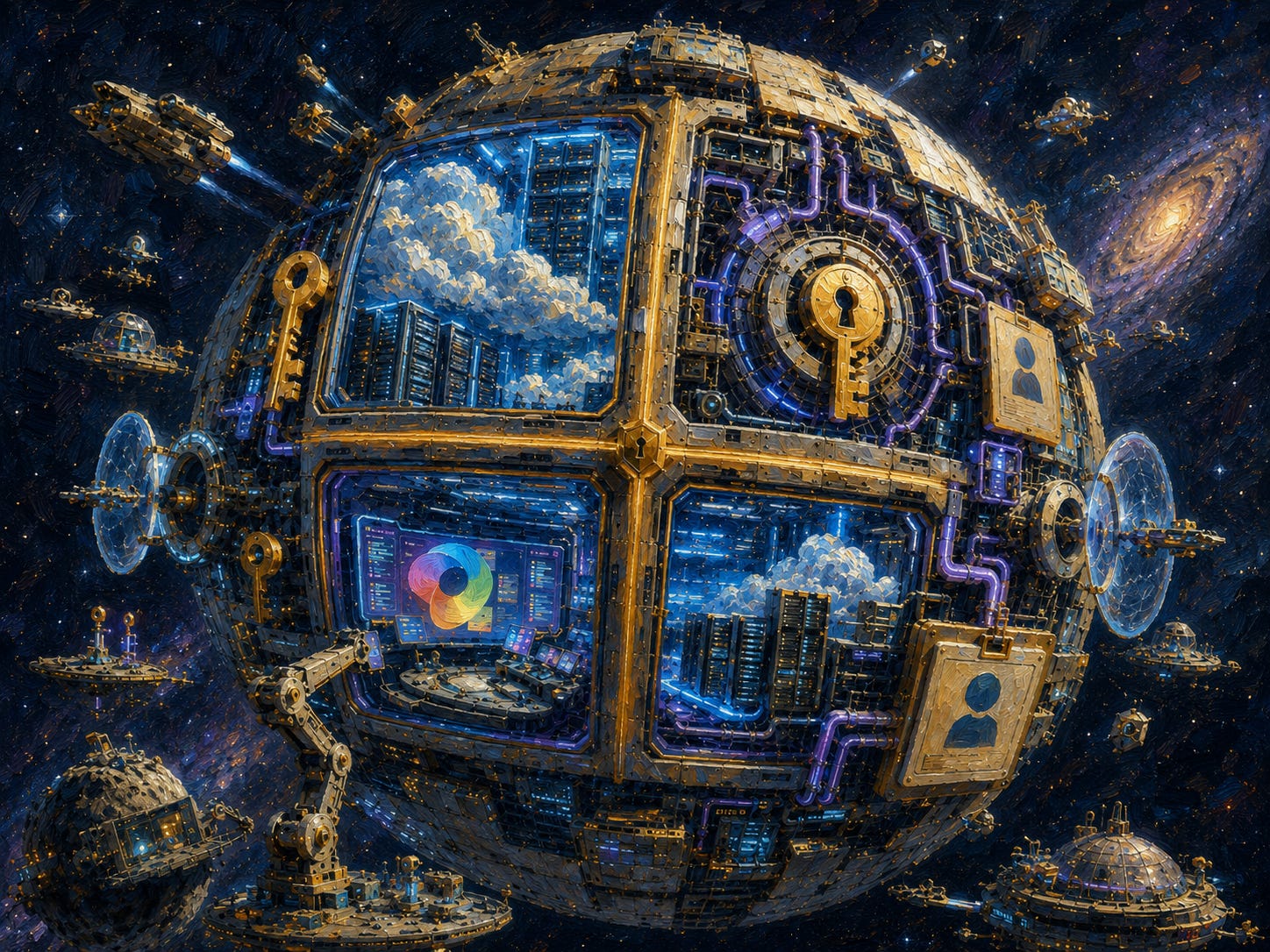
Microsoft stock is hard to read because the market is not really pricing a company; it is pricing a rotating set of AI anxieties. Dependence on OpenAI. Azure capex. Copilot ROI. Every week, one anxiety gets promoted to consensus.
The stock has become a referendum on whichever AI narrative the market woke up believing. Some days Microsoft is the obvious winner of enterprise AI; other days it is a very expensive bundle of AI-washed legacy software.
The stock will do what stocks do. The strategy is the more interesting read.
For the last three years, Microsoft’s AI strategy has looked almost unfairly simple: attach to OpenAI’s frontier momentum, pour that intelligence through Azure, package it as Copilot, and distribute it through the most valuable enterprise software estate on earth.
It was a brilliant trade. Microsoft got speed, narrative, and product gravity. OpenAI got capital, compute, and enterprise legitimacy.
But the market has moved. The first phase of enterprise AI was about access to intelligence. This phase is about control. Control over context, cost, deployment, and data.
Build 2026 was Microsoft’s answer to that shift. The company is trying to move from being “the best distributor of someone else’s intelligence” to the operating fabric for enterprise AI. That is the through-line across the announcements:
Windows transitions from operating system to AI runtime. Microsoft announced new Aion on-device models, broader Windows AI APIs, and the Surface RTX Spark Dev Box for developers building local AI applications. The next wave of AI apps will need to decide, task by task, what should run locally versus in the cloud. Local inference can be faster, cheaper, more private, and available offline; cloud inference can handle heavier reasoning and larger models. Microsoft wants Windows to broker that split.
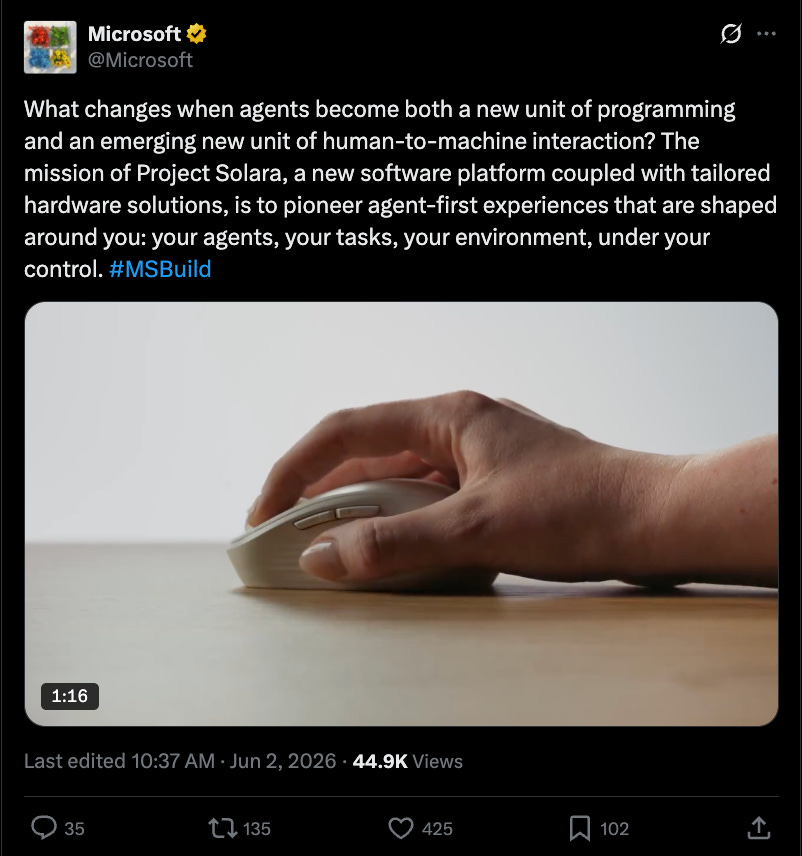
The move is classic Microsoft: give developers the APIs, give enterprises the management and security layer, give hardware partners a reason to build AI PCs, and make Windows the default deployment surface for everyday intelligence. Think DirectX for AI - a standard layer developers can build against while Microsoft makes the PC relevant again.Project Solara bets that agents will need new devices. Microsoft demoed Solara as an Android-based platform for agent-first hardware. They showed a desk device that looks like an enterprise Echo Show and unlocks with facial recognition, and a badge-style wearable with a camera and fingerprint scanner that can capture and transcribe conversations.
These are reference designs, not products Microsoft is trying to sell directly - which is the point. Microsoft is trying to define the operating layer for a new class of AI endpoints: ambient desk agents, frontline worker badges, retail/healthcare/service devices, and other lightweight form factors where the interface is less “open app, type thing” and more “recognize me, understand the situation, capture context, and help complete the task.” The point is to seed an ecosystem: Microsoft provides the OS/platform, identity/security/management layer, and agent framework; hardware partners can build the actual devices.The PC was built around files. The phone was built around apps. Agent-native devices may be built around delegation, ambient context, and interruption management. Microsoft’s bet is that if this new hardware category exists, it should come with Microsoft identity, Microsoft security, Microsoft management, Microsoft agents, and Microsoft enterprise defaults. Very shocking behavior from Microsoft.
IQ builds enterprise context. By bringing together Foundry, Fabric, and Microsoft 365, Microsoft is creating a unified intelligence layer that continuously understands the organization: its people, data, documents, workflows, meetings, permissions, systems, and institutional residue. Every AI company wants better context. Microsoft already sits on the motherlode: email, calendar, Teams, Office docs, identity, security policies, databases, workflows, and every “final_final_v6_ACTUAL” deck ever produced by modern knowledge work. IQ is the move from storing organizational data to operationalizing organizational context.
Web IQ extends that context beyond the company’s four walls. Enterprise agents cannot just reason over internal data; they need current external information too. Web IQ is Microsoft’s attempt to provide fast, high-quality, efficient web grounding for agents. They want to own not just the corporate memory layer, but the retrieval and grounding layer that makes agents trustworthy enough to use in production.
From Copilot to Autopilot. These are autonomous, long-running agents with enterprise-grade compliance - effectively agents designed to persist, monitor, and complete work across systems while staying inside the corporate control plane. That last part is the whole ballgame. The hard part is not getting an agent to take an action. The hard part is making agents act inside a company, with permissions, audit logs, approvals, rollback, cost controls, and a full appreciation for the sacred enterprise distinction between “technically possible” and “please route this through legal.”
This is why Microsoft has an advantage. Enterprise AI does not only need intelligence. It needs governed intelligence.Model Layer Foray. Microsoft does not want to be perceived as merely the world’s most successful OpenAI distribution partner, however lucrative that has been. They need control over the intelligence supply chain.
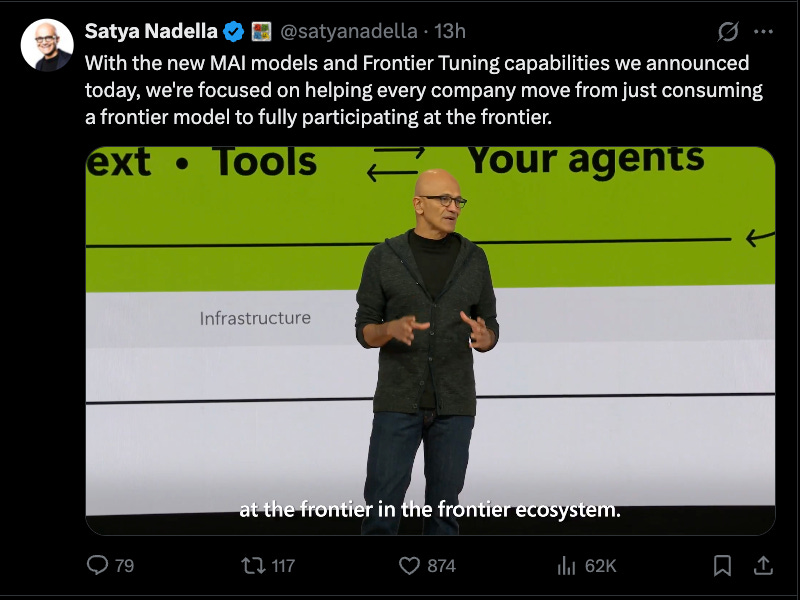
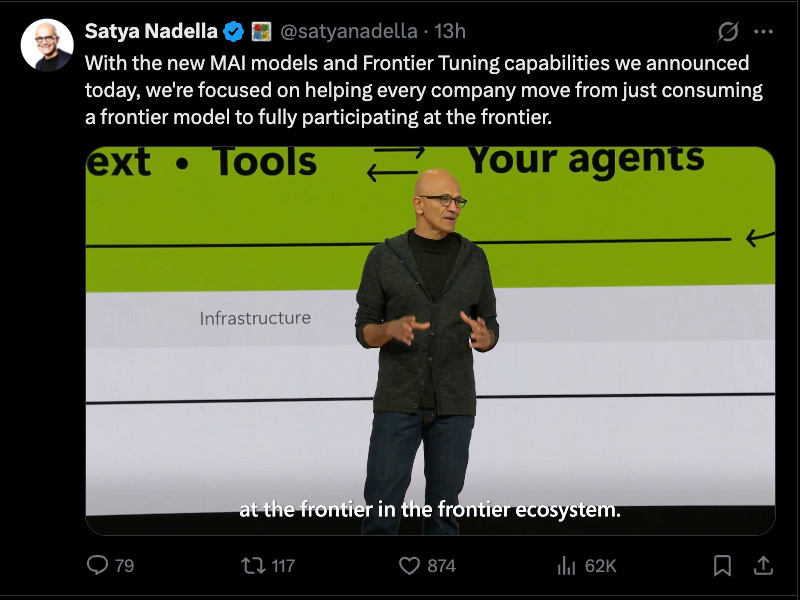
The future is not one model to rule them all. It is routing: a frontier model for hard reasoning, a smaller model for cheap repetitive tasks, a local model for private or latency-sensitive work, a tuned model for domain-specific workflows. With 7 new MAI models and tools to tune frontier capabilities, Microsoft is building optionality.Frontier Tuning. Generic intelligence is impressive, but differentiated intelligence comes from proprietary context and operational integration. Microsoft is giving companies a path from renting frontier capability to shaping it around their own business systems.
Majorana 2, the long-dated platform option. Majorana 1 proved the physics behind its topological quantum approach; Majorana 2 is about moving from lab proof point to engineering at scale. The appropriate reaction is neither “quantum is here” nor “nice sci-fi slide.” It is: Microsoft is taking its most contrarian research bet and trying to turn it into a manufacturable platform. Not relevant to Copilot ROI this quarter; very relevant if quantum ever becomes an actual computing layer rather than a recurring keynote seasoning.
The stock can continue being mysterious. The strategy is not. Microsoft is trying to become the enterprise AI control plane, which is a very boring phrase for a very lucrative ambition.
If only MSFT can pull it off. A big IF.
A beautifully written indepth article. Keeping bill gates and Microsofts history in mind. It was never the most innovative company, but it was always the best in "busines" Microsoft is boring, but that's its asset, it knows where the money comes from and it becomes the most important ecosystem for every innovation deployment and it knows corporations will remain it's most important customer base because they are the wealthiest customers to have.