
Weekly Wrap Sheet (06/19/2026): The Stack and the Staff
Microsoft builds platforms, Meta breaks morale

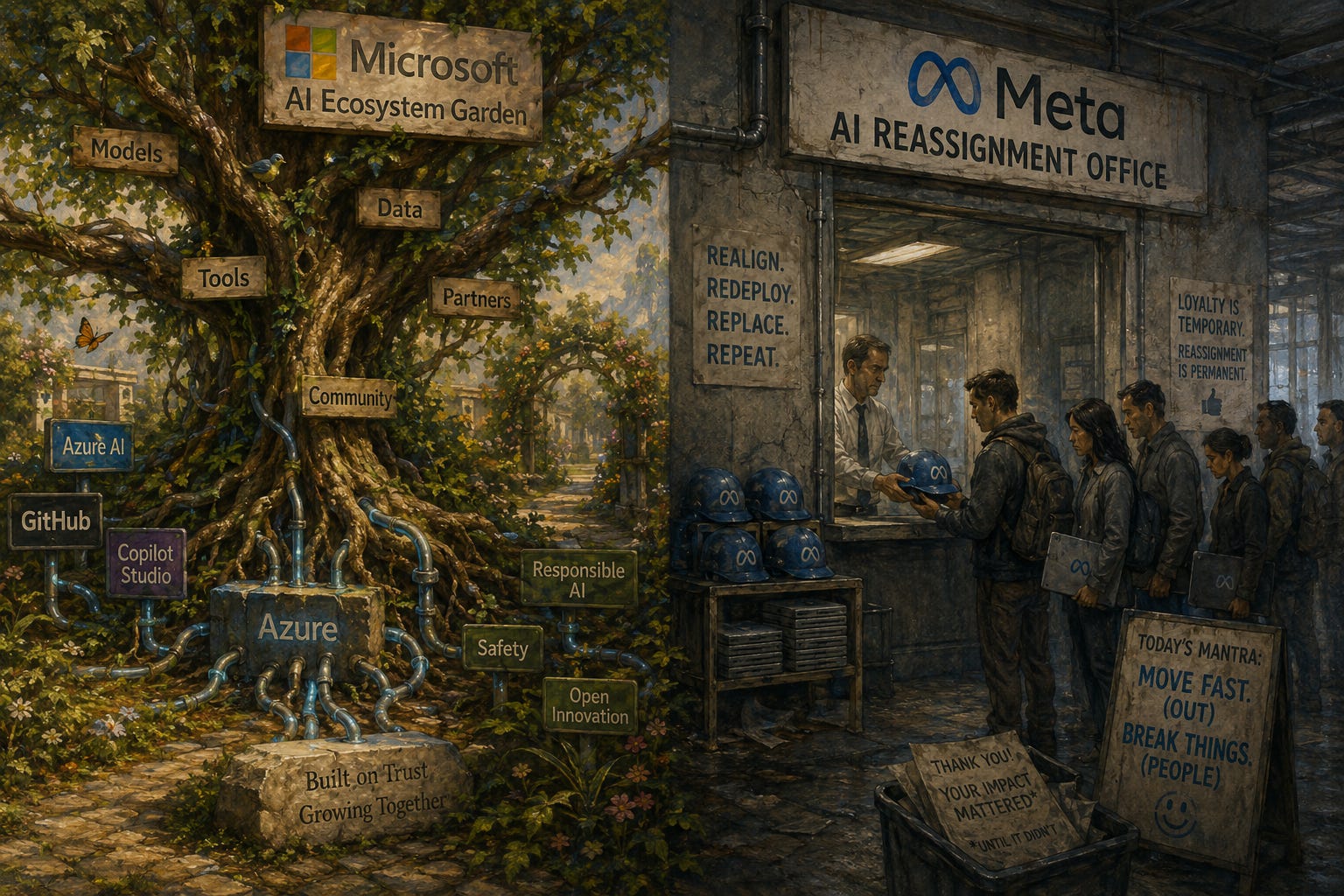
🎮 TL;DR
Microsoft makes the case that AI’s real value lives around the model, not inside it. Satya’s argument reframes the enterprise opportunity away from frontier model worship and toward the messy, lucrative harness around the model: data, permissions, memory, workflow, trust.
Meta is offering the first great cautionary tale of brute-force AI transformation. The company wants employees to think like founders while treating them like furniture. That may move boxes on an org chart, but it does not create belief, trust, or the kind of talent density AI transitions actually require.
🏗️ Microsoft Builds the Car Around the Engine
Satya Nadella published an AI manifesto arguing that “a frontier without an ecosystem is not stable.”
This is, among other things, an excellent sentence for the CEO of Microsoft to say. Microsoft is the ecosystem business. It owns the place where employees work, developers build, data sits, permissions live, and, increasingly, where agents do agent things. Of course Microsoft believes in ecosystems.
The interesting part is that Satya is probably right.
So far, AI strategy has had a frontier-maximalist flavor. Who has the best model? Who has the highest benchmark score? This is a fun way to run a research lab but a stressful way to run a company. If you are an enterprise, your AI strategy cannot be: “We hope the smartest lab continues to like us, price us reasonably, pass its safety evals, avoid regulatory trouble, and not revoke access to the model we built our workflow around.” That is a hostage situation.
Satya gives enterprises a more pleasant story to tell themselves: you are not powerless. You have the data, workflows, permissions, business logic, distribution, and institutional scar tissue that turns clever demos into something a bank, hospital, retailer, or insurer can run.
The frontier model may be smarter than your company, but it does not know your company. That gap is where the $$ is.
This is also where Microsoft’s argument becomes very Microsoft. The value, in this telling, migrates from the model to the harness around the model: memory, permissions, data, etc etc - things Microsoft already sells, bundles, secures, bills, and calls a platform.
The strategic elegance of the argument is that Microsoft does not have to say frontier models are commoditizing. That would be rude, especially given its OpenAI relationship. It simply says frontier models are unstable without ecosystems, a much nicer way of saying: the engine matters, sure, but you need to build the car around it to actually go places.
This is especially timely because the pure frontier bet is beginning to look expensive and brittle. Costs are spiraling. Pricing is a moving target. And if Fable 5 can be yanked out of customers’ hands overnight, the lesson is that dependency on any single provider is an architectural risk.
There is also a political argument hiding here. Satya warns that there is no societal permission for an AI future that hollows out entire industries. Such a world would be economically concentrated, politically fragile, operationally brittle, and socially hard to legitimate.
An ecosystem softens that threat. It spreads power around. It lets enterprises participate in the future rather than be colonized by it. It gives regulators more seams to grab. It gives customers more exit options. And, conveniently, it gives Microsoft the role it has always wanted: the control plane through which the frontier enters.
📉 Move Fast and Break Morale
Meta has given us the first great case study in how not to do an AI transformation. Over the last few months, the company has taken a butcher’s knife to what was once regarded as one of the strongest engineering cultures in tech.
It cut 10% of the workforce, created a new Applied AI org that many employees did not choose to join, and forcefully moved thousands into AI-related roles. Some workers described themselves as “draftees.” Others called the work “soul-crushing.” The smartest people I know at Meta are either gone, recently laid off, or still there with one foot out the door.
Andrew Bosworth has now admitted the rollout was “atrocious,” and Mark Zuckerberg acknowledged the company made mistakes. Employees are pushing back on the nature of the work, the lack of choice, the surveillance concerns, the loss of autonomy, and the feeling that the company was asking for extraordinary commitment while communicating that everyone was increasingly replaceable. That is a hard circle to square.
The mistake was not that Meta moved aggressively. In AI, speed matters. The mistake was assuming that speed required making employees feel disposable, disoriented, and conscripted.
AI adoption is not just a resource-allocation problem, it is also a collective-action problem. Every company in the world is trying to move people toward AI. The question is whether employees feel like they are being invited into the future or dragged into it.
You cannot lay people off, reassign thousands more into work they did not sign up for, stretch managers across absurd spans of control, monitor employee activity for training data, and then solve the resulting morale problem with snacks, offsites, and a hackathon. That is corporate Febreze.
One of the stranger management mistakes of the AI era is assuming that it makes people less important. If anything, the opposite is true.
When technology is stable, process matters. When technology is changing, talent matters.
In tech, the ability to attract and retain the best people has always been a leading indicator of company performance. You could have predicted that OpenAI and Anthropic would matter because great people wanted to work there. The entire AI industry is a case study in talent concentration.
Meta seems to have missed the lesson hiding in plain sight.
A mature company can often survive mediocre culture because the machine already knows what to do. An AI transition is different. There is no machine yet. The company needs its best people to invent one, but is instead giving them every reason to leave before it exists. It is asking them to think like founders while treating them like furniture. That is a difficult strategy.
The winning move is not to aggressively “AI-ify” the workforce through brute force, but rather to handle the human layer of AI adoption with care. You cannot automate trust, purpose, or belief. At least not yet.