

🎬 TL;DR
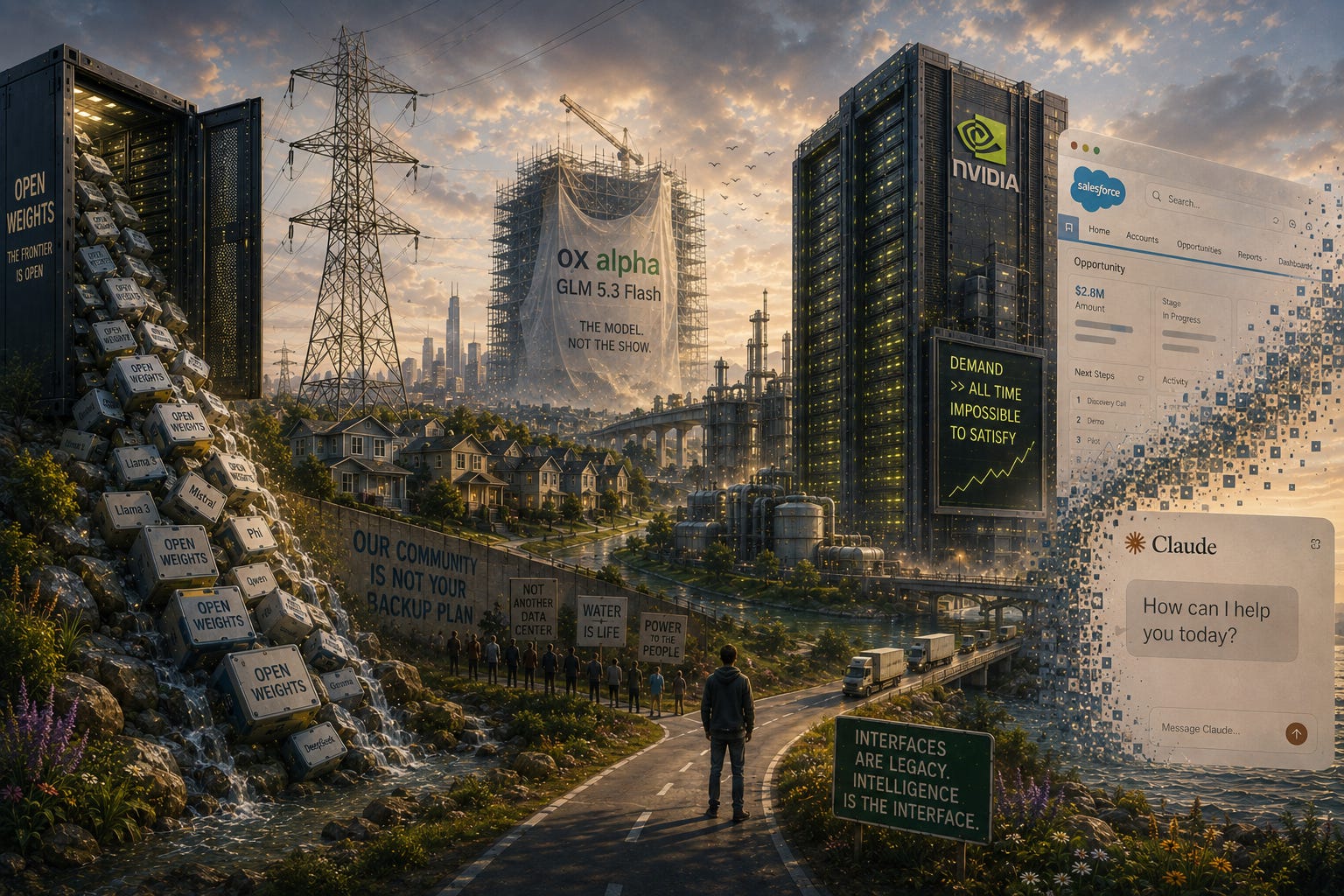
Open models are finally taking real share and frontier labs are still growing anyway. The market is expanding fast enough for both to be true.
The data center backlash is less anti-AI than anti-bad-deal. AI infra creates diffuse global benefits and painfully local costs. Communities need a better bargain.
By launching Ox Alpha anonymously, Z ai forced developers to judge the product before judging the passport. The result was part viral marketing stunt, part warning against underestimating China.
Nvidia is nearing a $100B quarter and still can’t build fast enough. The company is capturing more revenue from every gigawatt, while memory, power and supply chains become the constraint. At this scale, physics is starting to look like the competition.
Salesforce is proving that SaaS can lose the interface without losing the economics. If Claude becomes the front door while Salesforce remains the system of record, software gets less visible - and potentially much harder to replace.
🚪 Open Source Sneaks In Sideways
Thus far, the open-weight bull case has been a combination of anecdotes and arithmetic. Builders say they are using more open models. The economics suggest they should. Now we are finally beginning to see it in the numbers.
Over the weekend, Vercel CEO Guillermo Rauch shared a striking datapoint from the company’s AI Gateway: on Aug 22, open-weight models accounted for a record 62% of token volume, up from 28% two months earlier.
Importantly, none of this means OpenAI and Anthropic are shrinking. Quite the opposite. OpenAI generated $6.7B of revenue in Q2, +18% QoQ while Anthropic generated $11.6B, +142% QoQ, surpassing OpenAI's quarterly revenue for the first time.
The turf war between the two is unlikely to abate anytime soon. They remain locked in a wonderfully petty version of mutually assured innovation. Sam and Dario periodically rebut each other’s worldview in public. Customers receive better models as collateral damage. Long may this rivalry continue.
Regardless of who has the lead between them, both companies are continuing to grow very well even as open models increase share. How? Because the denominator is exploding. If the AI market triples and your market share falls by a third, congratulations: your business doubled. The whole pie is expanding so rapidly that even a declining slice of it shows very strong growth.
Also, token share understates the economic position of frontier labs because they disproportionately serve the most valuable tokens. Acc to Vercel data, in June, open-weight models accounted for 29% of tokens but <4% of spend. So the market is beginning to bifurcate in a fairly intuitive way - frontier for the best and open for the rest. Think airline economics: most passengers fly economy but most of the profits sit at the front of the plane.
The most misunderstood part of the open-source transition is where adoption will show up first. Enterprise leaders ask me some version of: “If open source is taking off, why don’t I see companies around me deploying open models everywhere?”
Because most enterprises probably won’t adopt them directly. Running an open model gives you weights and an endpoint. It does not give you Claude Code, Codex, Cowork, or a polished workflow. Exploiting open models well requires technical talent, infra, evals, routing and domain-specific post-training.
So the first big beneficiaries will be application companies. They can take an open model, post-train it for a narrow domain, and deliver comparable performance at dramatically better unit economics.
The adoption wave will not look like Fortune 500 CIOs announcing that they have standardized on Kimi. It will look like hundreds of AI startups swapping expensive proprietary inference for cheaper, specialized models underneath their products. Open source will get smuggled into the enterprise inside applications.
🔌 The Politics of Power
Data centers have become politically toxic with astonishing speed. A new poll finds that 75% of Americans would oppose a data center near where they live, vs 42% a year ago. And, charmingly, this cuts across party lines. Apparently the secret to uniting America was giving everyone a proposed 1,000-acre industrial campus next door.
The easy explanation is technophobia: AI is abstract, but a massive campus of transmission lines, turbines, and generators gives people something tangible to protest. That explanation gives the industry too much credit and communities too little.
The deeper source of the backlash is economic. There is a growing mismatch between who captures the upside from AI infra and who absorbs its costs.
The benefits of AI infrastructure are diffuse. A campus in Ohio may help train a model used by a pharma company in Boston, a bank in NYC, a startup in SF.
But its costs are intensely local. The transmission lines run through your county.
The turbines get built near your town. The water comes from your watershed. The electricity system is reinforced by your utility. Private upside, socialized infrastructure.
America has spent a century learning how to accommodate ugly industrial infrastructure but factories, refineries, steel mills offered communities something extremely legible in return: jobs. Data centers break that historical bargain. They are among the most capital-intensive pieces of infrastructure ever built, yet once construction ends they employ surprisingly few people. Brookings’ recent work suggests that the arrival of a large data center produces ~100-200 local jobs.
If a $10B facility arrives with 100 permanent employees, enormous power demand and a decade-long tax exemption, residents understandably ask why their town is subsidizing one of the richest corporations on earth.
People are not necessarily rejecting artificial intelligence in the abstract. They are rejecting the terms on which its infra is being built. Which means the industry’s problem may be less “convince America that AI is good” and more: convince individual communities that hosting AI infra is a good deal.
They need to bring the power, absorb the grid upgrade costs, guarantee the tax, minimize water consumption, make the economics transparent, and include the surrounding community in the upside.
We are already beginning to see the new bargain take shape with community-benefit packages. For eg Oracle’s Project in New Mexico has committed $50M to local infra, $360M to public services, and millions more to workforce development, while promising to fund its own energy infra rather than pass those costs to residents.
The race for AI infrastructure is becoming a race to construct a bargain that people will actually accept. And after all the talk about gigawatts, transformers and trillion-dollar capex plans, the decisive question may turn out to be a remarkably low-tech one: What’s in it for us?
🎭 Ox Alpha Takes Off the Mask
Over the last week, we watched one of the smartest model launches in AI - largely because, for most of the week, nobody knew who was behind it.
A mystery model called Ox Alpha suddenly appeared on OpenRouter on Aug 20 with a comically generous offer: ~1M-token context, native text/image/video input, strong coding and agentic capabilities, $0 pricing, near-unlimited usage - and, as the cherry on top, capacity for 100T tokens/day.
A good anonymous model is interesting.
A good anonymous model that someone is willing to let the entire internet hammer for free at 100T tokens/day is a whodunit.
Suddenly there were two mysteries: Who built this thing?
And even more intriguingly: Who has enough compute to let the entire developer ecosystem try to melt it for a week?
The speculation machine promptly went to work. Maybe it was Google’s next Gemini. Maybe Microsoft MAI. Maybe OpenAI's enormous rumored Astra model. Researchers started fingerprinting tokenizers and probing behavioral quirks like AI forensic investigators. Without spending a dollar on conventional marketing, the mystery turned developers into detectives, reviewers and distribution partners.
And, importantly, people actually liked the model. Early tests went viral and usage exploded. OpenRouter activity climbed from 2T tokens on Aug 21 to 6T tokens by Aug 24, and Ox Alpha hit #1 in its popularity ranking. The model went from nonexistent brand to object of fascination for the AI community in 4 days.
This morning, the mask finally came off: Ox Alpha is GLM-5.3-Flash from China’s Z ai.
GLM-5.3-Flash is a 320B parameter MoE model with only 18B active parameters. It uses a new hybrid architecture combining sparse and linear attention to substantially reduce the serving cost of long-context workloads.
Its a frontier class open model that costs ~1/10th of GLM-5.3 and 1/40th of Claude Opus 4.8. At $0.09 Cost per Task, it sits comfortably on the Pareto frontier.
And then came the reveal underneath the reveal: the Ox Alpha test was served using Chinese-made AI chips. Naturally, the reveal landed on August 26, the day NVIDIA is scheduled to announce 2Q27 results. If that timing was deliberate, chef’s kiss.
A blind taste test as model launch strategy is genius. AI models arrive carrying a lot of brand baggage. If OpenAI launches something, users expect intelligence. If Anthropic launches it, they expect coding prowess. If a Chinese lab launches it? A meaningful % of Western users may never bother trying it.
Model evaluation remains remarkably psychological. People don't just evaluate outputs; they evaluate outputs through expectations about who generated them. An anonymous model eliminates the provenance prior. Ox Alpha removed the label from the bottle. Z ai effectively said: Taste it first. We’ll tell you what it is later.
A masterstroke in marketing that ended as a systems-level flex. If there was still any temptation to discount Chinese labs in the AI race, Ox Alpha should cure it.
💰 The $100B Quarter Comes Into View
Nvidia has a habit of blowing past expectations but this quarter was particularly special, as it inched closer to a $100B quarter.
2Q27 revenue hit $96B, +106% YoY. Data Center reached $89B, +117% YoY. Q3 guide came in at $108B, even assuming 0 China revenue. At some point, “beat and raise” stops being a useful description. For once, the market seemed to agree. Stock is +9.7%. Some learnings from the call:
1. The AI infra cycle is still supply-constrained.
Nvidia expects FY28 revenue to grow 70% YoY, versus 44% acc to Street expectations - and notes that forecast is still supply constrained. Customer demand, according to Nvidia, can support growth closer to a doubling next year, but they simply cannot supply it all. A remarkable statement for a company approaching a $400B RR Rev.
In a traditional cycle, demand eventually gets saturated and inventory catches up. Here, demand is spilling outward, turning whatever sits one layer downstream into the next bottleneck.
2. Nvidia is monetizing more of the gigawatt
Nvidia is no longer just monetizing the GPU, it is expanding across the entire stack: GPU + CPU + NVLink + networking + rack-scale systems + software. This has expanded its revenue opportunity per GW dramatically with every chip generation:
$18B with Hopper → $25B with Grace Blackwell → $40B with Vera Rubin.
Networking had another record quarter, +18% sequentially. Spectrum-X grew 2.6x YoY. Grace CPU revenue has surpassed $5B, and CPU rev is set to more than 2x again. This is how great companies defend margins and market share - they move up the stack.
3. Physical constraints are showing up in the margins.
For years Nvidia managed to grow at absurd rates while holding gross margins around 75%. That gets harder from here. Q2 GM was ~75%. Nvidia guided Q3 to ~74%, but expects margins to bottom around 71–72% in Q4, before settling around 72–73% in FY28. The primary culprit is memory prices but constraints exist across the board. When asked to identify the key bottleneck, Jensen said: “Our entire supply chain is challenged. Everybody is really running flat out.”
4. Agentic AI changes compute intensity
Jensen argued that inference demand is structurally changing: an AI agent requires 15–100x the compute of a human-driven interaction.
His vision of the end state: “In the future, every company will have a whole bunch of agents. We have 40K employees, roughly. In the future, we'll have 400K agents, 4M agents.”
Naturally the GPU salesman believes the future contains 4M software workers who eat GPUs But the underlying point is important. If you believe in this trajectory, the transition from training-driven demand to persistent inference-driven demand could keep the infra cycle running for years.
In the face of seemingly infinite demand, Nvidia seems only constrained by the physical world’s ability to keep up. At nearly $100B of quarterly revenue, that is an extraordinary place to be.
🫥 Software Disappears, Lock-In Remains
SaaS is back. Salesforce is +25%, ServiceNow is +12%, and multiples broadly have bounced off the lows from just 3 months ago.
Key catalyst: Marc Benioff put Salesforce inside Claude. The idea is simple but radical: Salesforce is unbundling its system of record from its user interface. Or, as Benioff puts it: “The UI is the AI.”
Salesforce in Claude - Claudeforce - launches with 37 skills spanning pipeline reviews, meeting prep, account analysis and deal health. Claude can reason across Salesforce, Slack and other context, then actually do things: update opps, create campaigns, execute workflows.
Some thoughts:
1. The SaaS UI is becoming expendable, the system of record isn’t
The SaaSpocalypse thesis was roughly: agents can operate software, therefore agents replace software. But an AI that can reason is not the same thing as a system that knows what is true, who is allowed to change it, and what happens next.
Salesforce supplies state + semantics + authorization + execution. AI may commoditize the windshield while making the engine more valuable.
2. Salesforce is also giving Anthropic an enormous promotion
If employees start every morning in Claude - not Salesforce, Workday, ServiceNow, Jira - it becomes the aggregation layer for enterprise demand. Salesforce is betting that losing the interface is acceptable if it retains the authoritative data and transaction layer underneath.
Anthropic wants to own the employee. Salesforce wants to own the enterprise. Claudeforce is the handshake between them - and the future battleground.
3. “Headless SaaS” could actually increase switching costs
At first glance, removing the UI sounds like commoditization. But imagine thousands of agents continuously invoking Salesforce objects, rules and workflows.
Today you switch Salesforce by retraining humans. Tomorrow you may have to unwind millions of machine-to-machine dependencies. The less visible Salesforce becomes, the more deeply embedded it could get.
4. We may be recreating the browser relationship
An interesting historical analogy is the web browser. Browsers became the universal interface through which websites were consumed. Claude could become the enterprise equivalent: apps still exist, but Claude invokes their functionality on demand. Salesforce may remain economically enormous while Anthropic owns discovery, intent and user attention.
5. Agents could finally fix CRM's original sin
CRM has always had one structural flaw: the database is only as good as humans’ willingness to update it. Sales reps hate CRM tedium. Agents don’t. They can observe meetings, email, Slack and documents and continuously reconcile reality back into Salesforce. So AI may make Salesforce’s underlying dataset better precisely because humans spend less time using Salesforce.
We spent the first era of SaaS putting every business process behind a graphical interface. We may spend the next era taking the interfaces back off as apps become headless infra for intelligence.