

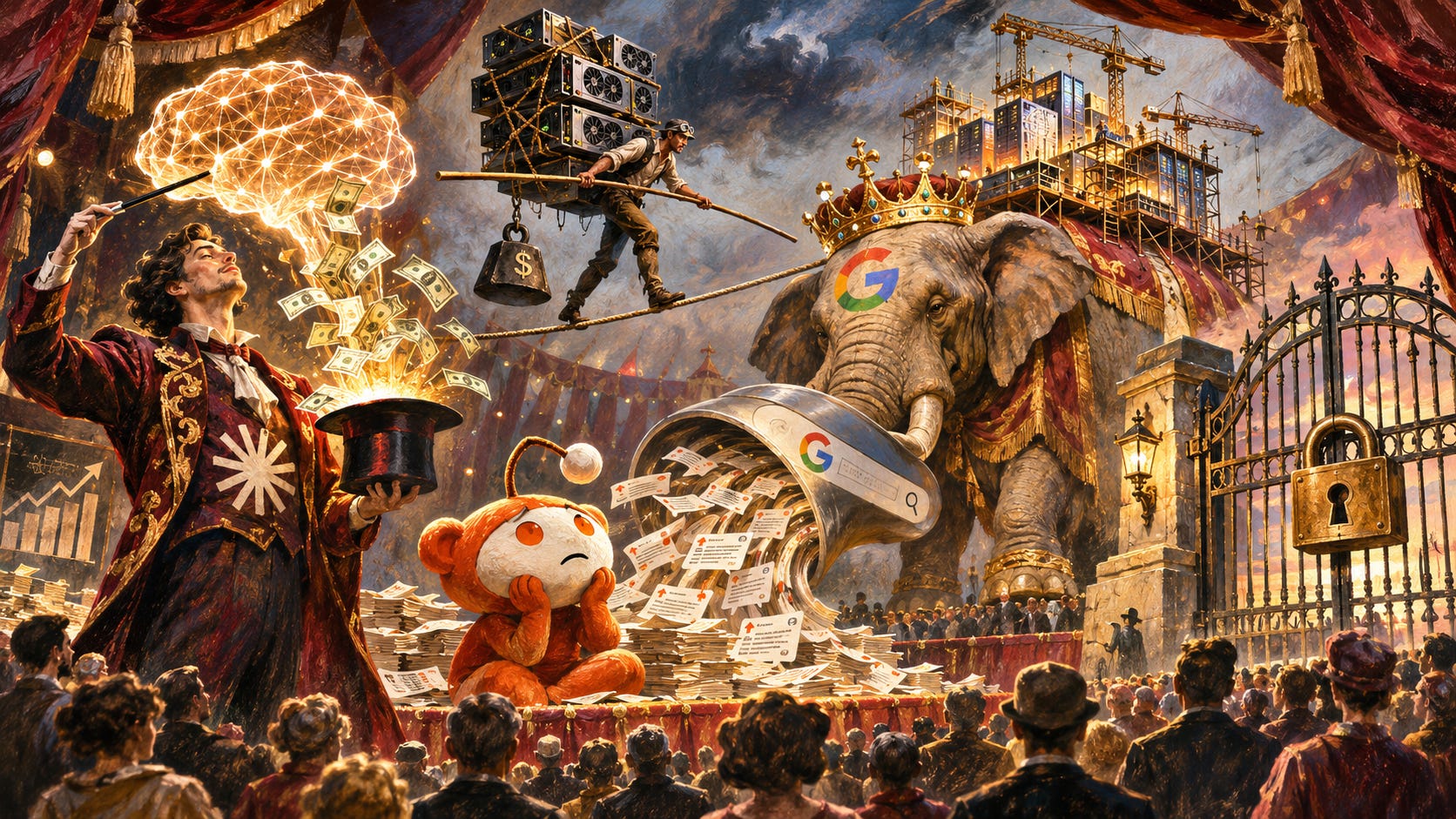
🎬 TL;DR
Anthropic finally released its much awaited S1. Revenue is exploding, compute costs are collapsing relative to sales, and enterprise customers are spending more as Claude does more. Intelligence is starting to look like a very good business. Keeping up with its own obsolescence is the hard part.
The GPU gold rush is becoming a credit story. Neolabs are moonlighting as compute speculators, neoclouds are borrowing against rapidly depreciating chips, and everyone is assuming that scarcity lasts forever. The final boss of AI infrastructure might be a loan officer.
Google won the model race, lost the earnings call. Gemini 4 topped benchmarks, Cloud revenue doubled, and profits surged. Investors responded by wiping 13% off the stock. Turns out spending $51B in a quarter to reinvent 4 businesses simultaneously can test market patience.
Reddit discovers the price of being useful. Revenue grew 53%, EBITDA margins hit 45%, and the stock fell 30%. Google’s AI is increasingly turning Reddit’s human knowledge into answers without sending users back. The internet’s oldest bargain - content for traffic - is coming undone.
The open web gets five new commandments. Search becomes a destination, content value divorces traffic, login walls become strategic assets, data rights become products, and direct distribution becomes the moat. The free and open internet is slowly becoming a collection of gated communities.
🧮 The Economics of Anthropic
Happy Anthropic S1 day to all! Buried underneath pages of warnings about competition, regulation, existential AI risk, and 17 ways the company could implode is the clearest picture yet of the economics of a frontier AI company.
Explosive revenue growth. $41m in revenue in 2023, $386m in 2024, $4.6b in 2025 and $16.3b in 1H26, 3.5x its entire 2025 revenue. ~80% is consumption-based. Customers pay for intelligence like electricity: use more, spend more.
Off the charts NDR. 11,900+ customers spend $100k+ annually, up from ~950 a year earlier. 1,900+ spend $1m+ and ~250 spend $10m+. They report ~900%(!) net revenue retention. The top 5% of Enterprise users who use Claude Code spend ~20x as much as those who don’t. The more autonomy customers give the model, the more compute they consume.
Compute leverage kicking in. In H1 2025, Anthropic spent 201% of revenue on compute. A year later: 55%. Revenue grew 1,368% YoY in the June quarter while compute expense grew ~300%.
Loss headlines are too dramatic. The $80.7b headline net loss for H1 includes ~$72.4b from marking convertible notes to fair value as Anthropic’s valuation increased. Anthropic became so valuable that accounting for how valuable it became produced one of the largest reported corporate losses in history. Capitalism is beautiful.
The more relevant numbers: H1 operating loss of ~$693m, down from $2.1b a year earlier, and ~$3.9b in positive operating cash flow. Even more striking: Anthropic had raised $141.1b by June 30 but still held $131.7b in cash, implying only ~$9.4b of net capital consumed to reach this scale.Anthropic runs on AI. 90%+ of contributions to Anthropic’s codebase in September were written by Claude. Avg daily code contributed per engineer was 45x higher than in 2024. Revenue per employee increased from $1.4m to $6.6m.
Complicated cloud relationships. 48% of H1 revenue flowed through cloud marketplaces, up from 11% in 2023. Those same hyperscalers provide Anthropic’s compute, finance infrastructure, invest in Anthropic and sell competing AI models. More twisted than a plate of spaghetti. This explains Anthropic Direct: leasing chips and deploying them in dedicated data centers itself.
Short half lives. Anthropic replaces the economic engine of its business every few months. 80%+ of Q3 revenue came from model versions released during the preceding 6 months. Your moat is the rate at which you can build the next thing.
Anthropic has demonstrated something remarkable: there is real, enormous, and rapidly expanding demand for machine intelligence, and the cost of serving that demand is falling much faster than many skeptics expected.
If that continues, Anthropic is likely to become one of the defining companies of this era. Assuming, of course, that it doesn’t destroy civilization first. That would be bad for the multiple.
🏗️ GPUs, Guppies & Credit Markets
If you’ve been on AI Twitter this week, you’d think the AI infra boom had suddenly run out of oxygen. Elon Musk says 200+ neoclouds are headed for “guppy-level death.”
It started when someone shared a conversation with a friend at a neolab who said, roughly: Even if we fail to train the best model, we locked in GPU capacity early. Rental prices have gone up 2–3x. We can just resell the compute and print money.
That is a pretty good summary of why everyone is suddenly nervous. The AI infra boom is now morphing from a tech story into a credit story - and credit markets are much less forgiving of miscalculated risk-taking.
Neolabs ostensibly exist to build models, but embedded inside many of them is another trade: a long position on GPU scarcity. Reserve compute early. Rental prices rise. Suddenly the downside case for your model company looks surprisingly attractive: Worst case, we become GPU commodities traders. That backfires if everyone has the same downside plan.
“Stranded compute” makes people imagine H100s sitting dark in a warehouse. But the subtler version is economic. Imagine you financed a cluster assuming $X/hour rental economics. Pricing falls to $0.7X while interest expense stays exactly where it was.
You can be fully utilized and financially screwed at the same time.
Of every capex dollar spent on AI infra, 60c goes into chips & hardware, ~25c into power & cooling, ~15c into land & construction. For a lender, those assets behave very differently.
A powered shell can remain useful for decades.
A scarce grid interconnection may actually appreciate.
A GPU begins depreciating ~5 mins after Jensen finishes his next keynote.
We have seen 3-yr GPU residual-value assumptions ranging from 10% to 60%. Less of a consensus, more an admission that nobody really knows.
The tricky part is that cash flow and collateral can deteriorate together. A new Nvidia architecture can compress rental rates on the old generation at the same time it lowers their resale value. So revenue falls, collateral falls, refinancing gets harder - all from the same tech transition.
“200 neoclouds'“ is probably not the equilibrium. I think the market sorts into 3 buckets:
Well-capitalized strategic builders. Hyperscalers, large model companies and a handful of neoclouds with enormous equity cushions can keep building even when credit markets get ugly. They may actually benefit from the shakeout.
Contract-backed infra. Companies with strong counterparties, long-duration commitments and financing structured directly around contracted cash flows.
Speculative compute. GPU fleets and half-built data centers financed on the assumption that somebody will eventually show up.
Turns out the final boss of the AI boom may not be scaling laws, it may be the credit market.
🥇 Gemini Gets Gold, Google Gets Sold
Google was all set to take a victory lap yesterday. Instead, it got mugged on the way to the podium.
Hours before earnings, Google unveiled Gemini 4 Carbon, its new frontier model. It took the #1 spot on the Artificial Analysis Intelligence Index, beating Opus 5.5 and GPT 6.
Then they reported earnings. Search missed by a little. CapEx was enormous. FCF remained negative. And the stock got taken behind the woodshed. Down 13% today, its biggest post-earnings drop ever.
Headline numbers were excellent. Alphabet generated $127.6b of revenue, +25% YoY. Op income +30% to $40.6b, with a 31.8% operating margin. The problems:
Ad rev of $82b missed consensus by ~2%. Search rev grew 12% to $63.3b, down from 17% last quarter.
Extraordinary capex continues. 3Q capex was $51.4b, more than 2x last year’s level. $195–205b CapEx guidance for 2026 maintained, spend will “increase significantly” in 2027.
$42.3b operating cash flow - $51.4b capex = - $9.1b quarterly FCF.
One of history’s greatest cash-printing machines is, at least temporarily, spending more building AI infra than its entire business is producing in operating cash.
Cloud
Lost in the selloff was an extraordinary Google Cloud quarter.
- Revenue grew 103% to $30.7b.
- Op income more than tripled to $11.1b.
- Op margin expanded from 23.7% to 36.2%.
- Backlog reached $561b, 55% expected to be realized in the next 24 months.
AI has catapulted Google from a distant third hyperscaler to a differentiated AI-native platform.
Search
AI is driving Alphabet’s fastest query growth in five years. Great.
Search revenue grew only 12%. Less great.
AI Mode queries are monetizing at a lower rate than traditional search, and its rapid growth is therefore diluting overall Search monetization.
The bear case was always: AI destroys search traffic. Instead, it seems AI grows Search usage but lowers revenue per query. Better problem, but non-trivial.
Early ad experiments are promising: sponsored and organic product listings in AI Mode already have similar click-through rates, while Google is expanding AI Mode ads internationally and introducing more formats.
If Google closes the monetization gap, the math gets interesting. More queries × more intent × agentic commerce could ultimately make AI Search more valuable than traditional Search.
Gemini
Gemini is now at 1B users, the fastest-growing product in Google’s history.
1st party model APIs are processing ~32b tokens/min, +4x YoY.
Internally, teams using its new model across Chrome, Ads and Search shipped 35% more code with 30% fewer errors. Sundar called 2027 a potential “golden age of productivity.”
Google’s challenge is that it is simultaneously trying to turn Cloud into AWS, Gemini into ChatGPT, TPUs into Nvidia, and use AI Search to reinvent Google. Attempting all 4 at once is extraordinarily expensive. Fortunately for Google, being underestimated is familiar territory.
🥊 The Great Reddit Traffic Heist
My favorite corner of the internet is getting its teeth kicked in by Wall Street today. Reddit, the platform where humanity goes to argue with strangers, seek relationship advice, and
ask AITA, just delivered a phenomenal quarter. Rev came in at $895m, +53% YoY, beating consensus of $875m. A comfortable 45% margin drove adj EBITDA to $402m, +70% YoY. FCF almost doubled to $363m.
But markets don’t trade the quarter that was, they trade the quarter that will be. And buried underneath the stellar results was a much more consequential disclosure: Reddit’s search referral traffic declined materially during Q3 and is now falling by 1M+ referrals per week. Stock tanked 30%.
The culprit, according to CEO Steve Huffman, is Google.
Increasingly, Google’s AI products are consuming Reddit’s content, synthesizing the answer, and satisfying the user without sending them to Reddit.
So the user gets the answer, Google gets the engagement, and Reddit gets the satisfaction of having contributed to the advancement of human knowledge. Which, unfortunately, is difficult to monetize.
Huffman declared: “Google has really shifted in their relationship with the rest of the Internet.”
This is the cleanest public-market example yet of what I’d call AI extraction economics. Reddit owns one of the most differentiated corpora on the internet: 27 billion posts and comments reflecting messy, opinionated, 1st person human experience.
It provides things models still struggle to manufacture convincingly: lived experience, community context, nuance, disagreement. 50% of U.S. shoppers use Reddit to verify AI recommendations. As synthetic data becomes abundant, human experience gets scarcer - and more valuable.
If one of the highest-quality corpora on the internet cannot preserve referral traffic, what happens to everyone whose content is considerably more substitutable?
Think: Pinterest, Yelp, Tripadvisor, Quora, recipe sites, product reviews, travel sites, news publishers, comparison sites, SEO-driven marketplaces and lead-gen businesses.
Any business whose acquisition equation includes substantial free Google referral traffic now has to revisit what that traffic is worth in an AI-first search world.
If AI consumes content without sending economically meaningful referral traffic, content owners have to replace the implicit bargain with an explicit one: you may use my content if you pay me.
Welcome to the next phase of the internet: licensing agreements, authenticated APIs, restricted access, usage-based pricing.
Reddit is already moving in this direction: it plans to make much more of Reddit logged-in only and push more users toward the app. It will be “trading reach for engagement.” Economically, that makes sense. Logged-in and app users already account for 80%+ of rev.
If others follow suit, the open web will transition from ‘crawl freely + monetize referrals’ to ‘restrict access + license data + own the user relationship’. RIP, open web.
🔐 Five Rules for the AI Internet
Reddit’s predicament points to 5 broad shifts in the economics of the web:
Search is becoming a destination rather than a router
Google increasingly answers queries instead of distributing them.Content value and traffic value are decoupling
A corpus can become more valuable to AI while generating less referral traffic for its owner.Authentication becomes strategically valuable
Login walls improve personalization and monetization while making AI scraping harder.Data rights become an economic product
If AI platforms no longer compensate publishers with traffic, publishers will increasingly demand cash.Distribution becomes the scarce asset
The winners are likely to be platforms that own a direct habit, app, identity or community rather than relying on Google to deliver users.