

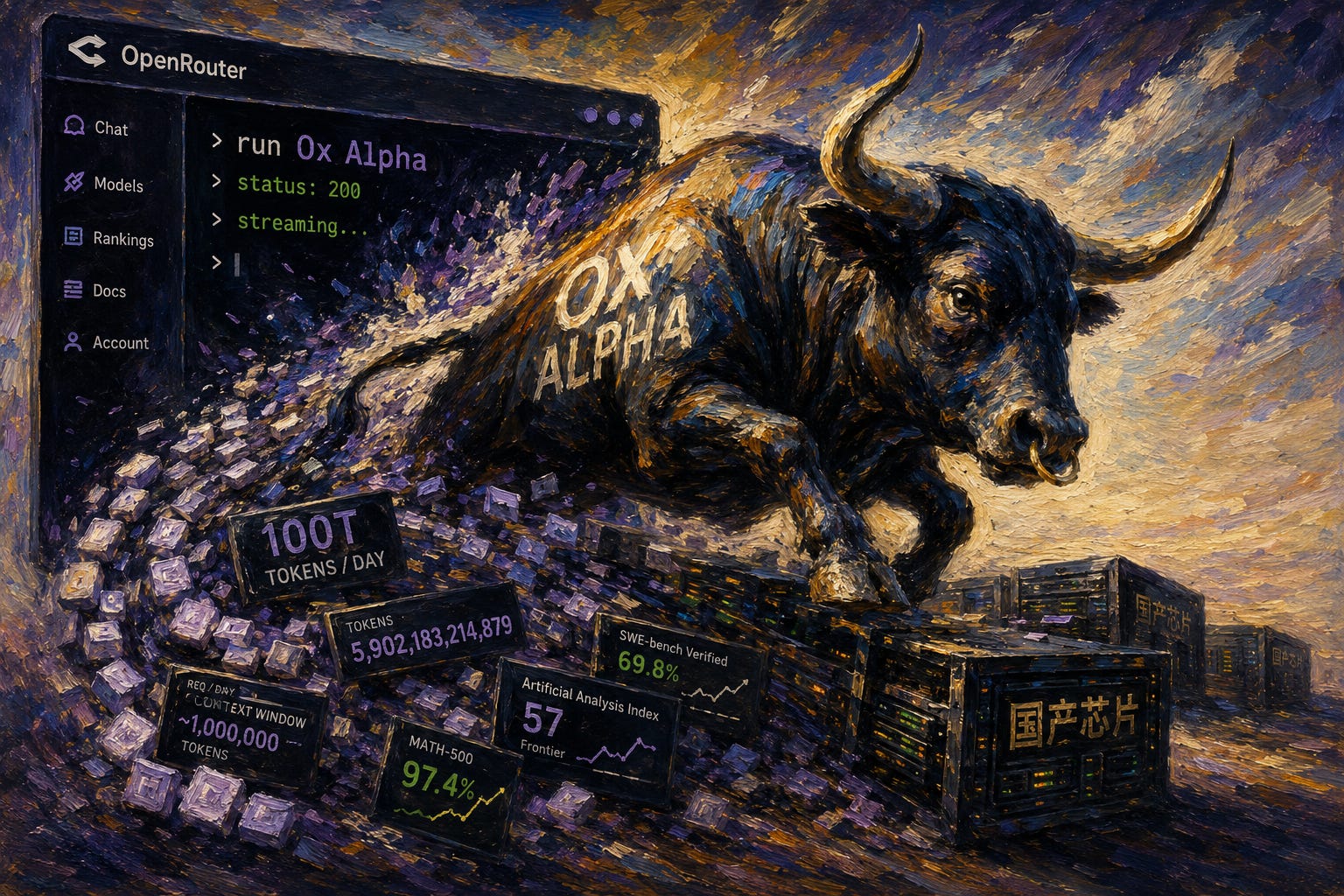
Over the last week, we may have watched one of the smartest model launches in AI - largely because, for most of the week, nobody knew who was launching it.
A mystery model called Ox Alpha suddenly appeared on OpenRouter on August 20. And then the internet did the marketing for them.

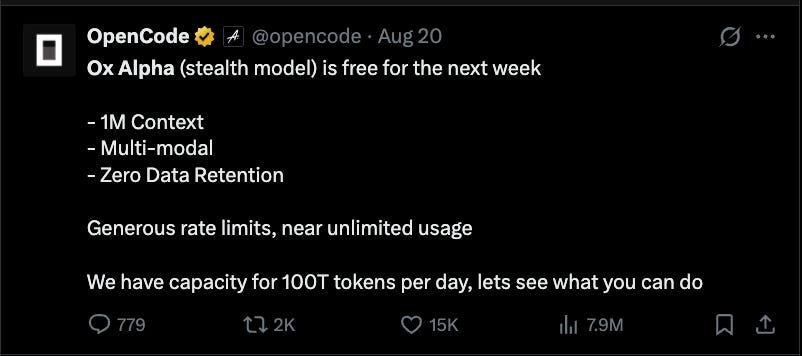
Ox Alpha arrived with an almost comically generous offer: ~1M-token context, native text/image/video input, strong coding and agentic capabilities, $0 pricing, near-unlimited usage - and, as the cherry on top, claimed capacity for 100 trillion tokens per day.
A good anonymous model is interesting.
A good anonymous model that someone is willing to let the entire internet hammer for free at 100T tokens/day is a whodunit.
Suddenly there were two mysteries: Who built this thing? And perhaps more intriguingly: Who has enough compute lying around to let the entire developer ecosystem try to melt it for a week?
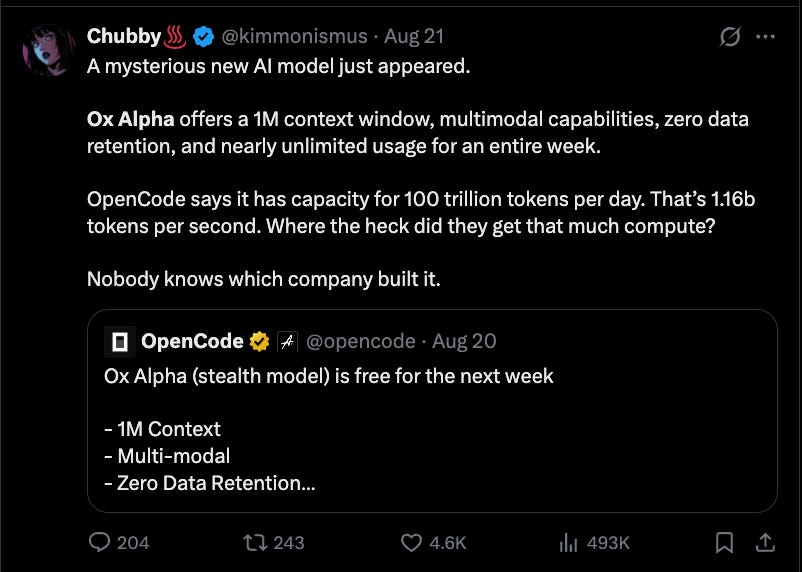
The speculation machine promptly went to work.
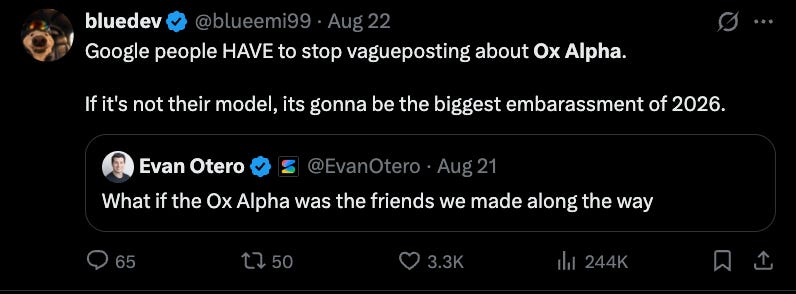
Maybe it was Google’s next Gemini. Maybe Microsoft MAI. Maybe OpenAI’s enormous rumored Astra model. Maybe the first public glimpse of a stealth neolab like Ilya Sutskever's SSI. Maybe Xiaomi. Maybe DeepSeek.
The theories became progressively more exotic. Researchers started fingerprinting tokenizers and probing behavioral quirks like AI forensic investigators. One analysis found an 11-for-11 tokenizer match with GLM-5.x.
Without spending a dollar on conventional launch marketing, the mystery turned thousands of developers into detectives, reviewers and distribution partners.
And, importantly, people actually liked the model. Early tests went viral and usage exploded. OpenRouter activity climbed from 27M requests / 2T tokens on August 21 to 70M requests / 5.9T tokens by August 24, and Ox Alpha hit #1 in its rolling-week popularity ranking. OpenCode, which was offering the model with near-unlimited free usage, reported 42 trillion tokens over the same period.
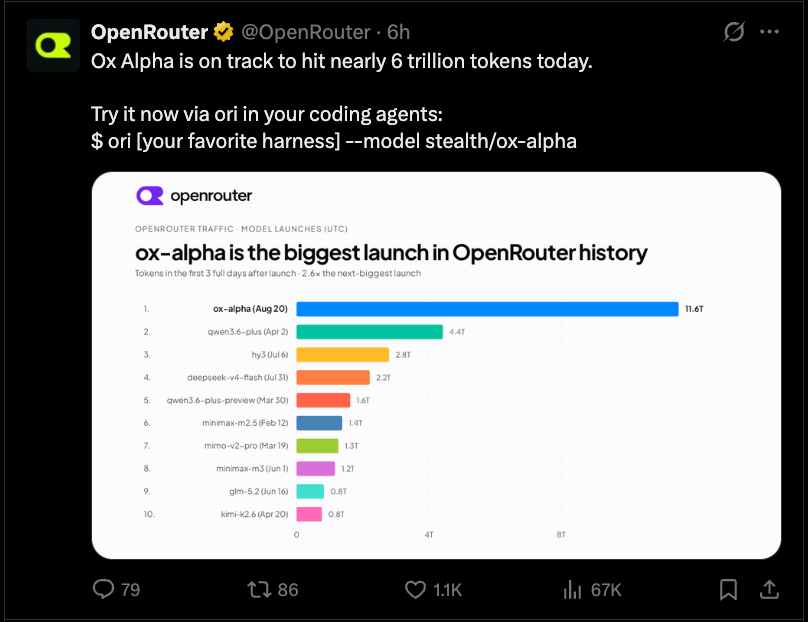
Free models obviously have an advantage on token-volume leaderboards, particularly with giant context windows, but that’s almost beside the point. The model had gone from nonexistent brand to default object of fascination for the AI developer community in about four days.
This morning, the mask finally came off: Ox Alpha is GLM-5.3-Flash from China’s Z.ai.

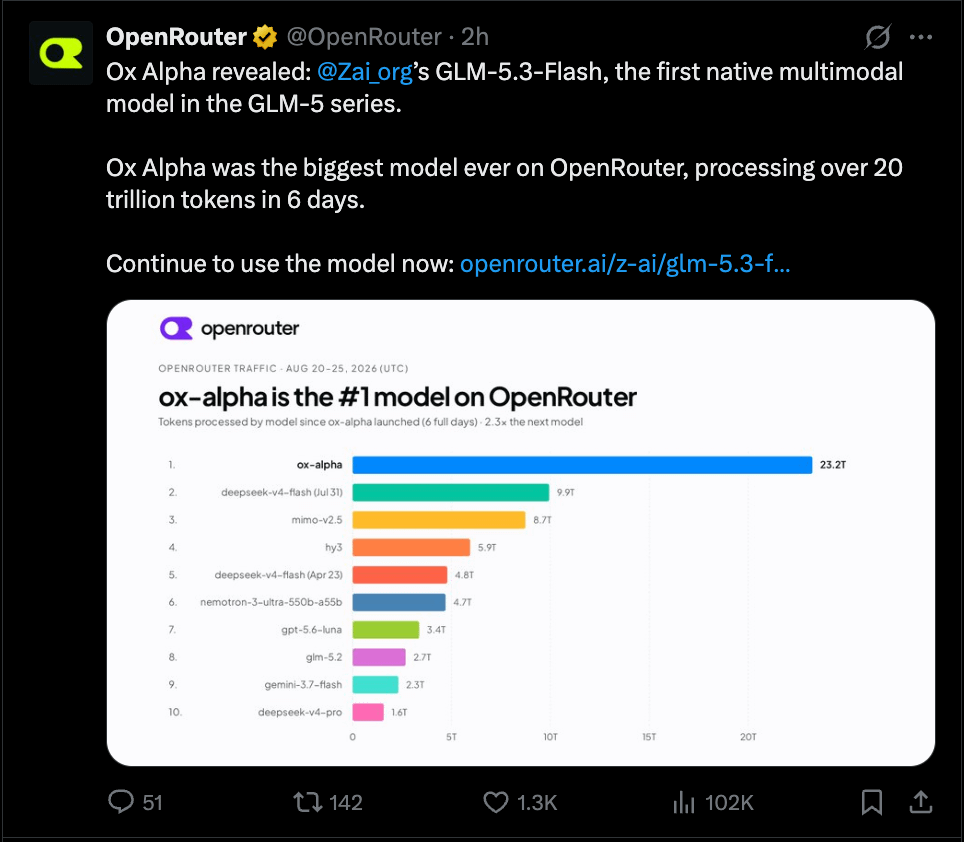
The reveal is even more interesting than the stunt. GLM-5.3-Flash is a 320B parameter MoE model with only 18B active parameters, and the first natively multimodal model in Z.ai’s GLM-5 family. Z.ai says it beats GLM-5.2 while using a new hybrid architecture combining sparse and linear attention to substantially reduce the serving cost of long-context workloads. The weights have been released on Hugging Face under an MIT license.
The architecture is designed around a problem becoming increasingly important in AI: how cheaply can you serve useful intelligence inside long-running agents? Z.ai says GLM-5.3-Flash costs ~1/10th as much as GLM-5.3, with introductory pricing as low as 1/20th, and claims pricing around 1/40th of Claude Opus 4.8.
Artificial Analysis Intelligence Index gives it a score of 57, putting it in the frontier band and level with GPT 5.6 Terra . At $0.09 Cost per Task, it sits comfortably on the Intelligence vs. Cost per Task Pareto frontier
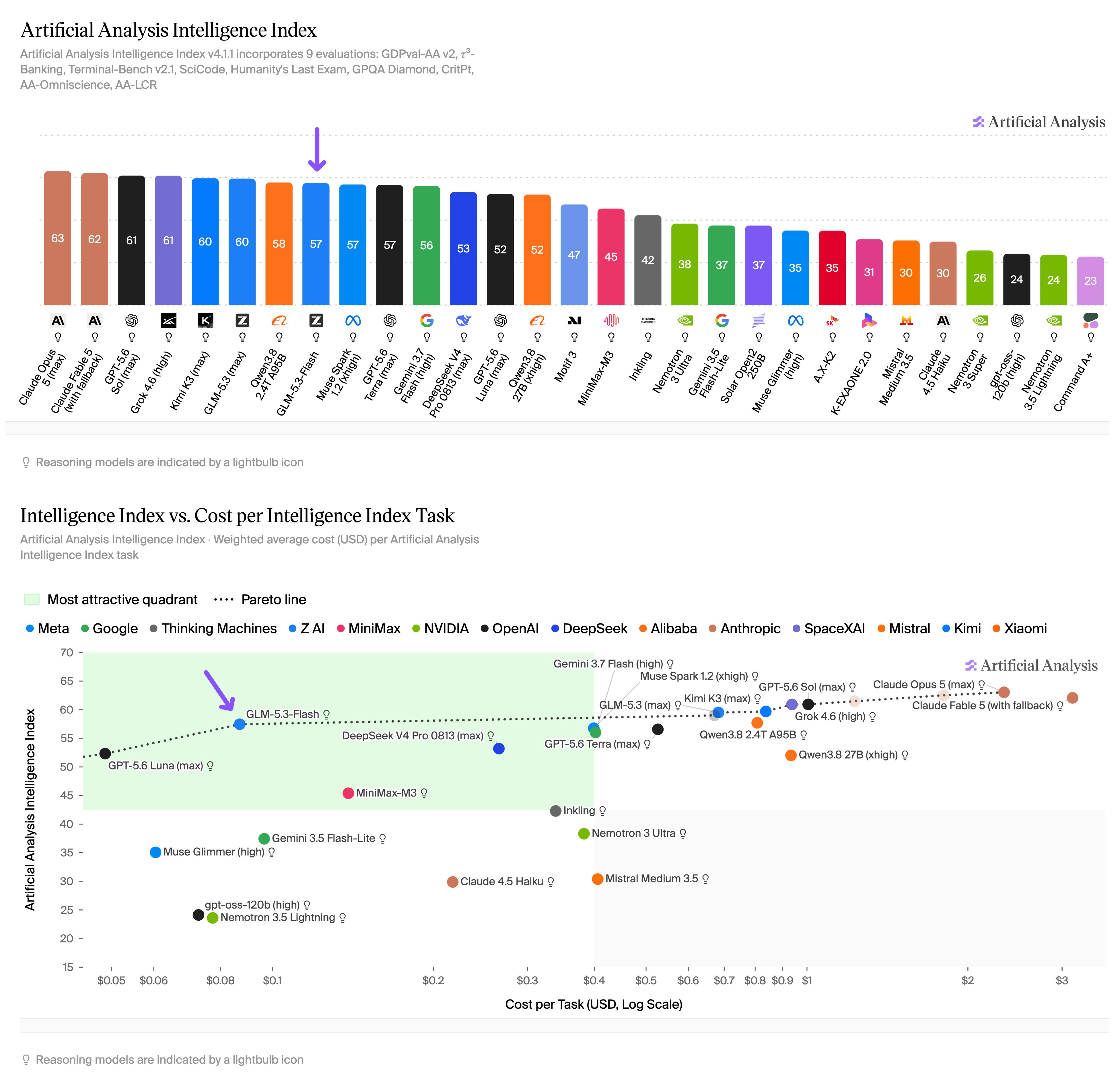
Treat vendor benchmark comparisons with the usual seasoning - but the broader point survives: this is a deliberately small-active-parameter model engineered to put serious capability behind extremely aggressive economics.
And then came the reveal underneath the reveal: every request generated during the Ox Alpha test was served using Chinese-made AI chips.
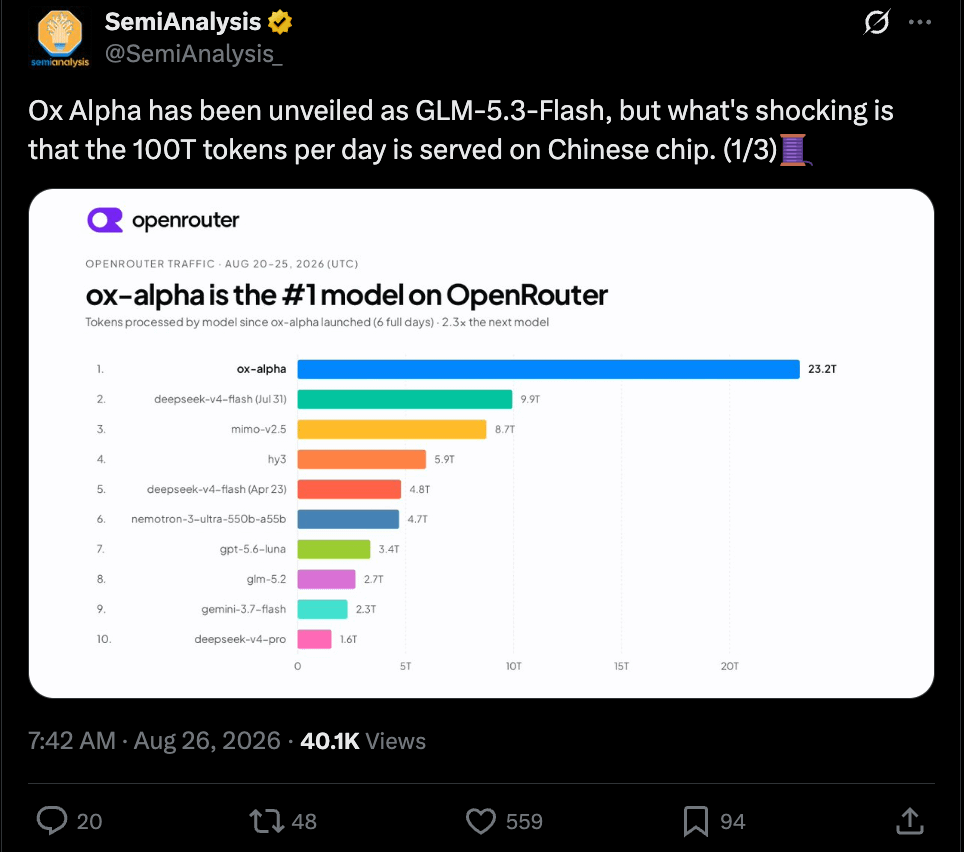
The blind taste test wasn’t just for the model. It was for the chips. And naturally, the reveal landed on August 26, the day Nvidia is scheduled to announce Q2 FY2027 results. If that timing was deliberate, chef’s kiss.
Some thoughts:
The genius of a blind taste test. AI models arrive carrying enormous amounts of brand baggage. If OpenAI launches something, users expect intelligence. If Anthropic launches it, programmers expect coding prowess. And if an unfamiliar Chinese lab launches it? A meaningful percentage of Western developers may never bother trying it.
Model evaluation remains remarkably psychological. People don't just evaluate outputs; they evaluate outputs through expectations about who generated them. An anonymous model eliminates the provenance prior.
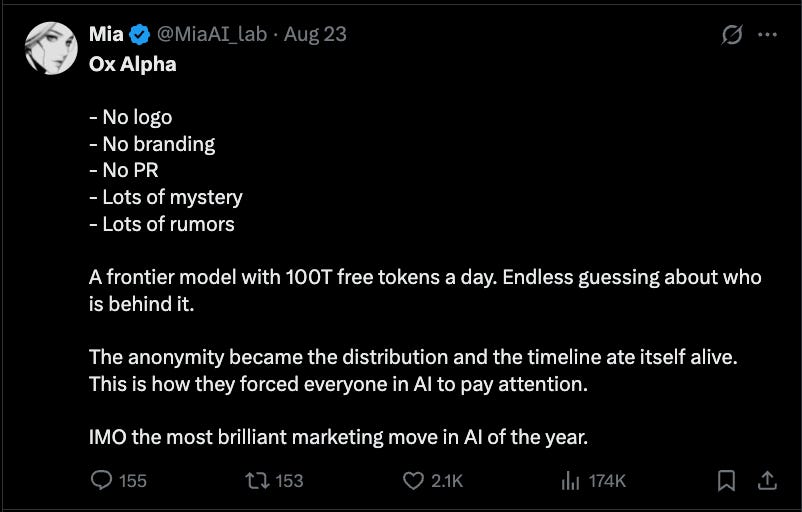
Ox Alpha removed the label from the bottle. Z.ai effectively said: Taste it first. We’ll tell you what it is later.Free inference is CAC. Ox Alpha wasn't merely anonymous. It was anonymous and essentially free to hammer. That turned curiosity into usage.
Normally, model launches ask developers to believe benchmark charts and then spend money to verify them. Ox Alpha inverted the funnel. Free tokens became marketing spend. Every developer stress-testing the model generated three things simultaneously: (1) product feedback, (2) eval data, and (3) social proof. And because nobody knew who made the model, every successful test intensified the mystery. You couldn't buy that kind of engagement with a Super Bowl ad.OpenRouter is becoming the new model-launch arena. Models increasingly don’t need to build distribution from scratch. Drop a competitive endpoint into OpenRouter/OpenCode, remove the economic friction, and the world’s developers become your instant evaluation network.
Chinese labs are changing the basis of competition. DeepSeek’s original shock was that the performance/cost frontier could move much faster than Western labs expected. The subsequent wave from DeepSeek, Qwen, Kimi, GLM, MiniMax and others has made that increasingly difficult to dismiss as a one-off. GLM-5.3-Flash has now demonstrated that China can produce frontier class models cheaply, openly, distribute them globally - and serve them at enormous scale on Chinese silicon.
A masterstroke in marketing that ended as a systems-level flex. If there was still any temptation to discount Chinese labs in the AI race, Ox Alpha should cure it.